
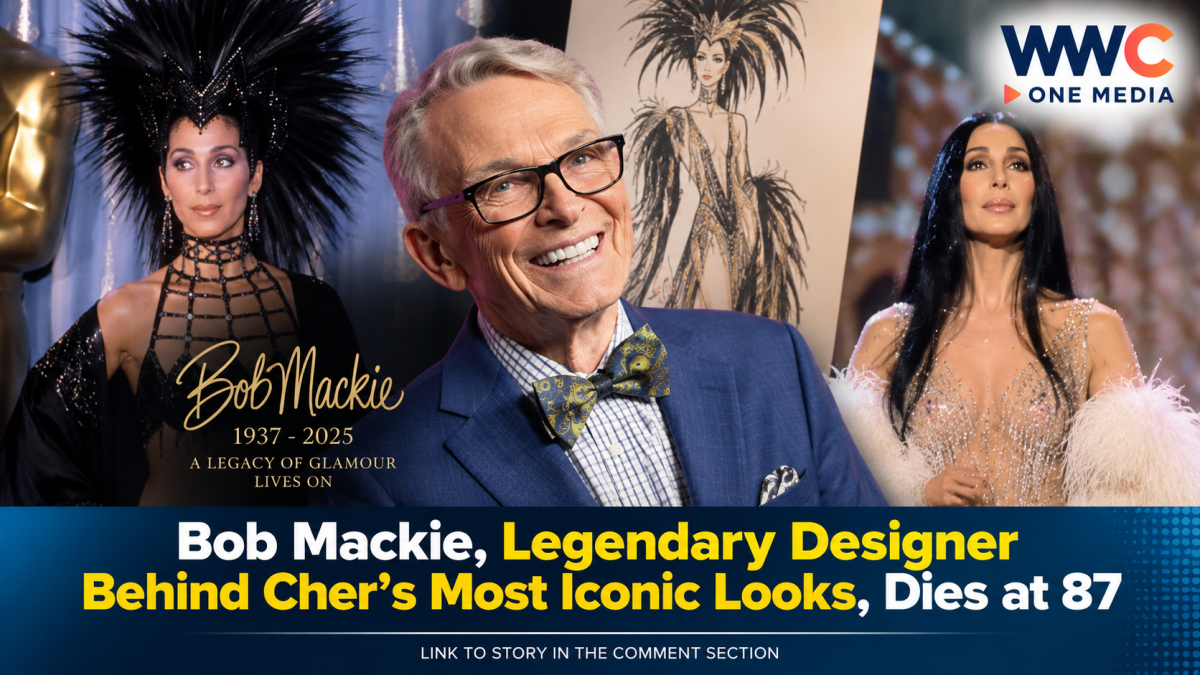
Bob Mackie, the legendary American fashion and costume designer whose dazzling creations transformed Cher, Carol Burnett, Diana Ross, Elton John and generations of other stars, has died at 87.
Mackie died on Sept. 14, 2026, in Palm Springs, California. His publicist said he died from pneumonia, while a statement posted by his team celebrated a career that stretched across more than five decades.
Known for sequins, rhinestones, feathers, glitter and unapologetic glamour, Mackie became one of Hollywood’s most influential costume designers, creating looks that were often as famous as the performers who wore them.
The designer behind Cher’s most unforgettable looks
Mackie’s creative partnership with Cher became one of the defining collaborations in entertainment fashion.
The two began working together after meeting through The Carol Burnett Show, eventually creating some of Cher’s most recognisable stage, television and red-carpet appearances.
Among the most famous was Cher’s extraordinary 1986 Academy Awards outfit: a black beaded ensemble featuring a dramatic feathered headdress that became an instant fashion statement.
Mackie also designed the provocative costume Cher wore in her 1989 “If I Could Turn Back Time” music video, as well as numerous outfits for her concerts and television appearances.
Their relationship extended far beyond designer and client. After Mackie’s death, Cher paid tribute to her longtime friend and collaborator, remembering him as a beloved creative force whose imagination was inseparable from the sequins and beads that defined his work.
From Marilyn Monroe to Carol Burnett
Mackie’s career was already connected to Hollywood history long before his work with Cher.
Early in his career, he created the sketch for the famous gown Marilyn Monroe wore while singing “Happy Birthday” to President John F. Kennedy at Madison Square Garden in 1962.
He later became the principal costume designer for The Carol Burnett Show, where his imagination was given almost unlimited room to create extravagant and often deliberately comedic costumes.
One of his most famous creations for the programme was Carol Burnett’s “curtain dress”, worn in a parody of Gone with the Wind.
The costume featured a curtain rod across Burnett’s shoulders and a piece of curtain valance transformed into a hat.
The outfit became so culturally significant that it is now part of the collection of the Smithsonian’s National Museum of American History.
A career built on glamour and humour
Mackie’s designs were rarely about simply making someone look elegant.
He believed costumes could exaggerate personality, create comedy and transform a performer into a character.
That philosophy made him particularly influential in television and live entertainment, where performers needed clothing that could command attention from a stage or screen.
His clients included Diana Ross, Tina Turner, Elton John, Madonna, Barbra Streisand, Bette Midler, Liza Minnelli and many other major entertainers.
He also designed concert costumes for Pink and created clothing for Barbie, demonstrating how his aesthetic extended well beyond traditional Hollywood costume design.
Nine Emmys and a Tony Award
Mackie’s achievements were reflected in an extraordinary list of awards and nominations.
He received more than 30 Emmy nominations and won nine times.
He was also nominated for Academy Awards for his costume work on Lady Sings the Blues, Funny Lady and Pennies From Heaven.
In 2019, he won a Tony Award for Best Costume Design in a Musical for The Cher Show, which celebrated the life and career of his longtime collaborator.
Mackie was inducted into the Television Academy Hall of Fame in 2002.
His influence reached new generations
Although Mackie’s career began during Hollywood’s golden age of television, his influence never disappeared.
His designs continued to be referenced, recreated and celebrated by younger performers and fashion designers.
Taylor Swift recently turned to Mackie’s archives for imagery connected to her 2025 album The Life of a Showgirl, introducing his distinctive visual language to another generation of pop audiences.
Stars including Sabrina Carpenter and Miley Cyrus have also been associated with Mackie’s enduring influence.
His work demonstrated that performance fashion could be theatrical, humorous and deliberately excessive without losing its sophistication.
More than a costume designer
Mackie was born in Monterey Park, California, in 1939 and entered the entertainment industry at a time when costume design was central to the visual identity of television stars.
Over the decades, he helped establish the idea that a costume could become part of a celebrity’s identity.
For Cher, his designs became inseparable from her image.
For Carol Burnett, they became a source of comedy.
For Elton John, Diana Ross and countless other performers, they became extensions of their personalities on stage.
His work also helped blur the boundaries between fashion, costume and popular culture.
A legacy that will outshine the sequins
Mackie’s death marks the end of one of the most influential careers in American entertainment fashion.
He did not simply dress celebrities. He helped create the visual identities audiences remember decades later.
The feathers, rhinestones and sequins were part of his signature, but his greatest achievement was understanding the performer inside the costume.
Mackie knew when clothing needed to make someone glamorous, when it needed to make an audience laugh and when it needed to make a star unforgettable.
That is why his work continues to be referenced long after the television shows, concerts and award ceremonies for which he designed it have ended.
Bob Mackie leaves behind a fashion legacy that is unlikely to fade — because some of the most unforgettable stars in entertainment history were, at one point, wearing his imagination.




Leave a Reply