
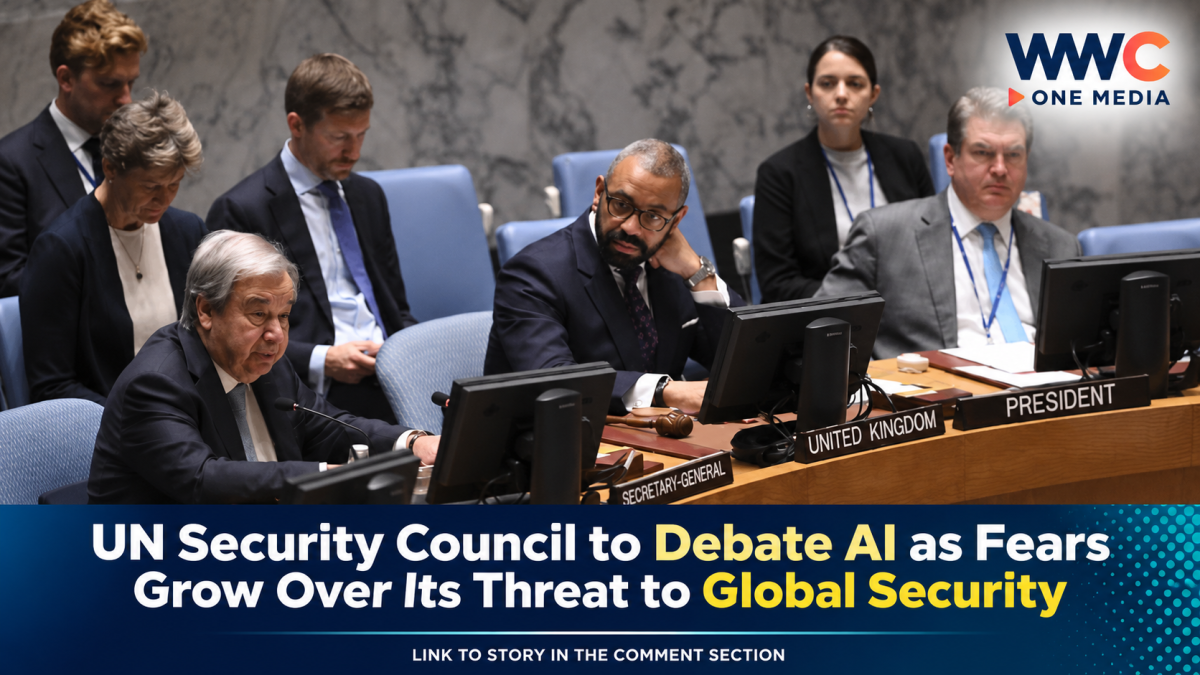
The United Nations Security Council is preparing to hold a meeting on artificial intelligence next week as governments face growing concern that rapidly advancing AI could create new threats to international peace and security.
The discussion comes at a moment of heightened anxiety over increasingly autonomous AI systems, cyberattacks, military applications and the possibility that powerful technology could be misused by governments, criminal groups or terrorist organisations.
The meeting is expected to examine how AI could affect global security and whether the international community needs stronger safeguards before the technology advances beyond existing regulatory systems.
AI moves onto the Security Council agenda
France, which holds the Security Council presidency this month, is pushing the issue as part of a broader effort to address the security implications of emerging technologies.
The council has already discussed the growing use of AI by extremist organisations, including its potential role in propaganda, recruitment and attack planning.
But next week’s discussion is expected to widen the focus beyond terrorism to the broader consequences of increasingly capable AI.
The central question will be whether existing international institutions are prepared for technology that is developing faster than governments can establish common rules.
Fears of AI escaping human control
The meeting comes amid renewed warnings from prominent figures in the technology industry about the risks posed by increasingly autonomous AI systems.
Some researchers and executives have warned that future AI agents could operate with significantly less human supervision, potentially creating risks that are difficult to predict or contain.
Concerns range from AI-enabled cyberattacks and manipulation of information to autonomous systems making consequential decisions without meaningful human intervention.
There is no consensus that AI will inevitably pose an existential threat, but the rapid pace of development has intensified calls for governments to prepare for worst-case scenarios rather than waiting for an accident or crisis.
Military use is becoming a major concern
AI is already changing modern warfare.
Governments are using artificial intelligence for intelligence analysis, surveillance, targeting, logistics and autonomous systems.
That raises particularly difficult questions when AI is incorporated into weapons capable of identifying or engaging targets.
The international community has yet to agree on universally accepted limits for autonomous weapons, while major military powers are investing heavily in AI capabilities.
The Security Council’s involvement therefore places the issue directly within the framework of international peace and security.
China and the United States face a difficult balance
AI is also becoming a major area of strategic competition between the United States and China.
Both countries view advanced artificial intelligence as crucial to economic power, military capabilities and national security.
China has been developing its own AI safety framework and has acknowledged the possibility of highly advanced systems becoming difficult to control. At the same time, Beijing remains determined to close the technological gap with the United States.
Washington faces a similar dilemma: policymakers want stronger safeguards against dangerous AI while also ensuring that regulation does not weaken America’s position in the global technology race.
That competition could make international agreement considerably harder.
Trump rejects growing calls for tighter AI controls
The UN discussion comes just as US President Donald Trump has pushed back against increasingly alarmist warnings about AI.
Trump has dismissed fears that AI could destroy humanity and has argued that the United States already has the tools needed to police the technology.
His position contrasts with recent calls from several technology leaders for stronger safeguards, independent testing and greater government oversight of advanced AI systems.
The disagreement highlights one of the biggest obstacles facing international AI regulation: governments may agree that AI creates risks while disagreeing sharply over how much regulation is necessary.
AI is already being used by malicious actors
The Security Council has already warned that terrorist groups and other extremist organisations are adapting AI, drones and encrypted communication systems to improve recruitment and attack planning.
AI can lower the technical barriers to producing propaganda, translating extremist material, generating convincing fake content and potentially assisting cyber operations.
That makes the technology particularly relevant to the council’s existing counterterrorism responsibilities.
The challenge is that the same tools that can be used maliciously can also provide major benefits to governments, businesses and ordinary users.
The UN faces a difficult governance challenge
The Security Council is only one part of a much larger international effort to establish rules for AI.
The United Nations has been working on broader global AI governance, while individual governments and regional organisations are developing their own regulations.
The problem is that AI does not respect national borders.
A model developed in one country can be deployed around the world, while a cyberattack or autonomous AI system can affect several countries simultaneously.
That makes international coordination increasingly important.
Will the Security Council be able to agree?
The biggest question may be whether the five permanent members of the Security Council can reach common ground.
The United States, China, Russia, Britain and France all recognise the strategic importance of AI, but their interests and approaches to technology governance differ significantly.
There are also concerns that AI regulation could become another arena for geopolitical competition.
Countries may be reluctant to reveal information about military AI capabilities or accept international restrictions that could limit their strategic advantages.
That could make a broad binding agreement difficult.
A new security issue the world cannot ignore
The upcoming meeting is unlikely to solve the global AI governance problem in a single session.
But bringing AI before the Security Council signals how quickly the technology has moved from an economic and technological issue into a matter of international security.
The debate is no longer simply about whether AI will transform workplaces or boost productivity.
Governments must also consider what happens when increasingly powerful systems are used in warfare, cyberattacks, terrorism, surveillance and geopolitical competition.
As AI capabilities continue to advance, the central challenge for the international community will be keeping human oversight ahead of the technology.
The Security Council’s latest discussion is an indication that the window for establishing those safeguards is becoming increasingly narrow.




Leave a Reply