
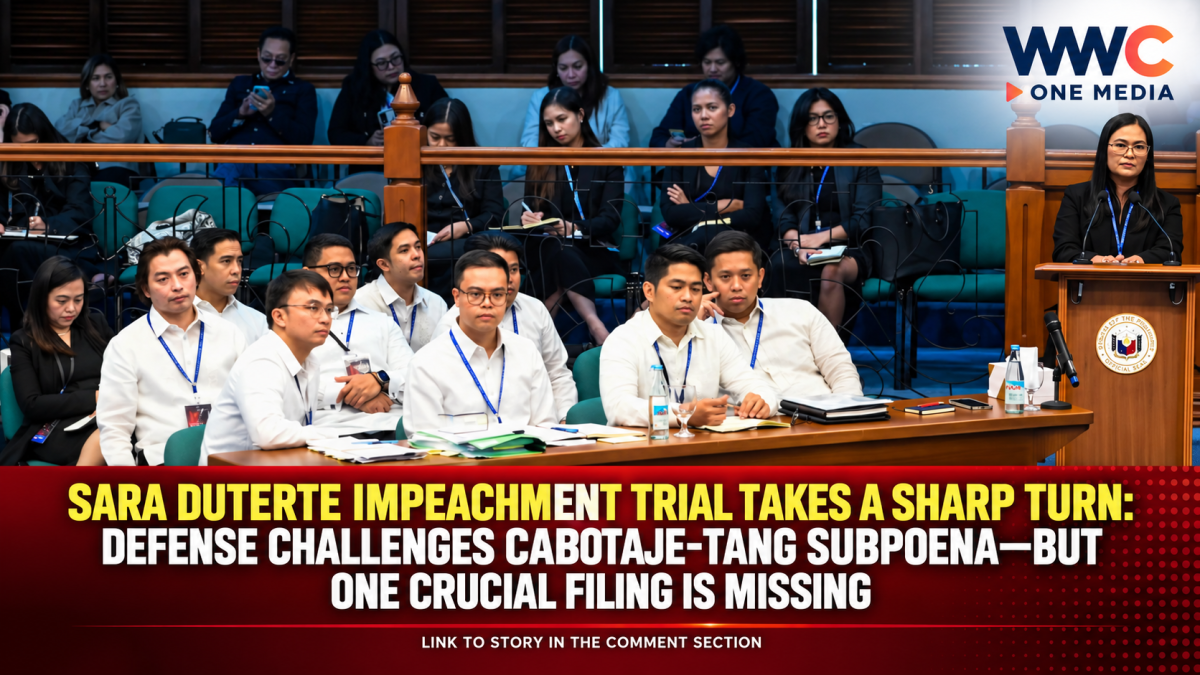
MANILA, Philippines — A procedural dispute over how retired Sandiganbayan Presiding Justice Amparo Cabotaje-Tang was subpoenaed has added another layer of tension to Vice President Sara Duterte’s impeachment trial, with the defense questioning the authority and manner by which the prosecution secured the witness’s appearance.
But according to the Senate impeachment court spokesperson, there was a key procedural step the defense did not take: it did not file a formal motion specifically asking the court to invalidate or set aside Cabotaje-Tang’s subpoena.
The controversy unfolded on September 14 as the Senate impeachment court opened Article II of the impeachment case, which involves allegations concerning Duterte’s supposed unexplained wealth, asset declarations and business interests.
Defense calls Tang a “surprise witness”
Duterte’s lawyer, Mark Vinluan, objected to the presentation of Cabotaje-Tang, arguing that the retired justice was not identified as a witness in the pre-trial order and that the defense had not been adequately furnished with information about the scope of her testimony.
Vinluan characterized Tang as a “surprise witness” and argued that her presentation could undermine Duterte’s ability to intelligently cross-examine her.
The defense also questioned Tang’s qualifications and potential neutrality, saying it did not have sufficient information about her background before she took the witness stand.
The defense argued that the issue went beyond trial procedure, saying Duterte’s constitutional right to due process was also at stake.
Despite the objection, the impeachment court allowed Tang to testify.
Why the subpoena became controversial
The dispute intensified because Cabotaje-Tang’s subpoena was routed through the office of House impeachment prosecutor Chel Diokno.
Senator-judge Imee Marcos questioned why a supposedly independent or disinterested witness would have her subpoena served through the office of one of the prosecutors.
Diokno explained that the arrangement was made primarily for security and protection purposes, including concerns over the handling of sensitive personal information and possible online harassment.
The defense, however, questioned whether Diokno had formal authority to serve the subpoena in that manner.
According to reports from the proceedings, Senate President and impeachment court presiding officer Chiz Escudero clarified that Diokno was not formally designated by the court as its subpoena-serving officer, although the arrangement was based on the prosecution’s request. Escudero also indicated that the defense could seek similar treatment if it had comparable security concerns.
The missing formal motion
This is where the procedural dispute became particularly significant.
The impeachment court spokesperson said the defense should have filed a formal motion if it wanted the court to directly rule on the validity of the subpoena.
Instead, the defense raised the issue during the proceedings and sought exclusion of Tang’s testimony.
That distinction matters because raising an objection orally or through a manifestation is not necessarily the same as asking the court to issue a specific ruling on the validity of the subpoena itself.
The dispute therefore remains tied to two separate questions: whether the subpoena was properly issued and served, and whether the defense properly asked the court to invalidate it.
Tang becomes first witness for Article II
Cabotaje-Tang ultimately took the witness stand as the prosecution’s first witness for Article II.
The prosecution said her role was primarily to provide the impeachment court with a legal framework for understanding concepts such as public accountability, unexplained wealth, SALNs, prohibited business interests and beneficial ownership.
Importantly, Tang did not testify that she personally knew whether Duterte possessed unexplained wealth or whether the Vice President’s SALNs were accurate.
Instead, prosecutors used her legal background to explain the principles that could be applied when the court examines the financial and corporate records that will be presented later.
Tang rejects claims her testimony was bought
During cross-examination, the defense also explored whether Tang had been promised anything in exchange for testifying.
Tang firmly rejected the suggestion.
She said she would not testify in exchange for any material or other benefit and maintained that she had no personal political motivation for appearing before the impeachment court.
The defense also questioned whether Tang was politically aligned against Duterte.
Tang denied being “anti-Duterte” or associated with the political groups suggested during questioning, according to reports on the hearing.
What comes next in the unexplained wealth case?
The controversy over Tang’s subpoena is only one piece of a much larger evidentiary battle.
The prosecution is preparing to present extensive financial and corporate records in support of Article II.
House prosecutors have said they have more than 1,800 financial documents and have identified as many as 25 potential witnesses for the unexplained wealth allegations. These include officials from the Office of the Ombudsman, Securities and Exchange Commission, banks, the Bureau of Internal Revenue and other agencies.
Among the next key witnesses are Ombudsman Records Division Officer-in-Charge Karen Batu, who is expected to testify regarding Duterte’s SALNs, and SEC official Gerardo del Rosario, who is expected to authenticate corporate records relevant to the case.
The prosecution has also filed 104 requests for admission involving subpoenaed bank records. If the defense admits the authenticity or other requested facts concerning those records, prosecutors could avoid calling numerous bank representatives to testify individually.
Prosecutor Terry Ridon has said the House panel is targeting completion of Article II by the first or second week of October, although the schedule could depend on the pace of the proceedings and the defense’s responses.
A trial increasingly focused on procedure and evidence
The Cabotaje-Tang dispute highlights how the impeachment trial is moving beyond political arguments and into increasingly technical questions involving evidence, witness procedure and constitutional rights.
For Duterte’s defense, the immediate objective is to ensure that witnesses and evidence presented by prosecutors comply with the rules and do not compromise the Vice President’s ability to defend herself.
For the prosecution, the challenge is to establish a documentary trail connecting Duterte’s declared assets, financial records, business interests and other evidence to the allegations contained in Article II.
And as the trial moves deeper into the unexplained wealth allegations, the fight over one subpoena could prove to be only the beginning of a much bigger battle over which evidence the impeachment court will ultimately accept.




Leave a Reply