
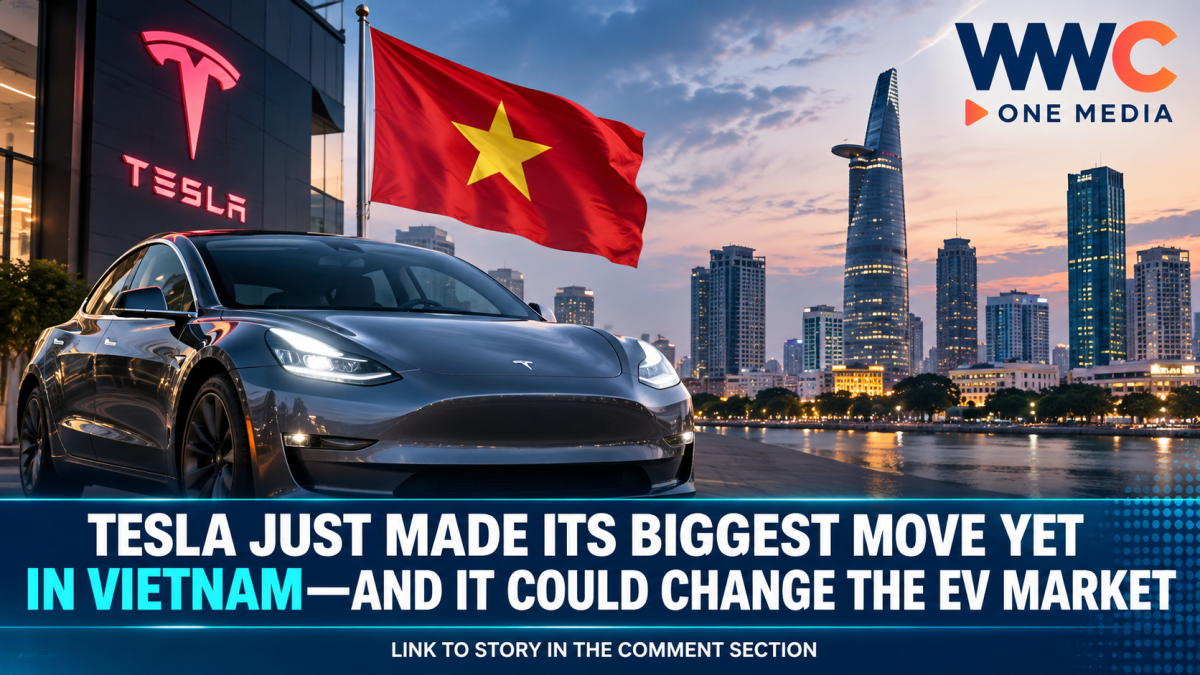
HANOI — Tesla has taken a major step toward establishing a direct presence in Vietnam after setting up a local company, a move that could pave the way for the U.S. electric vehicle giant to eventually sell and distribute its vehicles in one of Southeast Asia’s rapidly expanding EV markets.
According to a newly published business registration filing reviewed by Reuters, Tesla Motors Vietnam Limited Liability Company was established in Ho Chi Minh City on September 11, 2026, with registered charter capital of 77.667 billion Vietnamese dong, or about US$3 million.
The registration allows the company to conduct activities including the wholesale and retail sale of automobiles and vehicle parts, as well as machinery and equipment. It also covers related import, export and distribution activities.
That makes the move more significant than simply registering a corporate name.
A potential direct route into Vietnam
The establishment of a local Tesla entity could give the company a formal platform from which to develop commercial operations in Vietnam.
Vietnamese automotive outlets reported that the company’s registered business activities include automobile sales, vehicle parts and related distribution operations. Vietnamese business publication VietnamBiz reported that the company’s primary registered activity involves automobile wholesale, including export, import and wholesale distribution rights.
Vietnamese automotive media likewise interpreted the registration as a possible preparation for Tesla’s eventual official distribution of vehicles in the country.
However, Tesla has not announced a specific vehicle launch date, showroom opening, charging-network rollout or local manufacturing plan in Vietnam. Reuters reported that Tesla had not immediately responded to a request for comment.
That distinction is crucial.
The registration signals that Tesla is establishing a corporate foothold—but it does not, by itself, confirm that Vietnamese consumers will immediately be able to purchase Tesla vehicles through an official retail network.
Who is behind Tesla’s Vietnam operation?
The registration filing also identifies three key figures.
David Jon Feinstein, a U.S. national with an Austin, Texas address, is listed as chairman. Isabel Ching Fan is identified as general director, while Nguyen Manh Hung is listed as assistant to the general director.
VietnamBiz reported that Feinstein is a senior Tesla executive involved in trade and markets finance, adding to the significance of his role in the newly established Vietnamese entity.
The presence of Tesla executives in the company’s registered leadership structure further suggests that the entity is connected to Tesla’s broader corporate operations rather than being merely an unrelated local business using a similar name.
Why Vietnam matters to Tesla
Vietnam’s electric-vehicle market has been expanding rapidly, with domestic manufacturer VinFast establishing a strong position while international brands such as BYD and other automakers compete for customers.
Tesla’s arrival could therefore introduce one of the world’s most recognizable EV brands into an increasingly competitive market.
The timing is also notable because Vietnam has been strengthening policies designed to encourage electric-vehicle adoption.
Vietnam News, citing the Vietnam News Agency, reported in June that Vietnam had extended the zero-percent first-time registration fee for battery-electric vehicles through December 31, 2030 under Decree 202/2026/ND-CP. The measure is scheduled to take effect from March 1, 2027.
Such policy stability could make the Vietnamese market more attractive to global EV manufacturers considering long-term investment and distribution strategies.
But Tesla still faces a crowded market
Tesla would not be entering an empty field.
Vietnam’s homegrown EV champion VinFast has already built a substantial domestic presence, while Chinese manufacturers and other international automakers are expanding their electric offerings.
That means Tesla’s potential entry would likely bring a new dimension to competition—not simply over vehicle sales, but also over pricing, charging infrastructure, service networks, technology and brand loyalty.
Tesla’s challenge could be particularly interesting because establishing a successful EV business requires more than importing vehicles. Customers also expect reliable after-sales service, spare-parts availability, charging access and competitive pricing.
What happens next?
For now, the clearest development is the creation of Tesla Motors Vietnam Limited Liability Company.
The company has the registered authority to participate in automobile sales and related import, export and distribution activities, but Tesla has yet to publicly confirm when it will begin selling vehicles directly in Vietnam.
Still, the move sends a powerful signal.
After years of speculation about Tesla’s presence in Vietnam, the world’s high-profile EV maker now has an officially registered corporate vehicle in the country.
The bigger question is no longer whether Tesla has a foothold in Vietnam—it is how far the company intends to take it.
If Tesla proceeds with an official sales and distribution network, Vietnam’s already intense EV competition could be heading for an entirely new phase.



Leave a Reply