
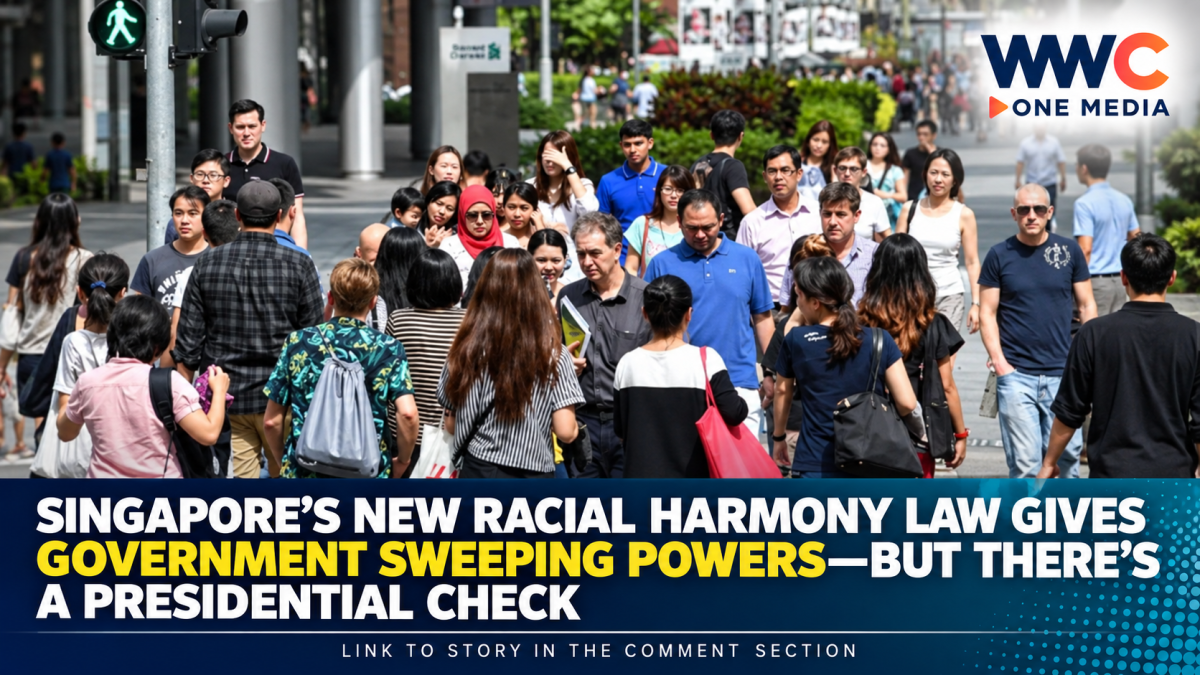
SINGAPORE — Singapore has enacted a major overhaul of its legal framework for protecting racial harmony, giving the Government new powers to act against content deemed harmful to race relations while creating a new Presidential Council to review restraining orders.
The Maintenance of Racial Harmony Act 2025 was passed by Parliament on Feb. 4, 2025, and received presidential assent on Feb. 26. However, the legislation remained uncommenced as of Sept. 11, 2026, meaning the new statutory framework had not yet formally taken effect at that point.
The law is designed to consolidate and strengthen Singapore’s existing legal safeguards on racial harmony, drawing heavily from the country’s long-standing Maintenance of Religious Harmony Act.
At the center of the new framework is a restraining-order regime that allows the Home Affairs Minister to act against people involved in producing, communicating or distributing content that prejudices racial harmony.
Under the legislation, an order can restrict the communication or distribution of specified material, prevent a person from addressing a particular audience on a specified subject, or require reasonable steps to remove specified material from public access in Singapore.
It can also restrict a person’s involvement with a specified publication, including editing, printing or serving on an editorial board.
Why the Government says speed matters
The Government has argued that racial tensions can escalate rapidly, particularly in the age of social media, where inflammatory material can spread widely before authorities have time to respond.
Home Affairs and Law Minister K. Shanmugam said the restraining-order powers are intended to be pre-emptive, allowing authorities to intervene when there is a risk of harmful conduct rather than waiting for a criminal prosecution to run its course.
The Government has also stressed that the new law is not intended to eliminate legitimate discussion about race.
During parliamentary debate, Shanmugam said similar powers under the Maintenance of Religious Harmony Act have existed for decades and had not been used, while acknowledging that such powers must be exercised carefully and judiciously.
The President gets a role—but with limits
One of the most closely watched features of the legislation is the role of the Presidential Council for Racial and Religious Harmony, which replaces the former Presidential Council for Religious Harmony and expands its mandate to include racial issues.
The council is intended to review restraining orders and make recommendations to the President on whether an order should be cancelled, confirmed or varied.
A person subject to an order can also make written representations to the council within 14 days. The council is required to make its recommendation within 44 days of the order being issued.
The President then considers the council’s recommendation together with Cabinet’s advice.
If Cabinet and the council disagree, the President has discretionary powers under the Constitution in deciding whether to confirm, cancel or vary the order.
If the President does not confirm the order within the prescribed period, the order lapses.
Orders can last up to two years
A racial-content restraining order can initially remain in force for up to two years.
The legislation also allows the Minister to seek extensions of up to another two years at a time, subject to the prescribed review and confirmation process.
Failure to comply with a restraining order is an offence.
The law goes beyond online speech
The legislation is broader than simply regulating inflammatory online material.
It also establishes measures aimed at preventing foreign influence from undermining Singapore’s racial harmony.
Designated race-based entities—including certain clan and business associations linked to Singapore’s major racial communities—will face disclosure and governance requirements.
The Government has said these entities may be required to disclose foreign and anonymous donations, foreign affiliations and leadership information. They will also face requirements concerning the citizenship or residency of their governing bodies and responsible officers.
Reuters reported that the measures are aimed at curbing foreign interference in race-based organisations, while noting concerns raised by some lawmakers about how the definition of foreign affiliations could affect legitimate longstanding international relationships.
More than 300 race-based organisations could be affected
When the legislation was being introduced, the Ministry of Home Affairs estimated that more than 300 race-based entities could initially be designated.
The Government said the approach was intended to be targeted and proportionate, focusing on entities assessed to have greater potential to become channels for harmful foreign influence.
A community-based alternative to prosecution
Another significant component is the Community Remedial Initiative.
Rather than relying solely on prosecution for less serious race-related offences, the framework provides a pathway for eligible offenders to undertake measures aimed at repairing relationships with affected communities.
The Government has presented this as part of a broader strategy: maintaining clear legal boundaries while also encouraging reconciliation and community healing.
Opposition concerns: Where does legitimate debate end?
The legislation also generated concerns over the potential impact on freedom of expression.
Workers’ Party MPs questioned aspects of the framework, including the role of the President and the possibility that broad restraining-order powers could discourage legitimate discussion about race.
NCMP Hazel Poa argued during the parliamentary debate that the legislation must strike a careful balance between protecting racial harmony and preserving freedom of speech and expression.
Workers’ Party MP Gerald Giam similarly warned that broad Government powers could potentially deter legitimate public discourse intended to expose racial problems or advocate for positive change.
Sylvia Lim also raised concerns about involving the President in decisions on racial matters, arguing that doing so could potentially affect the presidency’s role as a unifying institution.
Parliament’s vote revealed the political divide
While the Maintenance of Racial Harmony Bill itself passed unanimously, the accompanying constitutional amendments were more contentious.
Parliamentary records show that 78 MPs voted in favour and seven voted against the constitutional amendment concerning the President’s role. The seven opposing votes came from Workers’ Party MPs.
The Straits Times reported that the new framework was intended to consolidate existing powers while adding safeguards and a more community-focused response to racial incidents.
Why the law matters now
Singapore has long treated racial harmony as a cornerstone of its national model of multiracialism.
The new legislation reflects the Government’s argument that traditional criminal laws alone may not be sufficient in an era when inflammatory material can spread instantly through social media and cross borders.
That concern became particularly visible in June 2026, when Singapore authorities ordered social media platforms to block access to 14 posts targeting the Indian community. The Ministry of Home Affairs said the material appeared to originate overseas and contained narratives that sought to divide Singaporeans along racial lines.
The episode illustrates the environment in which Singapore’s new racial-harmony framework was developed: content created outside Singapore can rapidly enter the country’s information space and potentially inflame tensions among communities.
But the legislation also raises a difficult question that Singapore’s lawmakers debated extensively:
How can a government move quickly enough to prevent racial hatred from going viral without creating a chilling effect on legitimate conversations about race?
That balance—between protecting social cohesion and preserving open discussion—is likely to remain at the heart of public debate as Singapore moves toward implementing the new framework.




Leave a Reply