
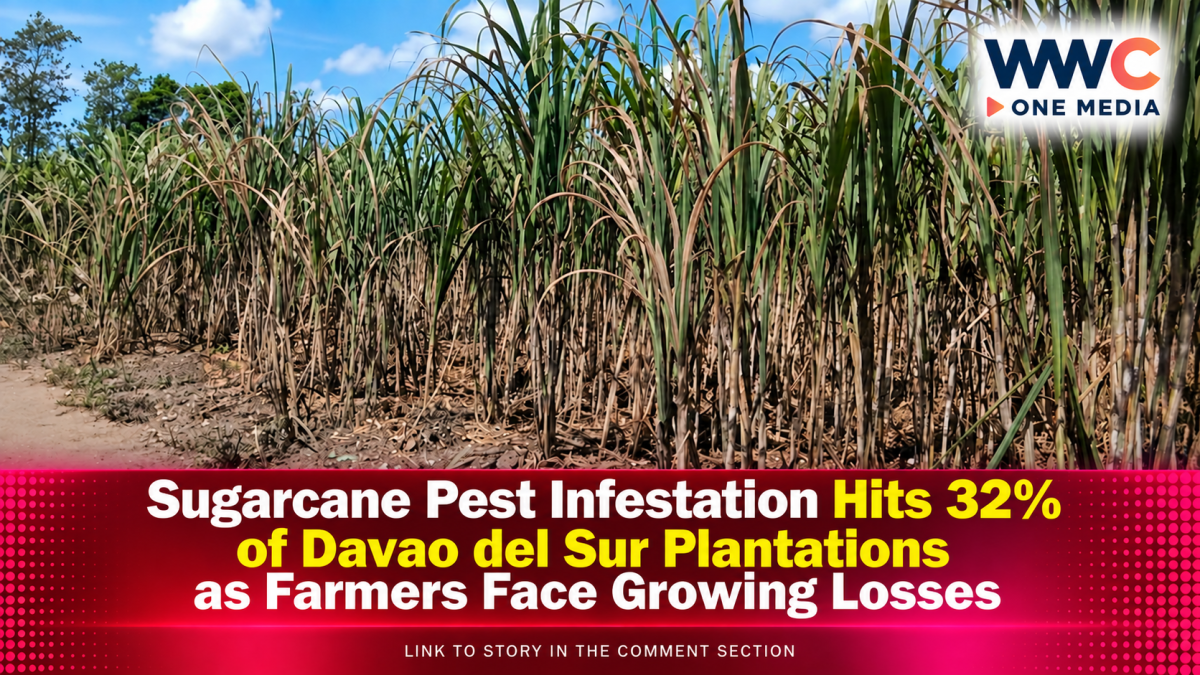
DAVAO DEL SUR, Philippines — A destructive sugarcane pest has spread across more than 32 percent of Davao del Sur’s sugarcane plantations, raising concerns over falling harvests, reduced farmer incomes and potential disruptions to one of the province’s key agricultural industries.
Provincial officials have convened an emergency response involving agricultural agencies, sugarcane cooperatives and other stakeholders after the red-striped soft scale insect (RSSI) affected 1,731.73 hectares of the province’s 5,372.70 hectares of sugarcane plantations.
The infestation has been reported across Bansalan, Matanao, Magsaysay, Hagonoy, Kiblawan, Sulop and Malalag, as well as Digos City, according to data presented to the Davao del Sur Provincial Government’s agriculture committee.
Hagonoy Records the Highest Infestation Rate
As of Aug. 27, Hagonoy had suffered the highest rate of infestation, with about 46.81 percent of its sugarcane areas affected.
Matanao followed with 38.42 percent, while Bansalan recorded 36.79 percent and Digos City reported 32.47 percent.
Other affected areas included Magsaysay at 26.73 percent, Kiblawan at 24.91 percent, Malalag at 20.17 percent and Sulop at 17.91 percent.
The scale of the outbreak prompted Davao del Sur’s 18th Sangguniang Panlalawigan Committee on Agriculture to meet with representatives from the Department of Agriculture in Davao Region, the Sugar Regulatory Administration, the Regional Crop Protection Center, the Bureau of Plant Industry, local cooperatives and other stakeholders to identify immediate measures.
Farmers Already Feeling the Economic Impact
For sugarcane growers, the infestation is more than an agricultural problem.
Provincial officials said affected plantations have produced lower-quality cane and reduced volumes of raw sugar, directly cutting into farmers’ income.
The Davao Mill District has 1,612 sugarcane planters and produces more than 224,000 tons of cane, making the outbreak a potentially serious concern for the wider local sugar industry.
The pest’s ability to weaken sugarcane and reduce sugar content has also raised alarm nationally. The Department of Agriculture has warned that RSSI can significantly reduce the productivity of affected crops, threatening both farm incomes and sugar production if outbreaks are not contained quickly.
Government Rolls Out Chemical Treatment
Authorities have already begun distributing chemical interventions to affected farmers.
According to the provincial report, 401 farmers have received Lambda-cyhalothrin and Thiamethoxam as part of efforts to control the infestation.
Treatment has been applied to more than 1,424 hectares of affected sugarcane areas.
However, officials are also looking beyond chemical treatment.
Natural predators, including earwigs and green lacewings, are being considered as part of an ongoing pest-management strategy.
The approach reflects a wider government effort to strengthen biological control and reduce the industry’s long-term dependence on chemical interventions.
RSSI Has Become a National Sugar Industry Threat
The Davao del Sur outbreak comes as the Philippine government intensifies its response to RSSI in other sugar-producing areas.
The Department of Agriculture and Sugar Regulatory Administration have expanded surveillance, chemical treatment, drone operations and biological-control programs in response to outbreaks that have affected sugarcane-producing regions across the country.
Agriculture officials have allocated funding for chemicals and pest-control operations while also working to develop long-term biological solutions.
One of the government’s strategies involves increasing the production of naturally occurring fungi that can help suppress the pest.
Authorities have also strengthened field surveillance and real-time reporting in an effort to detect outbreaks earlier and prevent further spread.
Race to Protect Davao del Sur’s Sugarcane Industry
Davao del Sur officials are now considering additional measures to address the infestation as farmers and agricultural agencies race to contain the pest.
The challenge is not only to treat plantations that are already affected, but also to prevent RSSI from spreading further across the province.
For thousands of workers and farmers connected to the sugarcane industry, the outcome could have serious economic consequences.
With more than a third of some municipalities’ sugarcane areas already affected, authorities face increasing pressure to act quickly.
The battle against RSSI in Davao del Sur has now become a race against time — because every additional hectare lost could mean lower harvests, deeper income losses and a growing threat to one of the province’s most important agricultural industries.
WWC ONE MEDIA J.M.D




Leave a Reply