
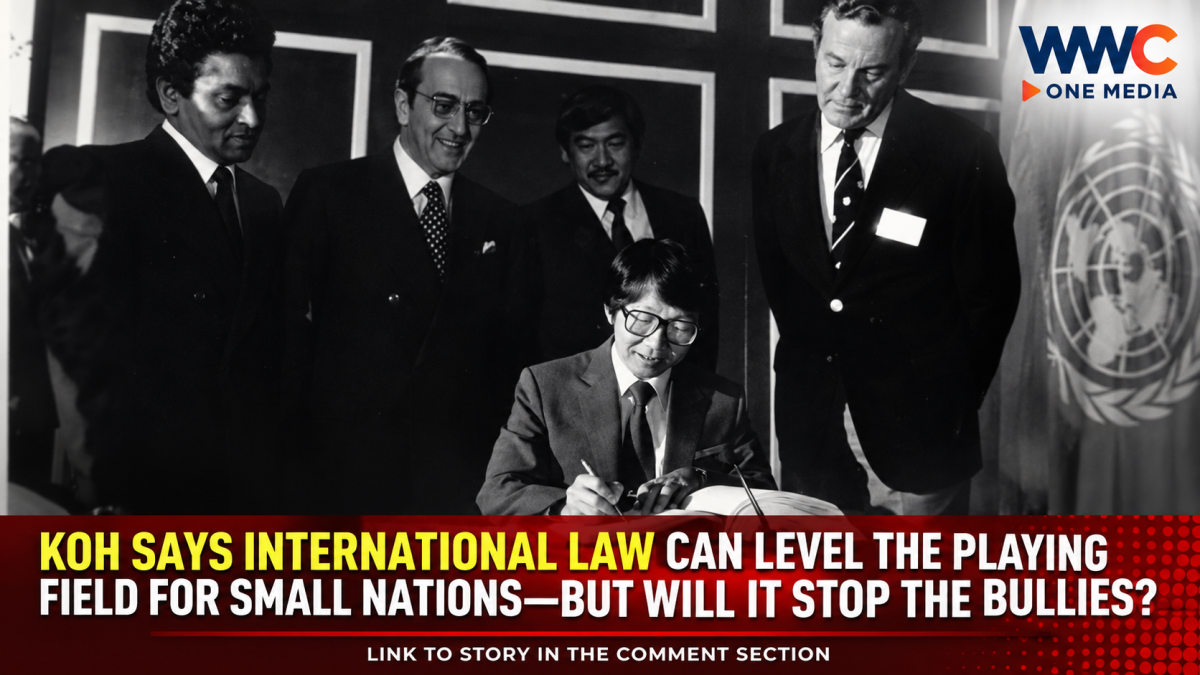
For smaller countries facing the military and economic weight of much larger powers, the battlefield is not always decided by ships, missiles or money.
Sometimes, the most powerful weapon available is international law.
That is the central idea highlighted by maritime security expert Collin Koh, who has emphasized the importance of rules, legal mechanisms and international partnerships for smaller states navigating an increasingly competitive Indo-Pacific.
The argument carries particular weight for the Philippines, which has repeatedly turned to international law as it confronts China’s expansive claims and increasingly assertive activities in the South China Sea.
The Philippines’ experience demonstrates why legal institutions can serve as an important equalizer when conventional power is heavily unbalanced.
For small states, the law can become a force multiplier
Small countries generally cannot match major powers ship-for-ship, missile-for-missile or dollar-for-dollar.
But international agreements such as the United Nations Convention on the Law of the Sea (UNCLOS) establish rights and obligations that apply regardless of a country’s military size.
That was precisely the logic behind Manila’s decision to bring its South China Sea case to arbitration in 2013.
The Philippines invoked UNCLOS and pursued arbitration under its dispute-settlement provisions, despite China’s refusal to participate in the proceedings.
The tribunal ultimately issued its landmark award on July 12, 2016.
Among its major findings, the tribunal rejected the legal basis of China’s claimed historic rights to resources within areas covered by the so-called nine-dash line and clarified the maritime entitlements of the parties under UNCLOS. It also found that several Chinese activities had violated the Philippines’ sovereign rights and that large-scale land reclamation had caused serious environmental harm.
The case became a powerful example of how a smaller country could use an international legal framework to challenge the position of a vastly more powerful state.
A decade later, the ruling remains at the center of the dispute
Ten years after the award, the legal battle has not disappeared.
The Philippines continues to regard the 2016 ruling as final and binding, while China continues to reject it.
In June 2026, the Philippine Department of Foreign Affairs again rejected China’s characterization of the award as “illegal, null and void,” stressing that the ruling was issued under UNCLOS and remains part of international law.
The Philippine National Security Council likewise described the award as an important interpretation of UNCLOS on issues including historic rights, maritime features and the rights and duties of states at sea.
The ruling has also received renewed international attention.
On July 12, 2026, the 10th anniversary of the decision, 14 countries and the European Union reaffirmed the legal significance of the arbitration and said China’s expansive maritime claims lacked a legal basis under international law.
That international backing illustrates another advantage available to smaller nations: law can create coalitions.
The fight is no longer just about the Philippines and China
The South China Sea dispute affects more than two countries.
The waterway is one of the world’s most strategically important maritime routes, linking major Asian economies and carrying a huge share of global trade. It is also surrounded by competing maritime claims involving countries including Vietnam, Malaysia, Brunei and the Philippines.
That means what happens in the South China Sea can influence freedom of navigation, fisheries, energy resources, maritime security and the broader rules governing international waters.
A recent analysis in the Harvard International Law Journal similarly argues that international law can act as a strategic power multiplier for small nations, citing the Philippines’ arbitration as a prime example. The analysis stresses that smaller states can gain leverage by choosing the right legal forum, carefully framing their claims and building strong evidence.
In other words, the law does not magically eliminate a power imbalance.
But it can make that imbalance less decisive.
The latest confrontation shows why the legal battle still matters
The issue has become particularly relevant again following a dramatic confrontation at the Seoul Defense Dialogue on September 8, 2026.
Philippine Defense Secretary Gilberto “Gibo” Teodoro Jr. was speaking about maritime security and China’s activities in the South China Sea when he received a written message defending Beijing’s rejection of the 2016 arbitration ruling.
Teodoro read portions of the message aloud and sharply challenged China’s position, including its assertion that the arbitral award had no binding force.
“Of course, because you lost,” Teodoro said in response to China’s rejection of the ruling, according to Philippine and South Korean reports.
Yonhap reported that the note came from a Chinese military attaché at the Chinese Embassy in Seoul and was passed to Teodoro through a forum staff member.
Teodoro later described China’s conduct as “coercion, bullying and aggression.”
The exchange underscored a fundamental point: the disagreement is not simply about who has the stronger navy.
It is also about which rules govern the sea—and whether those rules can constrain the behavior of powerful states.
Law cannot work alone
There is an important caveat, however.
International law can establish rights and produce authoritative decisions, but enforcement ultimately depends heavily on political will, diplomacy and the willingness of states to uphold the rules.
That is why the Philippines has increasingly combined legal arguments with diplomacy, defense partnerships, maritime cooperation and greater engagement with other countries.
The 2016 case itself demonstrates this.
The tribunal could issue a legally significant ruling, but the continuing dispute shows that winning in court and changing behavior at sea are two different challenges.
For smaller countries, therefore, international law is not a substitute for diplomacy, deterrence or national capability.
It is a tool that can reinforce all three.
The bigger lesson for small nations
The Philippine experience has implications far beyond the South China Sea.
A small nation confronted by a larger power may not have the military strength to impose its will.
But it can document violations.
It can invoke treaties.
It can bring disputes before international institutions.
It can build coalitions.
And it can turn a confrontation based purely on power into one that is also judged against internationally accepted rules.
That may be the real strategic value of international law for smaller states.
It does not make a small country powerful overnight. It makes power answerable to rules.
And as geopolitical competition intensifies across the Indo-Pacific, that distinction could become increasingly important—not only for the Philippines, but for every smaller nation caught between competing giants.
The question now is whether international law can do more than establish who is legally right.
Can it actually make the powerful think twice before bullying the smaller?



Leave a Reply