
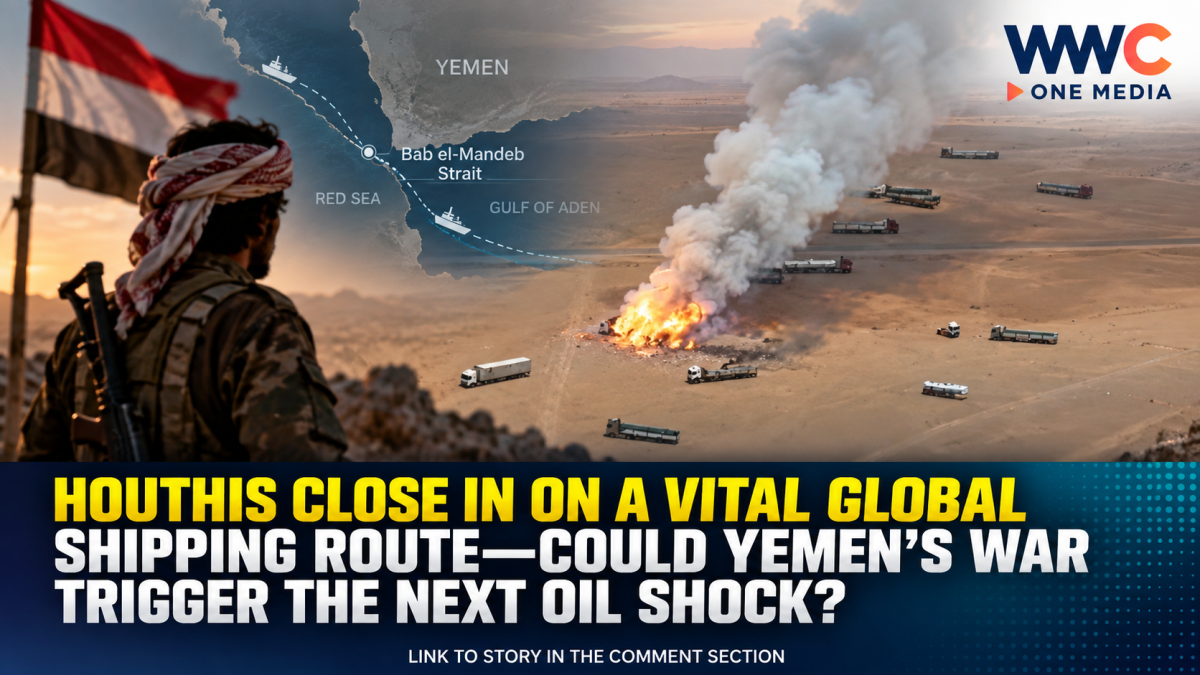
The war in Yemen is rapidly becoming a much bigger threat to the global economy as Iran-aligned Houthi forces make major gains along the Red Sea coast and move closer to the strategic Bab el-Mandeb Strait—one of the world’s most important shipping chokepoints.
The developments have raised fresh concerns over international trade, oil supplies and Saudi Arabia’s security, especially as tensions across the wider Middle East continue to intensify.
According to recent reporting by Reuters and other international outlets, Houthi advances along Yemen’s western coastline have brought the group closer to the Bab el-Mandeb Strait, the narrow waterway linking the Red Sea with the Gulf of Aden and the Indian Ocean.
The route is crucial because ships traveling between Europe and Asia use it to reach the Suez Canal.
Why Bab el-Mandeb Matters to the World
Bab el-Mandeb has long been considered one of the world’s most strategically important maritime chokepoints.
Any major disruption could force commercial vessels and oil tankers to take longer routes around Africa’s Cape of Good Hope, increasing fuel costs, shipping expenses and delivery times.
The situation has become even more sensitive because Saudi Arabia and other Gulf producers have been relying heavily on alternative export routes amid broader instability affecting regional waterways.
Reuters reported that the Houthis’ recent territorial gains, including their movement toward strategic islands and coastal areas near the strait, have created renewed concerns about their ability to threaten shipping and energy infrastructure.
Saudi Arabia Caught Between Yemen’s War and the Global Oil Crisis
The growing Houthi threat comes at a particularly difficult time for Saudi Arabia.
Recent reports said the kingdom shut down its critical East-West oil pipeline following a drone attack, further increasing pressure on Saudi Arabia’s ability to move crude oil to Red Sea export terminals. The pipeline is particularly important because it provides an alternative route that avoids the Strait of Hormuz.
With risks now affecting multiple strategic waterways and energy routes, analysts fear the Middle East could face a dangerous supply-chain squeeze.
Reuters reported that oil prices surged sharply amid the escalating conflict, reflecting growing fears over possible disruptions to global energy supplies.
Houthis Make Major Gains Along Yemen’s Red Sea Coast
The latest developments represent one of the most significant shifts in Yemen’s conflict in years.
Reports from Reuters, AP and Al Jazeera said Houthi forces captured or advanced through key areas along Yemen’s Red Sea coast, including the strategic city of Mocha, while also moving toward islands near the Bab el-Mandeb Strait.
The advances have alarmed the internationally recognised Yemeni government and its Saudi-backed allies.
AP reported that renewed fighting has displaced tens of thousands of people, while heavy clashes have caused significant casualties and deepened Yemen’s already severe humanitarian crisis.
The rapid Houthi offensive also threatens to undermine years of efforts to prevent Yemen’s civil war from returning to full-scale conflict.
Could the Houthis Actually Disrupt Global Shipping?
That is now one of the biggest questions facing governments, shipping companies and oil markets.
The Houthis have repeatedly demonstrated their ability to use drones, missiles and other weapons against regional targets and maritime traffic.
Their growing presence along Yemen’s coastline could potentially give them greater leverage over vessels passing through or near Bab el-Mandeb.
However, controlling territory near the strait and completely shutting down international shipping are very different things.
Analysts cited by Al Jazeera have questioned whether the Houthis can sustain control over their newly captured positions and whether they have the military capability to fully close one of the world’s busiest shipping routes.
Still, even the threat of attacks can have serious consequences.
Shipping companies may reroute vessels, insurers may raise premiums, and oil traders may react to fears of supply disruptions before an actual blockade occurs.
A Bigger Regional Conflict Is Taking Shape
The fighting in Yemen is no longer being viewed in isolation.
The latest escalation is closely tied to wider tensions involving Iran, Saudi Arabia, the United States and other regional powers.
Reuters reported that the Houthi gains have left Gulf states facing increasingly difficult choices as they weigh military responses against diplomatic efforts to prevent the conflict from spreading further.
Meanwhile, the Houthis have launched further attacks targeting Saudi Arabia, according to AP and other international reports, adding to fears that the conflict could expand beyond Yemen’s borders.
Oil Markets Are Watching Every Move
The consequences could reach far beyond the Middle East.
Oil markets have already reacted to rising geopolitical risks, with crude prices climbing sharply as traders assess potential disruptions to key production and shipping routes.
Reuters reported that the combination of attacks on Saudi infrastructure and growing threats around Bab el-Mandeb has increased fears over global oil supplies and prolonged market volatility.
For consumers, sustained disruptions could eventually mean higher fuel prices, more expensive shipping and additional inflationary pressure.
For governments, the crisis raises a more urgent question:
What happens if instability threatens more than one of the world’s critical oil routes at the same time?
What Happens Next?
The situation in Yemen remains highly fluid.
Saudi Arabia and its Yemeni allies are under pressure to respond to the Houthi offensive, while the Houthis appear determined to consolidate their gains along the Red Sea coast.
At the same time, international powers are closely watching whether the conflict will remain centred on Yemen—or evolve into an even wider confrontation involving major energy infrastructure and global shipping routes.
For now, the battle for Yemen’s coastline is becoming much more than a local conflict.
The struggle around Bab el-Mandeb could determine not only the next phase of Yemen’s war, but also how vulnerable global trade and oil markets really are.
And with tensions rising by the day, the world’s attention is now turning to one narrow stretch of water between Yemen and Africa.
Because if the conflict reaches deeper into Bab el-Mandeb, the consequences may not stay in the Middle East for long.




Leave a Reply