
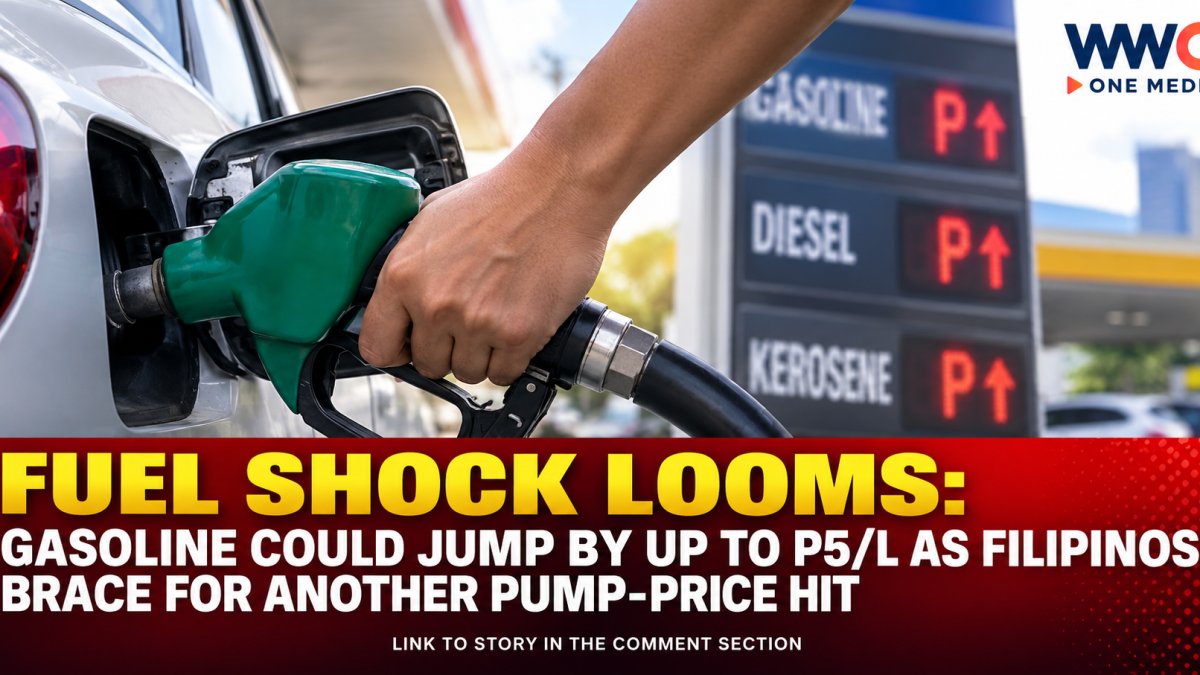
MANILA, Philippines — Filipino motorists are facing another painful hit at the pump, with gasoline prices potentially rising by as much as P5 per liter this week as renewed Middle East tensions, tighter global fuel supplies and the weaker Philippine peso continue to push petroleum costs higher.
The projected increase comes just days after oil companies implemented one of the steepest fuel-price adjustments of the month.
An oil industry source cited by the Philippine News Agency (PNA) estimated that gasoline could increase by P4.50 to P5 per liter, while diesel may rise by around P2 to P2.50 per liter. The estimates were based on developments in Asian oil markets and foreign-exchange movements.
The GMA News estimate was somewhat broader, placing the possible increase at P2 to P4 per liter for gasoline and P3 to P5 per liter for diesel, based on Mean of Platts Singapore (MOPS) prices and peso-dollar trading from September 7 to 9.
That means motorists could once again find themselves paying significantly more for every liter of fuel beginning Tuesday, September 15, although the final adjustment depends on the complete trading picture.
Gasoline faces the biggest pressure
Department of Energy Oil Industry Management Bureau Director Rino Abad said another increase was expected across petroleum products.
According to Philstar, Abad said gasoline remained under particularly strong upward pressure, while the projected increases for diesel and kerosene were expected to be smaller than the previous week’s adjustments.
The latest projections are especially concerning because pump prices have already climbed sharply.
On September 8, oil companies raised gasoline prices by P4.69 per liter, diesel by P5.18, and kerosene by P5.58, according to reports citing the Department of Energy.
The increases pushed gasoline and diesel prices above the P100-per-liter level at some Metro Manila stations. Inquirer monitoring on September 8 showed gasoline and diesel prices reaching as high as about P102 per liter in some locations.
Why are fuel prices rising again?
The latest pressure on Philippine pump prices is being driven largely by developments in the international oil market.
Oil industry officials have pointed to renewed military tensions in the Middle East, concerns over energy shipments and disruptions affecting major oil-producing and trading routes.
PNA reported that reduced exports from the Middle East and Russia, lower US exports and increasing seasonal demand have tightened global diesel supplies. Gasoline markets have also been pressured by strong demand, lower Chinese exports and refinery maintenance in parts of Asia.
The Strait of Hormuz, one of the world’s most important oil-shipping chokepoints, has become a major focus of concern because disruptions there could restrict the movement of crude and petroleum products to international markets.
Philstar also reported that concerns over shipping through the Red Sea and Bab el-Mandeb Strait have added another layer of risk to an already strained global energy market.
The peso is adding to the pain
Global oil prices are not the only factor.
The Philippine peso’s performance against the US dollar also affects domestic fuel prices because the Philippines imports much of its petroleum requirements.
When the peso weakens, Philippine oil companies generally have to spend more pesos to purchase the same amount of dollar-denominated petroleum.
That combination—higher international oil prices and currency pressure—can translate into another increase at local fuel stations.
Another increase after an earlier rollback
The latest developments are particularly frustrating for motorists because the September increases followed a brief period of relief.
Before the latest spike, oil companies implemented rollbacks in gasoline, diesel and kerosene prices at the start of September. But the relief was short-lived as international oil markets quickly turned higher.
The September 8 adjustment then erased much of that relief, with gasoline rising P4.69 per liter and diesel climbing P5.18 per liter.
Now, another increase is looming.
What motorists should watch on Monday
The figures circulating ahead of the next adjustment remain estimates, not the final pump-price announcement.
Oil companies normally announce their final weekly adjustments after the complete trading period is evaluated, including international benchmark prices and foreign-exchange movements.
The projected increase is expected to take effect on Tuesday, September 15, following the announcement of the final adjustment on Monday.
For motorists, the difference could be substantial.
A P5-per-liter increase would mean an additional P250 for a 50-liter tank every time it is filled. For drivers who refuel several times a month, the cumulative impact could quickly reach hundreds or even thousands of pesos.
And the impact will not stop at the gas station.
Higher fuel costs can increase transportation and delivery expenses, potentially putting additional pressure on the prices of food, consumer goods and other services.
Transport groups already feeling the pressure
The continuing fuel-price surge has also intensified pressure on public transport operators.
Transport group Manibela announced a nationwide transport strike for September 14, citing rising fuel prices among its concerns. GMA News reported that the announcement came after the latest large increases in gasoline and diesel prices.
The development highlights how quickly movements in global oil markets can spill over into the daily lives of Filipino commuters, drivers, businesses and consumers.
The bottom line
Another P5-per-liter fuel increase is possible—but it is not yet the final price adjustment.
Current industry and government estimates point to another significant increase, with gasoline potentially taking the biggest hit and diesel also expected to rise.
For motorists, the critical question is now no longer whether fuel prices are under pressure—but just how much more they will have to pay when the next adjustment takes effect Tuesday.




Leave a Reply