
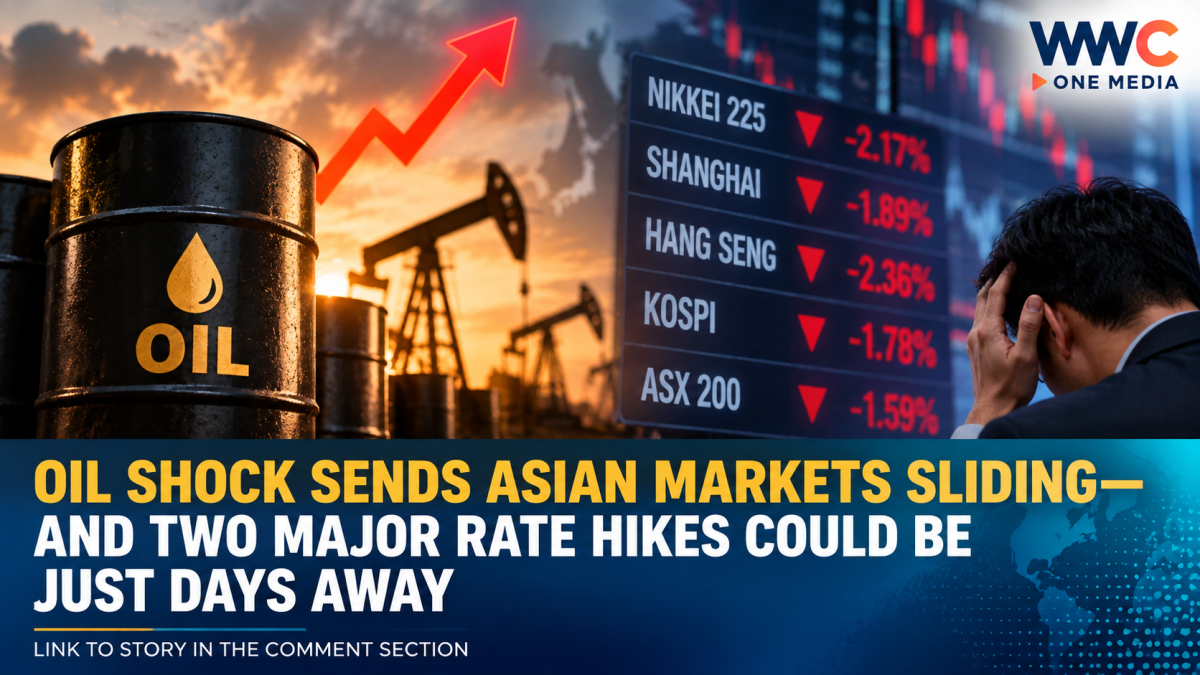
Asian stock markets opened lower on Monday as a fresh surge in oil prices rattled investors, while financial markets braced for possible interest rate hikes from both the United States Federal Reserve and the Bank of Japan later this week.
The renewed market turmoil comes as escalating attacks involving Saudi Arabia and shipping routes in the Gulf raised fears of a deeper disruption to global energy supplies.
Brent crude climbed sharply, rising around 3 per cent and moving above US$107 a barrel after fresh attacks intensified concerns over oil infrastructure and shipping security. Reuters reported that Brent briefly reached more than US$108 a barrel, while US crude also surged above US$103.
Asian Stocks Slide as Oil Shock Returns
The rise in crude prices weighed heavily on investor confidence across Asia.
Markets are now confronting a dangerous combination: higher energy costs, renewed inflation pressures, rising government bond yields and the prospect of tighter monetary policy.
The latest sell-off follows weeks of market volatility as the conflict affecting Middle Eastern energy routes threatens to push fuel costs higher for businesses and consumers worldwide.
According to Reuters, concerns have intensified after disruptions to Saudi Arabia’s East-West oil pipeline, which analysts say could threaten a significant portion of global oil supply if the outage continues. The pipeline had played a crucial role in moving Saudi crude toward Red Sea export facilities.
The situation has become even more sensitive because the Strait of Hormuz remains a critical route for global oil shipments.
Fresh attacks on ships and energy infrastructure have raised fears that supply disruptions could last longer than markets initially expected.
Why Rising Oil Prices Are Making Investors Nervous
Higher oil prices do not just affect motorists.
When crude prices surge, transportation, manufacturing, shipping and food production costs can also rise. Those increases can eventually be passed on to consumers, potentially making inflation harder for central banks to control.
That is now one of the biggest concerns facing global markets.
Recent market reports have shown that rising energy and commodity prices are already adding to broader inflation worries, while investors have also been pulling money from global equity funds as uncertainty increases.
The fear is simple: if oil stays above US$100 for an extended period, central banks may have fewer reasons to cut interest rates—and may instead have to raise them.
Fed Rate Hike Now in Focus
Investors are closely watching the US Federal Reserve, which is scheduled to make its latest policy decision this week.
Markets have increasingly priced in the possibility of a 25-basis-point interest rate increase, with Reuters reporting that market expectations have climbed above 80 per cent.
A rate increase would be particularly significant because it could mark another major shift in global monetary conditions after markets had previously focused heavily on the possibility of easier policy.
Higher US interest rates could strengthen borrowing costs globally, pressure stock valuations and increase stress on emerging markets.
US inflation data has also added to investor caution.
August consumer prices rose strongly enough to reinforce concerns that inflation may remain stubborn, especially if higher oil prices continue feeding through the global economy.
Bank of Japan Could Also Raise Rates
The Federal Reserve is not the only central bank worrying investors.
The Bank of Japan is also expected to consider raising interest rates, with markets assigning a strong probability to another increase.
A move by the BOJ would be closely watched because Japan spent decades maintaining extremely low interest rates.
A higher Japanese policy rate could have major consequences for global markets, particularly for currency trading and so-called carry trades, where investors borrow cheaply in yen to invest in higher-yielding assets elsewhere.
Reuters has reported that expectations of further Bank of Japan tightening have already helped strengthen the Japanese yen and increased uncertainty across regional markets.
Bond Yields Add More Pressure
The oil rally has also pushed investors to rethink the outlook for inflation and interest rates.
US Treasury yields have climbed sharply in recent sessions, with the benchmark 10-year yield approaching levels not seen in years.
Higher bond yields can create additional pressure on stock markets because they increase borrowing costs and make safer government bonds more attractive compared with riskier assets.
That has created a difficult environment for investors already dealing with geopolitical uncertainty and volatile energy markets.
Could Oil Reach Even Higher?
The biggest question now is whether the latest spike in oil prices is temporary—or the beginning of a longer energy shock.
Analysts have warned that crude prices could continue climbing if attacks on energy infrastructure and shipping routes persist.
Reuters reported that some market analysts see the potential for Brent to test significantly higher levels if diplomatic efforts fail to reduce tensions and supply disruptions continue.
The postponement of planned regional talks aimed at easing tensions has added another layer of uncertainty to the market outlook.
For investors, businesses and consumers, the stakes are growing.
What Happens Next Could Shake Global Markets
This week could become one of the most important periods for financial markets in months.
Investors are now watching three major developments at once:
- Whether oil prices continue climbing above US$100 per barrel
- Whether the US Federal Reserve raises interest rates
- Whether the Bank of Japan delivers another rate hike
A combination of higher oil prices and tighter monetary policy could create a new challenge for the global economy: fighting inflation without slowing growth too sharply.
Asian markets are already showing signs of stress.
And with energy supplies under pressure, bond yields climbing and two of the world’s most important central banks preparing to make major decisions, investors are asking the same question:
Is the world heading toward another major inflation shock—or will policymakers and diplomacy move fast enough to calm the markets?
The answer could begin to emerge in the days ahead.




Leave a Reply