
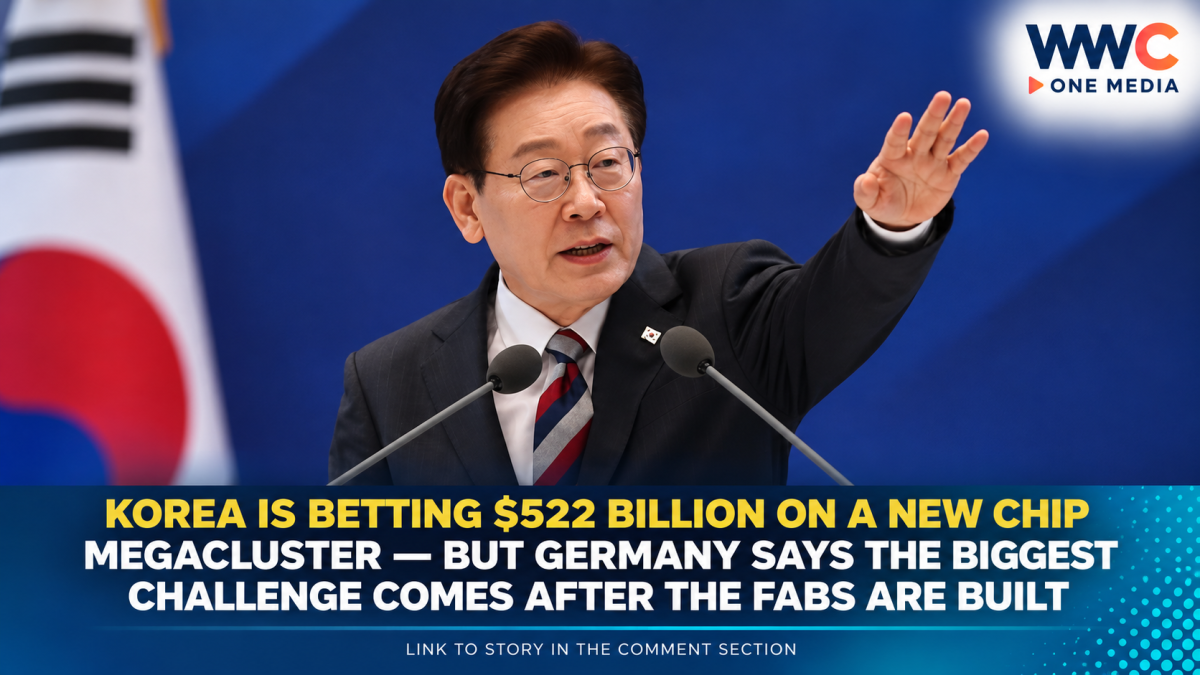
GWANGJU, SOUTH KOREA — South Korea is preparing one of the biggest semiconductor investments in its history, with Samsung Electronics and SK hynix tied to an 800 trillion won (about US$522 billion) semiconductor cluster in the Honam region.
But as Korea races to turn the southwest into its next chipmaking powerhouse, a German official is urging policymakers not to judge the project by the number of fabrication plants alone.
Dennis Bloch, counselor for economic affairs at the German Embassy in Seoul, says the real test will be whether Gwangju and South Jeolla can build the much larger ecosystem that makes semiconductor production sustainable for decades — including universities, research institutions, suppliers, skilled workers and shared infrastructure.
His model is Silicon Saxony, the German technology cluster centered around Dresden that now produces roughly one-third of Europe’s chips.
And its history carries an important lesson for Korea.
“Semiconductor clusters are built over decades,” Bloch said during a semiconductor and AI forum in Gwangju.
Korea’s enormous Honam semiconductor plan is already moving
The warning comes at a pivotal moment.
In July, South Korea selected the site of Gwangju’s military airport for the government-backed Honam semiconductor production cluster. Samsung Electronics and SK hynix have pledged a combined 800 trillion won toward the project, according to Yonhap, making it the largest investment plan announced for the country’s southwestern region.
The project forms part of Seoul’s wider regional-development push involving semiconductors, physical artificial intelligence and AI data centers.
Gwangju has said it wants to move quickly enough to begin semiconductor mass production by 2030. But achieving that deadline involves far more than constructing factories. The military airport itself must be relocated, while the region needs sufficient power, industrial water, transport infrastructure and a workforce capable of supporting highly sophisticated manufacturing.
That is exactly where Germany’s experience becomes relevant.
Silicon Saxony took more than 60 years to become a chip powerhouse
Dresden did not become one of Europe’s most important semiconductor centers overnight.
Its microelectronics history stretches back to 1961, decades before today’s semiconductor boom.
Saxony now has about 3,650 companies and 82,500 employees across its microelectronics and ICT ecosystem, according to Saxony’s economic development agency. Roughly one in every three chips manufactured in Europe comes from the state.
Major manufacturers operating around Dresden include Infineon, GlobalFoundries and Bosch, with TSMC joining the region through the European Semiconductor Manufacturing Company, or ESMC.
But Bloch’s point was that the fabs represent only the most visible part of the system.
Behind them sits a dense network of component suppliers, universities, training institutions and applied-research organizations such as Germany’s Fraunhofer institutes.
Silicon Saxony’s industry association itself links hundreds of companies, research organizations and public-sector partners.
That ecosystem is much harder to build than a factory.
Germany is still pouring billions into Dresden
Silicon Saxony is also far from finished.
Infineon opened its new €5 billion Smart Power Fab in Dresden in July 2026, describing it as the world’s largest factory dedicated to power semiconductors and analog/mixed-signal technologies. The plant is expected to create around 1,000 direct jobs.
Another massive development is ESMC, the joint venture led by Taiwan’s TSMC alongside Bosch, Infineon and NXP.
Germany received European Commission approval for €5 billion in state aid for the Dresden project. The facility is designed to manufacture 300-millimeter wafers using 28/22-nanometer and 16/12-nanometer technologies, particularly for automotive and industrial customers.
At full capacity, the European Commission says the plant is expected to produce about 480,000 wafers per year.
Together with other investment in the region, these projects reinforce the point Bloch made in Gwangju: a successful chip cluster continually attracts new manufacturers, researchers, suppliers and workers rather than functioning as a collection of isolated factories.
Honam’s project could become even larger than currently announced
Korea’s plan may also grow beyond its initial configuration.
Seoul Economic Daily reported in August that officials and participating companies were examining a possible expansion of the Honam cluster from four fabs to as many as nine.
But that distinction matters: four Samsung and SK fabs have been officially announced, while any expansion beyond that remains under discussion rather than confirmed.
Officials have also considered surrounding areas in South Jeolla for supplier operations, research facilities, power, logistics and other supporting functions — potentially turning the project into a much wider industrial belt rather than concentrating everything at the former military airport site.
That broader approach looks remarkably similar to the ecosystem model Germany is recommending.
Why Korea and Germany may actually complement each other
Bloch also sees an opportunity rather than simply a lesson.
South Korea and Germany occupy different strengths within the global semiconductor supply chain.
Korea dominates important areas of memory semiconductors, high-bandwidth memory, mass manufacturing and advanced packaging.
Germany, meanwhile, has deep expertise in automotive chips, power semiconductors, industrial applications, sensors and specialized manufacturing equipment.
That creates opportunities for collaboration instead of straightforward competition.
One mechanism already exists through K-FAST, the Korea-Fraunhofer Collaboration Hub for Science and Technology.
The partnership was launched in 2024 with support from Korea’s Ministry of Trade, Industry and Energy. Fraunhofer says the platform links Korean companies and research organizations with German institutes for collaborative R&D, including work in semiconductors, AI, batteries, mobility and other advanced technologies.
Fraunhofer’s Korean cooperation network has since expanded substantially, with dozens of German research institutes participating in K-FAST.
The real challenge isn’t building a factory — it’s convincing an ecosystem to stay
For Honam, that may become the defining issue.
Semiconductor fabs require enormous upfront capital, but the long-term competitiveness of a region depends on thousands of smaller decisions made around them.
Will suppliers establish nearby factories?
Will researchers relocate there?
Can universities train enough semiconductor engineers?
Will talented workers want to live in the region?
Can energy, water, transportation and housing expand fast enough?
And can that ecosystem survive changes in governments and corporate investment cycles?
Bloch’s argument is essentially that those questions matter as much as the headline investment number.
Silicon Saxony survived enormous political and economic changes because institutions, infrastructure and industrial relationships gradually accumulated around Dresden.
“Look at the whole ecosystem and connect research with industrial demand,” Bloch told the Gwangju forum.
For South Korea, the timing of that advice is significant.
The Honam project already has the extraordinary investment numbers, two of the world’s most powerful memory-chip companies and government backing.
What it does not yet have is Dresden’s six decades of accumulated industrial history.
And that may explain why Germany’s biggest lesson for Korea’s 800 trillion won semiconductor gamble is surprisingly simple:
The fabs may be the easiest part to see — but everything built around them could determine whether the project still matters 30 years from now.




Leave a Reply