
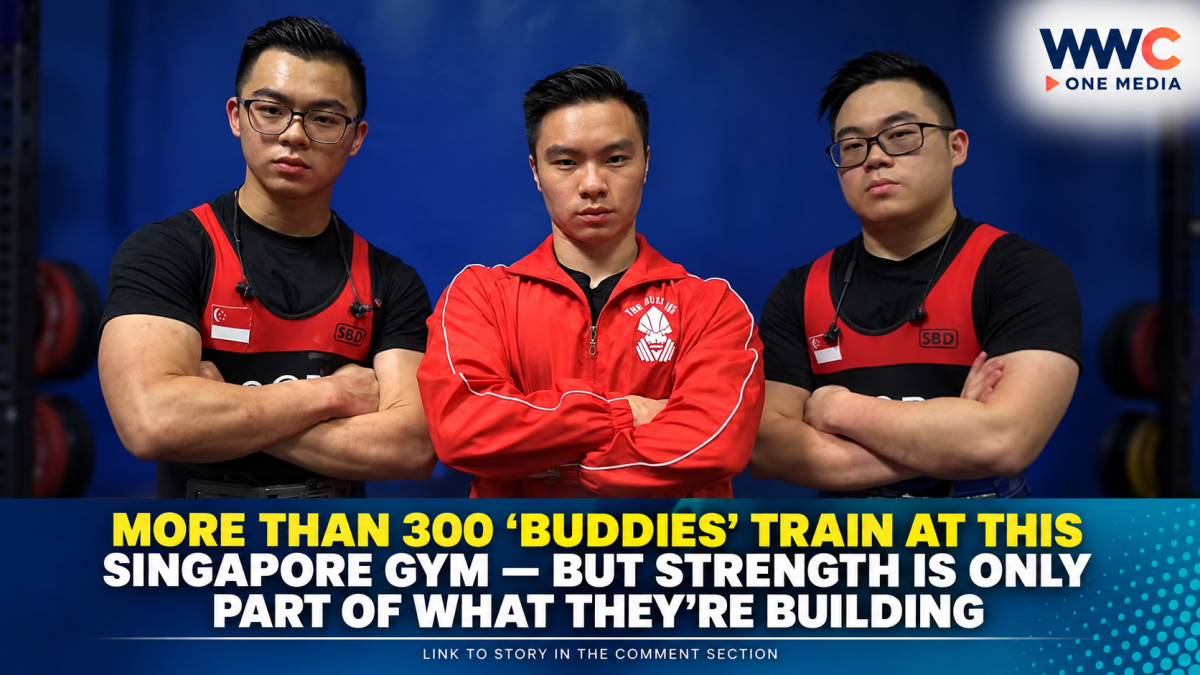
SINGAPORE — Five minutes before it is time to leave home, Malcolm Ho is already waiting at the door.
For the 30-year-old, who has Down syndrome, gym day is apparently not something that requires persuasion.
If his father, Alex Ho, is taking too long, Malcolm has a simple instruction: “Papa, go already.”
The destination is NCSF Uplift, a Singapore programme where the familiar sights of a gym — barbells, weights and exercise stations — come with a very different philosophy.
Participants are not expected to adapt themselves to the gym.
The gym adapts to them.
NCSF Uplift provides free strength training for people with special needs and disabilities, including those with intellectual disabilities, autism and physical, hearing or visual impairments. Exercises can be changed according to each individual’s abilities, communication style and even how they are feeling that day.
And sometimes the most successful workout does not look like a conventional workout at all.
If lifting weights doesn’t work that day, they may simply dance
Volunteer trainer Francis Chan told CNA that trainers learn not to force a predetermined routine when one of the programme’s participants — referred to as “buddies” — is having a difficult day.
Sometimes the answer is a simpler activity.
It could even be dancing.
The principle, Chan explained, is that some movement is better than none.
That flexibility lies at the heart of NCSF Uplift.
Co-founder Chung Tze Khit told CNA that if somebody needs more time, encouragement or an entirely different approach, trainers accommodate it rather than expecting every participant to move at the same pace.
It sounds straightforward.
But for families who have struggled to find mainstream fitness environments capable of accommodating their children or adult family members, it can make the difference between exercising regularly and not exercising at all.
One mother had worried a conventional gym wouldn’t understand her son
A separate Baseline Singapore feature in 2025 documented a similar concern from Cecilia Lai, whose adult son Cavan Chan has Down syndrome.
Lai said she had found it difficult to consider enrolling him in an ordinary gym because she worried that trainers might not understand him — or that he might not understand them.
NCSF Uplift changed that.
After joining, Cavan began looking forward to his weekly sessions. His mother said he became stronger and eventually started taking initiative himself, including helping with warm-ups, moving equipment and encouraging other participants.
That transformation illustrates why NCSF Uplift’s founders describe their mission as being about more than muscular strength.
The organisation says it wants to improve functional outcomes for people with special needs while creating a more inclusive fitness community.
From a small initiative to hundreds of participants
NCSF Uplift was founded in 2022 and began as a relatively small volunteer initiative.
By October 2025, Baseline reported that it was supporting more than 250 people with special needs with over 200 volunteers.
Less than a year later, that community had grown substantially.
CNA reported on September 12, 2026 that NCSF Uplift was supporting about 300 buddies with some 500 volunteers.
The organisation’s own current programme page provides a slightly different measure because it specifically counts active volunteers: it lists more than 300 buddies, over 400 active volunteers and more than 50 buddies waiting for places.
Rather than conflicting, those figures point to the same larger story: demand has grown quickly.
NCSF Uplift now runs sessions throughout the week at locations including Tai Seng, City Hall and Bukit Timah, according to both its programme information and Singapore’s Inclusive Sport portal.
The official portal lists the programme for people with physical and intellectual disabilities and autism, while its programme-provider directory also identifies participation opportunities for people who are deaf or hard of hearing and those with visual impairments.
Some participants have gone from the gym floor to major fitness competitions
For certain NCSF Uplift members, adapted training has become a gateway to competition.
The Straits Times reported in November 2025 on visually impaired athletes Dennard Lee and Valerie Ng, who competed in the adaptive division of HYROX Singapore.
Lee had returned to sport after progressively losing his sight. Through NCSF Uplift, he decided to try HYROX, where rules or exercises can be adapted to accommodate different impairments.
Ng, who has impaired vision, had also trained through NCSF Uplift before competing.
Her story had previously been highlighted by Baseline, which reported that she was among eight NCSF Uplift athletes preparing for HYROX’s adaptive category and was also training for the Standard Chartered Singapore Marathon.
Those cases underline an important distinction.
Inclusive fitness does not necessarily mean making exercise less challenging.
Often, it means removing the particular barrier that prevents somebody from taking on the challenge in the first place.
Singapore is trying to make sport more accessible beyond one gym
NCSF Uplift sits within a much wider push toward inclusive sport in Singapore.
The country’s Disability Sports Master Plan, first introduced in 2016 and refreshed in 2024, aims to increase sporting opportunities for persons with disabilities and make mainstream sporting environments more inclusive.
Government figures show how much participation has already changed.
Sports participation among persons with disabilities rose from 28 per cent in 2015 to 46 per cent in 2023. Under the refreshed plan, Singapore is targeting a 70 per cent participation rate by 2030, while seeking to increase regular places in disability sports programmes from 3,200 to about 5,400.
Public gyms are changing as well.
ActiveSG facilities are progressively being equipped with accessible machines. Some use pneumatic resistance rather than conventional weight stacks and have removable seats to accommodate wheelchair users. Caregivers accompanying people with special needs can also receive complimentary gym entry under the ActiveSG caregiver scheme.
The new ActiveSG Sport Park @ Teck Ghee, which opened in January 2026, includes inclusive strength-training equipment and even a calming room for users with special needs who require a quiet space to self-regulate.
Families say the benefits can extend far beyond fitness
The impact is difficult to measure using kilograms lifted or repetitions completed.
In an August 2026 letter published by The Straits Times, the parent of a 21-year-old autistic son described programmes including NCSF Uplift, Runninghour, Special Olympics and Play-Ability as providing much more than recreation.
The parent said regular participation had helped his son become physically stronger and more confident socially, while structured activities also offered routine, friendship and a sense of belonging.
That experience closely mirrors what Malcolm Ho’s father told CNA.
Alex Ho said his son’s connection to NCSF Uplift is so strong that Malcolm effectively regards the gym as another home.
And that may explain why the most revealing number in the NCSF Uplift story is not how much weight anyone can lift.
It may be the 50-plus people currently waiting for their opportunity to join.
Because behind every squat, press and adapted exercise is a larger question about what inclusion actually looks like.
At NCSF Uplift, the answer is surprisingly ordinary: a place where someone can walk through the door, be understood on their own terms, exercise at their own pace — and want to come back again next week.



Leave a Reply