
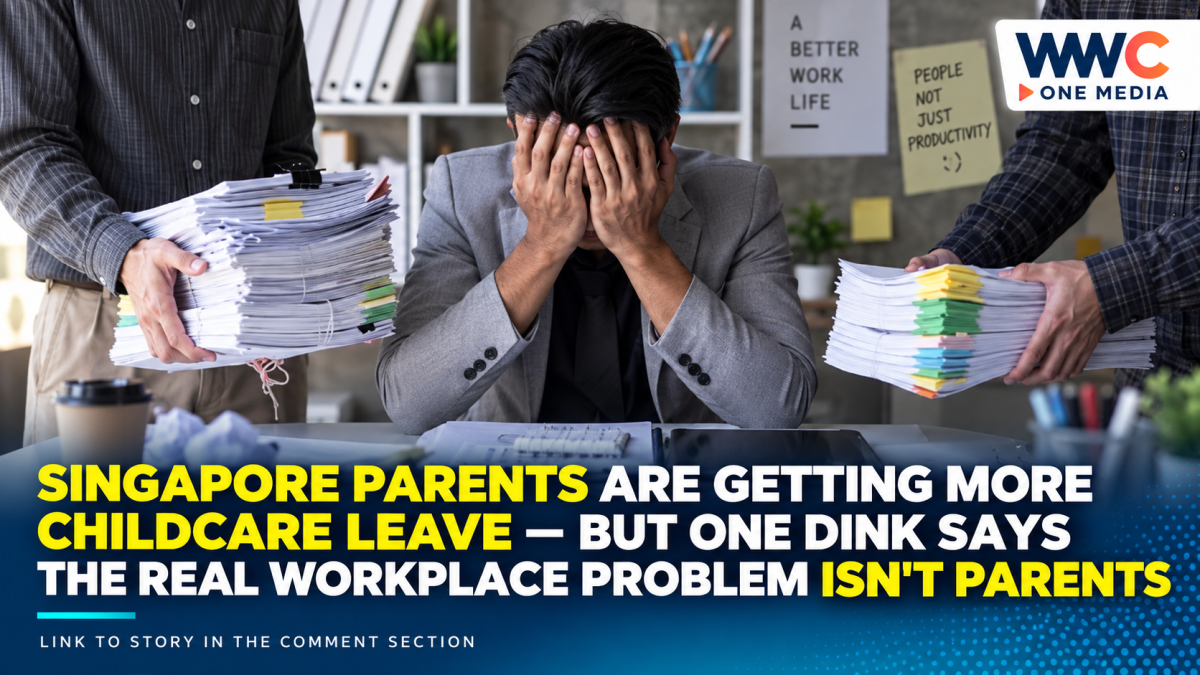
SINGAPORE — Parents are set to receive significantly more childcare leave under Singapore’s latest push to make raising a family easier. But amid concerns that employees without children could end up carrying more work, one self-described DINK has offered a striking counterargument: supporting parents does not have to mean short-changing everyone else.
The debate follows measures unveiled by Prime Minister Lawrence Wong at the 2026 National Day Rally, under which each eligible working parent with Singapore Citizen children aged 12 and below will eventually receive eight days of childcare leave for one child, 10 days for two children and 12 days for three or more children.
For a couple with three or more eligible children, that could amount to a combined 24 days of childcare leave a year.
But the increase has also triggered a question familiar to offices everywhere: When parents are away, who picks up the work?
That is where an opinion piece published by AsiaOne, originally from Wonderwall.sg, has gained attention.
Writer Gwen Tay, who describes herself and her husband as a DINK — double income, no kids — argues that additional support for parents is reasonable even if child-free workers occasionally have to accommodate colleagues who are away. At the same time, she draws an important line: employees without children should not become a company’s permanent backup staffing strategy.
That distinction may turn out to be the most important part of Singapore’s growing conversation about family-friendly workplaces.
More leave for parents — but child-free workers have concerns too
Those concerns are not imaginary.
Channel NewsAsia reported that some employees without children worry that an expansion of childcare leave could mean heavier workloads, especially in small teams where unplanned absences are difficult to cover. Some said they support policies aimed at families but do not want their own personal commitments treated as less important simply because they do not have children.
The concern becomes sharper when childcare leave is taken at short notice because of sickness, emergencies or school-related needs — situations that, by their nature, cannot always be planned weeks in advance.
But workplace experts have cautioned against turning the issue into a parents-versus-non-parents argument.
NTU accounting professor Chua Yeow Hwee argued in a CNA commentary that non-parents should not automatically become substitute workers whenever colleagues take childcare leave. Instead, the policy could push employers to improve job design, cross-training and workforce planning so that one person’s absence does not create an emergency for everyone else.
That closely mirrors the central point made in the AsiaOne commentary: if one employee taking legally protected leave causes an entire department to struggle, the bigger issue may be staffing capacity rather than the employee taking leave.
Singapore is making a bigger shift in family support
The expanded leave scheme is only one part of a much larger policy reset.
Every Singapore Citizen child is also set to receive around S$70,000 in direct government support from birth to age 17, including a S$10,000 Baby Gift, S$5,000 MediSave grant, S$5,000 Child Development Account First Step Grant, government co-matching, annual Child Credits and a S$10,000 Post-Secondary Education Account top-up at age 17.
The new approach marks a shift away from concentrating much of the assistance around childbirth. Instead, the government intends to spread support across a child’s growing years.
Preschool fees at government-supported centres are also scheduled to fall progressively, with full-day childcare targeted at S$150 per month and infant care at S$300 per month by 2030.
The childcare leave rules themselves will also become simpler. Singapore currently provides six days of Government-Paid Childcare Leave when a parent’s youngest child is below seven, while parents whose youngest child is aged seven to 12 can receive two days of Extended Childcare Leave. The new framework will merge those arrangements and instead link the entitlement to the number of eligible children.
Another significant change: the government intends to reimburse employers for the full duration of statutory child-related leave, subject to the applicable reimbursement cap, reducing the portion employers themselves must finance.
One important detail: the new leave has not started yet
Despite headlines saying parents “get” eight to 12 days, the enhanced childcare leave scheme is not yet in force.
As of September 2026, the government has not announced its start date. Minister in the Prime Minister’s Office Indranee Rajah said further details on when the enhanced entitlement will take effect are expected in early 2027, as legislation and implementation arrangements with employers and unions still have to be worked out.
That distinction matters because employees should not assume they can already claim the expanded entitlement.
Why Singapore is pushing harder on families
Behind the new benefits is a demographic problem that policymakers increasingly describe in urgent terms.
Singapore’s preliminary resident total fertility rate fell to a record-low 0.87 in 2025, down from 0.97 in 2024 and 1.24 a decade earlier. There were about 27,500 resident births in 2025, the lowest figure in Singapore’s recorded history.
At the same time, Singapore is ageing rapidly. About one in five citizens was already aged 65 or older in 2025, compared with roughly one in eight a decade earlier, according to government figures.
Singapore is far from alone. Falling fertility is affecting much of East Asia and many developed economies, and researchers have repeatedly found that financial incentives alone are unlikely to persuade people to have children if housing costs, career pressures, childcare demands and uncertainty about the future remain significant barriers.
That is partly why Singapore’s latest measures focus not just on cash but also on time.
The argument is not really parents versus DINKs
There is an easy way to turn the debate into a culture war.
Parents could argue that raising children benefits society and deserves special support. Child-free employees could respond that they should not work longer simply because colleagues made a different personal choice.
Both concerns can exist at the same time.
The more practical question is whether companies can design workplaces where parental leave, annual leave, reservist duties, medical absences and other life events do not repeatedly become somebody else’s emergency.
The government itself has stressed that employers will play a critical role. PM Wong urged businesses to ensure that becoming a parent does not become a career disadvantage, while policymakers have also acknowledged that workplace practices need to evolve alongside formal leave entitlements.
And flexibility does not have to stop with parents.
Employees without children may be caring for elderly parents, supporting partners, dealing with their own health needs or simply taking legitimate annual leave. A genuinely flexible workplace would recognise all of those realities rather than forcing workers to compete over whose personal responsibilities matter more.
The bigger question
The AsiaOne article is ultimately one DINK writer’s personal commentary, not evidence that all child-free Singaporeans support the policy. CNA’s reporting shows that views among non-parents are more mixed, particularly when the workplace consequences fall unevenly on smaller teams.
But the argument it raises is larger than the writer herself.
Singapore can give parents more leave. It can spend billions supporting children. It can lower preschool fees and redesign family benefits.
Yet whether those policies create a genuinely family-friendly society may depend on something legislation cannot fix by itself: whether workplaces learn to accommodate people’s lives without making colleagues resent one another for having them.
And that may be the real test of Singapore’s family-policy reset.



Leave a Reply