
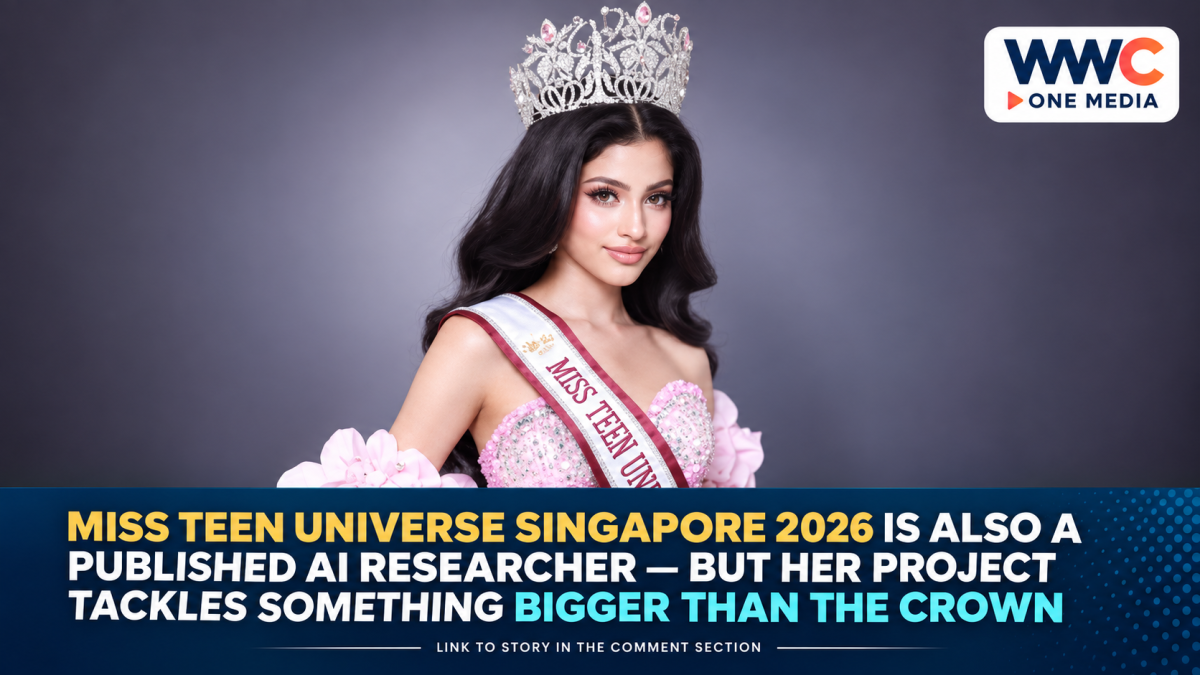
SINGAPORE — At first glance, Riona Krishnan Dighe’s résumé reads like it belongs to several different people.
She is 18 years old. She holds the title Miss Teen Universe Singapore 2026. She has pursued modelling across major fashion capitals. She has raised money for charitable causes. And behind the gowns, runway training and pageant appearances is another achievement that is far less typical of the beauty-queen stereotype: published research examining whether artificial intelligence could help measure a country’s happiness.
Now, she is preparing to represent Singapore on the international stage at Miss Teen Universe 2026 in Cambodia, where the official competition schedule runs from October 19 to 26, with the final show slated for October 25.
But the crown may only be one chapter of her story.
From Fashion Week to Miss Teen Universe Singapore
According to AsiaOne and the original Wonderwall profile, Dighe’s interest in pageantry started years before she won her current Singapore title.
She grew up watching Miss Universe with her mother and grandmother and eventually moved into modelling. Her reported fashion journey has included appearances connected with Fashion Weeks in New York, London, Milan and Paris. She previously held the title Miss Teen London 2024 and finished as first runner-up at Miss Teen Universe UK 2025.
Her 2026 international pageant campaign is demanding considerably more than simply appearing on stage.
Dighe told Wonderwall that she is spending around three to four hours a day on catwalk training, alongside fitness, speech and media preparation. For the talent component, she is learning a traditional Peranakan dance, which she hopes will give an international audience a window into Singapore’s cultural heritage.
CNA has also described the 18-year-old as both an AI researcher and education-equity advocate, while noting the comprehensive training programme she is undergoing ahead of the Cambodia finals.
But the surprising part of her résumé is AI
Dighe’s work in artificial intelligence is more substantial than simply having an interest in the technology.
A paper under her name, “The Use of AI to Measure Gross National Happiness,” appears in the November 2024 edition of the International Journal of High School Research. The journal lists her affiliation as Cheltenham Ladies’ College in the United Kingdom.
Her research explored whether existing artificial-intelligence tools could offer an alternative way of analysing Gross National Happiness, or GNH, the development philosophy closely associated with Bhutan.
Rather than asking an AI system to decide whether an entire nation is “happy”, Dighe’s project used natural language processing and sentiment analysis to examine whether information from sources such as online text, social media and news content could supplement traditional survey-based measurements.
That distinction matters.
Her World reported that the intention was not to have artificial intelligence define happiness for people, but to investigate whether technology could make information gathering more efficient and provide policymakers with another way of understanding communities.
Her research tested four different approaches
The published paper says the project examined four classification approaches: a multi-layer perceptron classifier, decision tree, linear model and K-nearest neighbours.
In the test described in the paper, the multi-layer perceptron approach produced the strongest result among the four models. The work also incorporated a pilot application involving Bhutan.
Dighe said the idea developed partly because she had visited Bhutan from a young age through charitable activities and became fascinated by the country’s Gross National Happiness framework.
She later presented her work in Bhutan, including to the Centre for Bhutan and GNH Studies, according to biographical material published with the research.
So while “AI researcher” makes for an attention-grabbing description, the more precise story is arguably more interesting: a teenager used established AI techniques in a student research project to test whether technology could complement traditional methods of assessing national well-being.
She also has a warning about AI
Perhaps unexpectedly for someone who has spent years researching an AI application, Dighe is not arguing that artificial intelligence should replace human thinking.
She told Wonderwall that AI can improve productivity and save time but warned young people against becoming excessively dependent on it.
Her argument is essentially that technology should remain a tool — while the ability to think independently could become increasingly valuable in a world where AI systems are everywhere.
That stance gives her story an unusual contrast: the teenager experimenting with AI is also cautioning her generation not to outsource too much of its thinking to machines.
The advocacy started before the pageant crown
Dighe’s public-service activities also predate Miss Teen Universe Singapore.
She says she became involved in charity work when she was around 11. Independent fundraising pages provide evidence of some of those efforts.
A JustGiving campaign organised in her name raised £20,000 to support a not-for-profit school in rural Punjab, India, following difficulties caused by the COVID-19 pandemic. Another fundraiser for UK children’s palliative-care charity Together for Short Lives recorded £12,406 in donations.
A post from Cheltenham Ladies’ College principal Eve Jardine-Young said Dighe had raised more than £30,000 across charitable causes over several years.
Those activities help explain why Dighe appears to view pageantry as more than a beauty competition.
For her, the title offers a bigger audience for causes she was already pursuing.
There is still an ordinary 18-year-old behind the résumé
Yet one of the more revealing parts of the Wonderwall profile is how normal parts of Dighe’s life remain.
She likes desserts, listens to Taylor Swift and wants time with her friends. She acknowledged that one of her biggest challenges is balancing modelling, pageant preparation and academic ambitions with simply experiencing life as an 18-year-old.
She recently completed her A-Levels at Cheltenham Ladies’ College and, according to Wonderwall, plans to attend University College London to study business.
That balancing act may ultimately be more central to her public image than any attempt to fit the traditional mould of a beauty queen.
Singapore’s representative heads to Cambodia
The next major test comes in October.
The official Miss Teen Universe website lists the 2026 competition week in Cambodia from October 19 to 26, including interviews, rehearsals, national costume and preliminary rounds before the October 25 final show.
Dighe will arrive with the conventional tools of a pageant contestant — runway training, presentation skills and a carefully prepared talent segment.
But she will also carry an unusually varied résumé: international modelling, education advocacy, charitable fundraising and published student research involving artificial intelligence.
Whether any of that leads to the international crown will be decided in Cambodia.
The more interesting question may be what happens afterward.
Because at just 18, Dighe is already trying to prove that a young woman does not have to choose between the runway and research, or between pageantry and technology.
And if her journey so far is any indication, Miss Teen Universe may turn out to be only the most visible part of a much bigger story.




Leave a Reply