
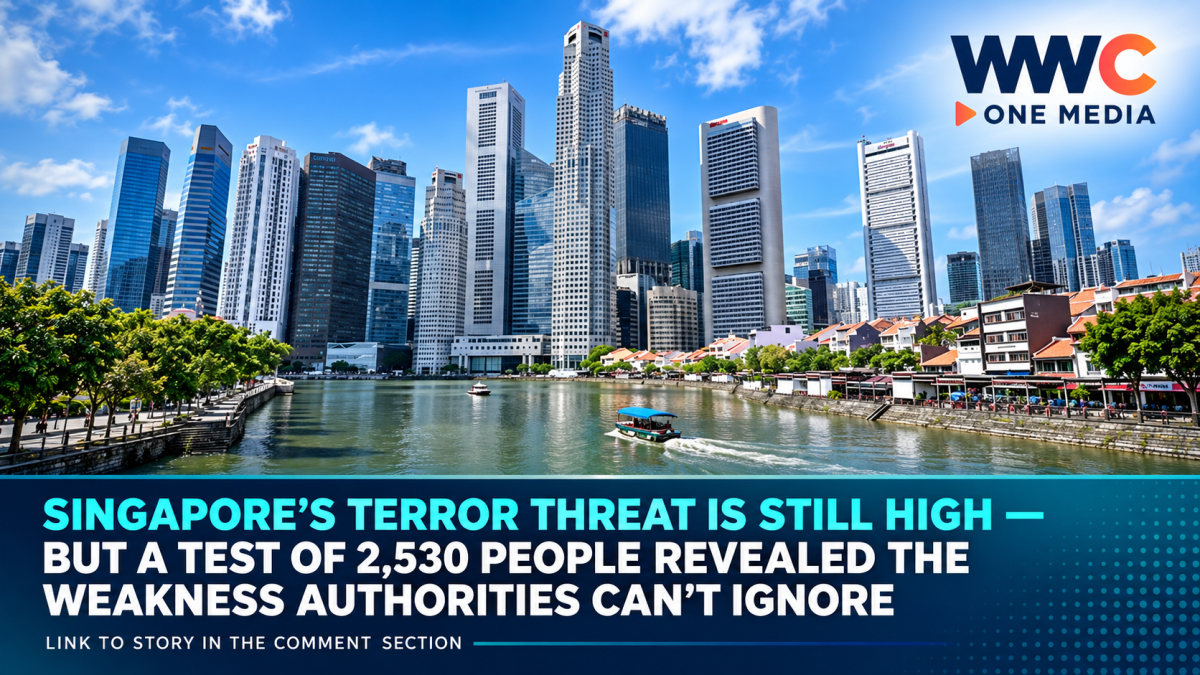
SINGAPORE — Singapore has spent a decade teaching residents how to recognise and respond to terrorism. But as SGSecure marks its 10th anniversary, one uncomfortable question is moving to the centre of the country’s security debate: Would people actually know what to do — and act — when a real attack unfolds?
The concern is no longer theoretical.
Singapore’s Internal Security Department said in its latest terrorism assessment that the country continues to face a high terrorism threat, driven largely by online self-radicalisation, overseas conflicts and an increasingly fragmented extremist landscape. At the same time, authorities stressed that there is currently no specific or credible intelligence pointing to an imminent attack on Singapore.
What worries security officials and psychologists is the gap between knowing there is a threat and taking decisive action when something suspicious actually happens.
A Singapore Experiment Revealed a Striking Awareness Gap
In June 2025, the Ministry of Home Affairs staged controlled SGSecure experiments at Our Tampines Hub and near Bishan Community Club.
One scenario involved suspicious luggage designed to resemble a concealed explosive device. Another featured a badly parked vehicle containing visible gas cylinders, with smoke periodically coming from the boot.
A total of 2,530 people passed the suspicious objects.
Only 17.3% noticed them, according to MHA.
More strikingly, among those who noticed something unusual, only about 5.9% — 26 people — intended to alert or actually alerted the authorities. Most simply moved on.
The finding contrasted sharply with a previous SGSecure public-perception survey in which 88% of respondents said they would contact authorities if they encountered suspicious behaviour or objects, according to reporting by AsiaOne citing MHA.
That difference highlights what psychologists describe as an “intention-action gap”: people may genuinely believe they would act during an emergency, but their behaviour can change when faced with an ambiguous real-world situation.
Psychological barriers can include uncertainty over whether something is actually dangerous, fear of overreacting, concern about making a false report, or the assumption that somebody else will take responsibility.
Singapore Wants People to Move Beyond Fear
Home Team psychologists say preparing for terrorism is not simply about making people afraid of possible attacks.
Jasmine Tan, assistant director of MHA’s Home Team Psychology Division, told CNA that psychological preparedness involves giving people enough knowledge and confidence to respond rather than freeze.
That includes understanding what an attack could look like, knowing how to report danger, evacuating safely and being prepared to help others where appropriate. Emotional preparation is also important so people can function under extreme stress rather than panic.
The broader SGSecure strategy reflects that approach.
Its three central messages are to Stay Alert, Stay United and Stay Strong, encouraging residents to recognise suspicious activity, protect social cohesion after an attack and build the resilience needed to recover from a crisis.
In March 2026, MHA refreshed the campaign under the banner “Play Your Role”, shifting more of its emphasis from simply knowing about terrorism to taking practical action. Interactive roadshows and educational programmes are being used to teach people how to recognise radicalisation, react to attacks and develop emergency-response skills.
Why the Concern Is Growing: More Young People Are Being Radicalised
The renewed push comes as Singapore confronts a changing domestic extremist threat.
According to ISD’s Singapore Terrorism Threat Assessment Report 2026, eight Singaporeans were dealt with under the Internal Security Act since July 2025.
Seven were assessed to have been self-radicalised.
Six of the eight were younger than 21.
The longer-term trend is even more striking.
ISD recorded just four youth ISA cases between 2017 and 2021. Since 2022, the number has risen to 15. Authorities say online platforms, social media and gaming environments can expose young people to extremist propaganda, violent imagery and communities that may gradually normalise violence.
ISIS propaganda continues to feature prominently, but officials are also seeing people combine ideas from several extremist movements.
ISD calls this Composite Violent Extremism, or CoVE — sometimes described previously as “salad bar” extremism — in which individuals mix elements of ideologies that may even contradict one another, including Islamist extremism, far-right beliefs, antisemitism, racial supremacy, accelerationism and incel-related ideas.
The 14-Year-Old Case Showed How Close the Threat Could Come
One recent case has become a stark example of the danger.
A 14-year-old Singaporean student detained by ISD had drawn up a 21-page manifesto and was preparing to conduct a mass-casualty stabbing at his secondary school during the June 2026 school holidays.
Authorities arrested him in May — only weeks before the planned attack.
He had been exposed to multiple extremist influences online and had recreated violent attacks in video games. According to ISD, personal grievances, including bullying and academic stress, also became intertwined with his extremist worldview.
Two other self-radicalised youths detained separately this year had also made preparations for violence, reinforcing ISD’s warning that youth radicalisation is not merely an online ideological problem — in some cases, it can progress toward concrete attack planning.
Psychological First Aid Could Become Part of the Security Response
Singapore’s preparedness strategy also extends beyond stopping an attack.
Home Team psychologists argue that a major terrorist incident can inflict psychological damage far beyond people physically present at the scene.
Family members, witnesses, emergency personnel and even people repeatedly exposed to disturbing footage and misinformation online can experience distress.
MHA therefore sees value in psychological first aid, where ordinary people can learn basic ways to assess immediate emotional needs, listen to those affected and connect them with relatives or professional support.
Dr Diong Siew Maan, director of the Home Team Psychology Division, told CNA that there simply would not be enough psychologists or counsellors to personally reach everyone during a large-scale crisis, making community-level psychological skills increasingly valuable.
First responders themselves also need psychological support. Police, civil defence personnel and other Home Team officers may encounter injured colleagues, children or traumatic scenes even when they are professionally trained to handle emergencies.
Another Threat Can Arrive Seconds After an Attack: Misinformation
Modern terrorism also creates a second battlefield online.
False reports, rumours, manipulated images and unverified claims can spread across social media faster than authorities can confirm what actually happened.
Home Team psychologists warn that this can amplify public fear and force emergency agencies to manage both the incident itself and the rapidly developing information vacuum surrounding it.
SGSecure therefore advises people to rely on official information during a security crisis and avoid spreading unverified claims.
The Bigger Question After 10 Years of SGSecure
Singapore is not starting from zero.
SGSecure has spent a decade building public awareness, teaching emergency responses and strengthening community resilience.
But the 2025 experiment suggests awareness alone may not be enough.
When more than 2,500 people were quietly tested in ordinary public spaces, only a fraction recognised suspicious warning signs — and an even smaller number moved toward reporting them.
That matters at a time when Singapore’s latest security assessment says self-radicalisation remains the key domestic terrorism threat and younger people are increasingly appearing in ISA cases.
Singapore has so far succeeded in disrupting serious plots before they could be carried out. But officials repeatedly stress that intelligence agencies cannot be everywhere.
The next phase of SGSecure may therefore depend less on whether Singaporeans have heard the security message — and more on whether they can overcome hesitation and act when something does not look right.
Because if a genuine attack ever comes, the most important test will not be what people said they were prepared to do.
It will be what they actually do in the first few minutes.


Leave a Reply