
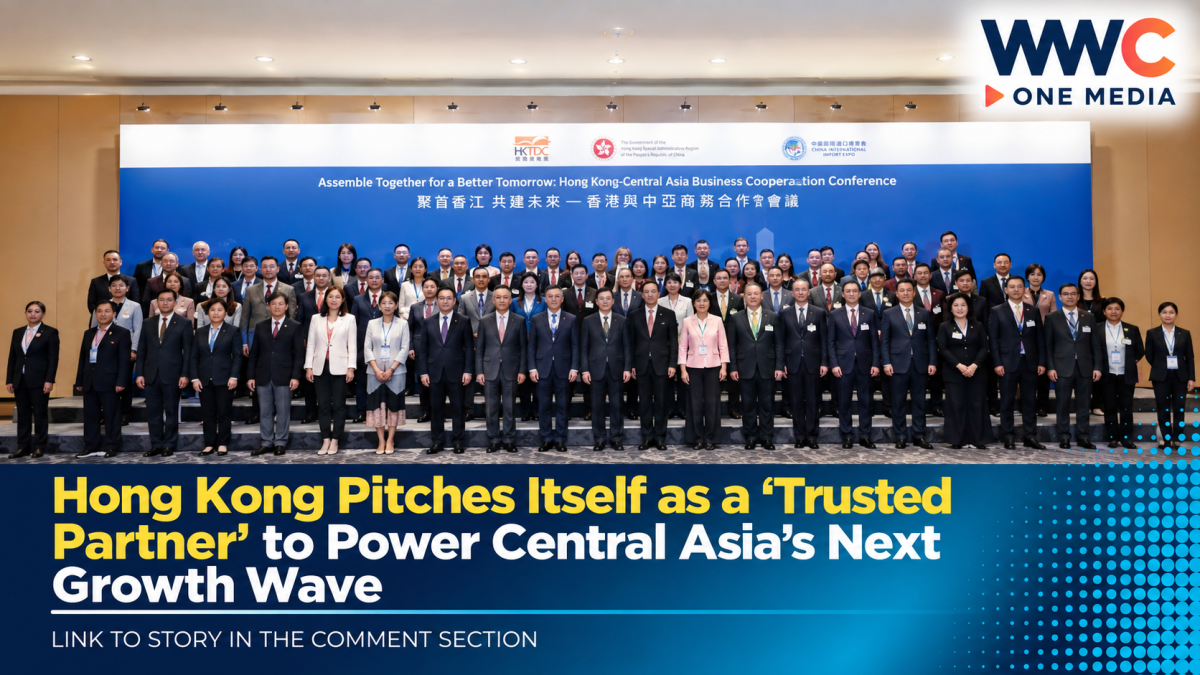
ASTANA, Kazakhstan — Hong Kong Chief Executive John Lee has positioned the city as a “trusted partner” and strategic gateway for Central Asia, saying Hong Kong is ready to help businesses tap into one of the world’s fastest-emerging regions for trade, investment and cross-border growth.
Speaking virtually at the South China Morning Post China Conference: Central Asia 2026 in Astana on Sunday, Lee said the region offered enormous potential and that Hong Kong could provide the financial, legal and professional services needed to connect Central Asian markets with mainland China and the wider world.
The message marks Hong Kong’s latest effort to deepen ties with Kazakhstan, Uzbekistan and other Central Asian economies as Beijing expands economic links across the region.
Why Central Asia Is Suddenly a Bigger Priority
Central Asia has become increasingly important to China and international businesses because of its strategic location between Asia and Europe, its natural resources and its potential as a major trade and transport corridor.
The region includes Kazakhstan, Uzbekistan, Kyrgyzstan, Tajikistan and Turkmenistan.
For Hong Kong, the opportunity lies in becoming the service hub connecting capital, companies and expertise across these markets.
Lee said Hong Kong’s international networks, financial system and professional services could help businesses identify opportunities and manage the complexities of expanding across borders.
The city’s government has increasingly promoted Hong Kong as both a “superconnector” between mainland China and global markets and a “super value-adder” for companies seeking financing, legal services and international partnerships.
From Finance to Legal Services, Hong Kong Wants a Bigger Role
Hong Kong is pitching a broad range of services to Central Asian companies and investors.
These include:
- International finance and capital markets
- Legal and dispute-resolution services
- Trade and investment facilitation
- Asset and wealth management
- Infrastructure financing
- Professional and business services
The strategy is designed to make Hong Kong more than simply a gateway into China.
Officials want the city to become a platform through which mainland Chinese companies can expand into Central Asia — while Central Asian companies can use Hong Kong to access capital and international markets.
John Lee’s Central Asia Mission Is Already Producing Deals
The latest conference follows Lee’s major visit to Kazakhstan and Uzbekistan in June, when he led a large Hong Kong and mainland Chinese business delegation to the region.
According to Invest Hong Kong, the mission involved 75 senior executives and resulted in 96 cooperation agreements and memorandums of understanding worth more than US$1.65 billion. The agreements covered areas ranging from investment and mineral resources to technology and other commercial sectors.
The scale of the agreements highlighted how seriously Hong Kong is taking its Central Asia strategy.
Lee’s government has argued that the city can provide the services needed to turn political and diplomatic connections into long-term commercial projects.
Kazakhstan Is Becoming a Key Entry Point
Astana’s selection as the location for the SCMP’s first China Conference in Central Asia is also significant.
Kazakhstan is China’s largest trading partner in Central Asia and has become increasingly important as a transport and investment hub.
Its position along major routes linking China with Europe has made the country strategically important to Beijing’s broader Belt and Road ambitions.
The Astana International Financial Centre, which co-hosted the conference, is also seeking to strengthen its role as a regional financial hub.
That creates a natural area for cooperation with Hong Kong, one of Asia’s most established international financial centres.
Hong Kong Sees a New Economic Opportunity Beyond Traditional Markets
Hong Kong’s Central Asia push comes as the city searches for new sources of economic growth.
Lee recently identified financial services, innovation and technology, and education as three major growth drivers that will shape Hong Kong’s first five-year development blueprint.
The government is also pursuing new initiatives in commodities trading, gold clearing, innovation and the Northern Metropolis development.
Expanding links with Central Asia fits directly into that strategy.
The region offers opportunities in:
- Energy and natural resources
- Infrastructure
- Financial services
- Logistics and transport
- Technology
- Green development
- Digital industries
- Education and professional services
For Hong Kong, stronger links could create new business opportunities at a time when companies across Asia are increasingly looking beyond traditional Western markets.
The Belt and Road Strategy Is Moving Into a New Phase
The growing focus on Central Asia also reflects changes in China’s Belt and Road Initiative.
The emphasis is increasingly shifting toward investment, technology, trade corridors and higher-value economic cooperation.
Hong Kong is seeking to position itself at the centre of that evolution.
The city’s upcoming Belt and Road Summit will specifically highlight new cooperation opportunities involving ASEAN, Central Asia and the Middle East, reflecting growing interest in connecting these regions through investment and business partnerships.
A recent Hong Kong Trade Development Council survey also found strong interest among mainland enterprises in overseas expansion, with Belt and Road markets emerging as the preferred destination for many companies. Hong Kong was identified as the preferred service platform by a large share of surveyed businesses planning international growth.
Can Hong Kong Become Central Asia’s Global Business Bridge?
That will be the biggest test of Lee’s strategy.
Hong Kong has well-established strengths.
It has a freely convertible currency, deep capital markets, an international legal system and extensive experience handling cross-border business.
But Central Asia is also becoming increasingly competitive.
Countries across the Middle East, Europe and Asia are seeking stronger commercial relationships with Kazakhstan and its neighbours.
Hong Kong will need to demonstrate that it can offer something competitors cannot.
Its strongest argument may be its unique position.
Hong Kong can connect international businesses with mainland China while also helping Chinese companies navigate global markets.
That two-way role could become increasingly valuable as companies look for new trade routes, investment destinations and supply-chain partners.
A ‘Trusted Partner’ in a Changing Global Economy
Lee’s message in Astana was ultimately about confidence.
Central Asia is emerging as a region where governments and businesses are looking for investment, infrastructure and international partnerships.
Hong Kong wants to be part of that growth story.
The city is not trying to replace Central Asia’s own financial centres or business hubs.
Instead, it is presenting itself as a partner capable of bringing together Chinese capital, international expertise and Central Asian opportunities.
The real question is whether Hong Kong can turn its reputation as a global financial hub into long-term influence across one of Eurasia’s most strategically important regions.
For now, the momentum is building.
After a US$1.65 billion wave of agreements, high-level visits and a growing calendar of Central Asia-focused events, Hong Kong is making its intentions clear:
It does not just want to watch Central Asia’s economic rise. It wants to help finance it, connect it and profit from it.
WWC ONE MEDIA J.M.D



Leave a Reply