
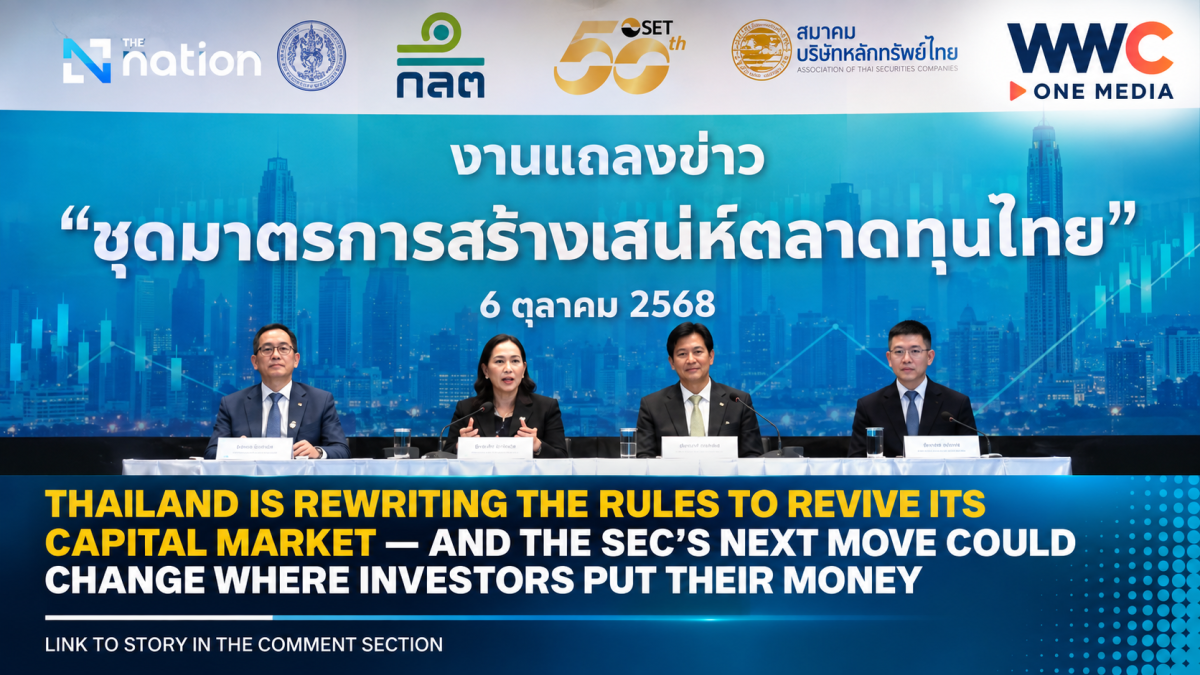
BANGKOK — Thailand is moving to strengthen its domestic capital market as regulators confront slowing IPO activity, a narrower investor base and growing competition from other Asian financial centres.
The Securities and Exchange Commission (SEC) is accelerating a package of reforms designed to bring more companies and investors into Thailand’s capital markets, while using digital technology to make investing more accessible.
The push includes faster IPO approvals, incentives for “New Economy” companies, a new long-term savings account for Thai investors and the expansion of tokenized financial products. Recent announcements from the SEC and the Stock Exchange of Thailand (SET) show that the effort is becoming one of the country’s major financial-policy priorities.
Why Thailand is moving now
Thailand’s SEC has acknowledged that the country’s capital market faces structural challenges.
Its 2026–2028 strategic plan says Thailand has experienced a slowdown in fundraising through the capital market, particularly in IPOs, while the country’s representation in the MSCI Asia ex-Japan Index has declined significantly since 2022.
The regulator’s stated strategy is built around “Building Trust, Powering Growth”, with competitiveness, investor confidence, digital technology and long-term investment identified as key priorities.
The objective is not simply to increase trading activity.
The SEC wants to make Thailand’s capital market more attractive to companies seeking financing, encourage more citizens to invest for the long term and create new investment products without weakening investor protection.
IPO approvals could get much faster
One of the most immediate reforms involves the country’s IPO process.
The SEC and SET are working to reduce the time required to review and approve IPO applications.
Thairath Money reported that the SEC is targeting a reduction from an average of 147 days to around 70–100 days, while other Thai business reports have cited an ambition to bring the review period down further in some circumstances. The important point is that the regulator is attempting to make the process substantially faster while retaining qualification and disclosure requirements.
The reform comes as Thailand attempts to attract businesses from industries that have historically been less represented on the local exchange.
These include technology, biotechnology, digital businesses, advanced manufacturing and other emerging industries.
The SET has also introduced revised listing rules aimed at attracting companies in 10 New Economy sectors, including a more streamlined pathway for qualifying companies and foreign corporations seeking a secondary listing. The revised framework took effect on September 11.
Thailand wants the next generation of companies on the SET
The strategy reflects a broader concern: Thailand’s stock market needs more exposure to high-growth industries.
The SEC’s own strategic plan notes that technology companies in other Asian markets make significant use of IPOs and secondary offerings to raise capital, while Thailand’s technology-related fundraising remains comparatively limited.
To address that gap, the SEC and SET are developing an IPO Sandbox for New Economy businesses.
Three companies are currently being prepared for the pilot, with their filings expected to enter the pipeline between October and December, according to Thairath Money.
The government is also connecting the capital-market push with Thailand’s Board of Investment (BOI) and Eastern Economic Corridor (EEC) programs, creating a pathway for investment-promotion projects to eventually access the stock market.
The bigger bet: getting more Thais to invest
Thailand’s capital-market problem is not only about companies.
It is also about demand.
The SEC is advancing the Thailand Individual Savings Account, or TISA, a proposed savings-and-investment structure intended to encourage people to shift some money from traditional deposits toward longer-term investments.
The concept is designed around “one account, two purposes”: retirement savings and investment for individuals and minors.
The SEC says the program could help expand the country’s investor base, which Thairath reported currently has fewer than one million active stock-trading accounts.
The SEC has submitted TISA proposals to the Cabinet and is targeting tax benefits beginning in the 2027 tax year, subject to the necessary policy and legislative processes.
That could become one of the most consequential parts of the reform package.
If successful, TISA could transform household savings into a larger pool of domestic investment capital.
Thailand is also going digital
The SEC’s capital-market overhaul is moving beyond traditional stocks and bonds.
Thailand is preparing to expand tokenization, in which traditional financial assets can be represented digitally.
The SEC is promoting tokenized funds and has said its first tokenized money-market fund could launch around late September or early October.
Thairath Money reported that the proposed product could use tokenization to allow real-time T+0 redemption, compared with the traditional T+1 waiting period for money-market-fund redemptions.
The SEC is also pushing legislation to establish a broader legal framework for electronic securities.
Importantly, tokenization does not necessarily mean creating an entirely new class of cryptocurrency.
The SEC has explained that digital securities can represent securities already recognized under Thai securities law — such as shares, debt securities or investment units — but issued and transacted electronically.
The law itself is being rewritten
Thailand’s Cabinet approved four draft capital-market laws in August, covering areas including:
- digital capital markets;
- securities and derivatives businesses;
- secondary-market operations;
- fundraising;
- audit-firm supervision; and
- stronger law enforcement.
The SEC said the legislation is intended to modernize Thailand’s regulatory framework and improve the efficiency and competitiveness of the capital market.
That means the current reforms are broader than simply changing IPO paperwork.
Thailand is effectively attempting to redesign parts of the infrastructure through which businesses raise money and investors participate.
Investors are already being given more international choices
The push is happening alongside another major change at the SET: expanding access to overseas investments.
Reuters reported that the Thai exchange planned to list 28 new depositary receipts linked to international stocks and ETFs, including companies from Asia, the United States and Europe.
The lineup includes names such as Dell, Intel, Palantir and Airbus, as well as Chinese semiconductor companies.
The move gives Thai investors easier access to international companies without necessarily having to establish direct overseas brokerage arrangements.
It also highlights the competitive pressure facing Thailand’s exchange.
Local investors increasingly have access to global markets, meaning Thailand’s own stock market needs to offer compelling companies, products and investment opportunities if it wants to retain domestic capital.
What this means for Thailand
The SEC’s strategy is ultimately an attempt to tackle both sides of the market.
Supply: Bring more high-growth companies onto Thai exchanges and make fundraising faster.
Demand: Encourage more Thai citizens to become long-term investors.
Technology: Introduce digital securities and tokenized products.
International competitiveness: Make Thailand more attractive to domestic and foreign issuers while giving local investors broader investment choices.
Investor protection: Strengthen disclosure, corporate governance and enforcement alongside the reforms.
The SEC’s strategic plan specifically identifies stronger corporate governance, improved disclosure and more effective law enforcement as central to restoring confidence.
But faster does not automatically mean better
There is an important catch.
Thailand’s challenge is not simply getting more companies listed or making IPO approval quicker.
A stronger capital market ultimately depends on quality companies, credible disclosures, investor confidence and sufficient liquidity.
If regulatory processes become faster without maintaining rigorous screening and enforcement, the reforms could create new risks.
That is why the SEC has repeatedly stressed that streamlining IPOs does not mean abandoning investor safeguards.
The bigger question
Thailand is now attempting something much larger than an IPO makeover.
It is trying to change the way Thai households save, how companies raise capital and how investors access financial products — all while making the country’s capital market more competitive with Singapore and other regional exchanges.
The coming months will provide an important test.
If TISA gains momentum, New Economy companies begin entering the IPO pipeline and tokenized funds attract investors, Thailand could start building a broader and more technology-driven capital market.
But if investors remain cautious and high-growth companies continue looking overseas for capital, the reforms could face a much harder road.
Thailand has changed the rules. Now comes the real test: will investors and the next generation of companies choose to stay?



Leave a Reply