
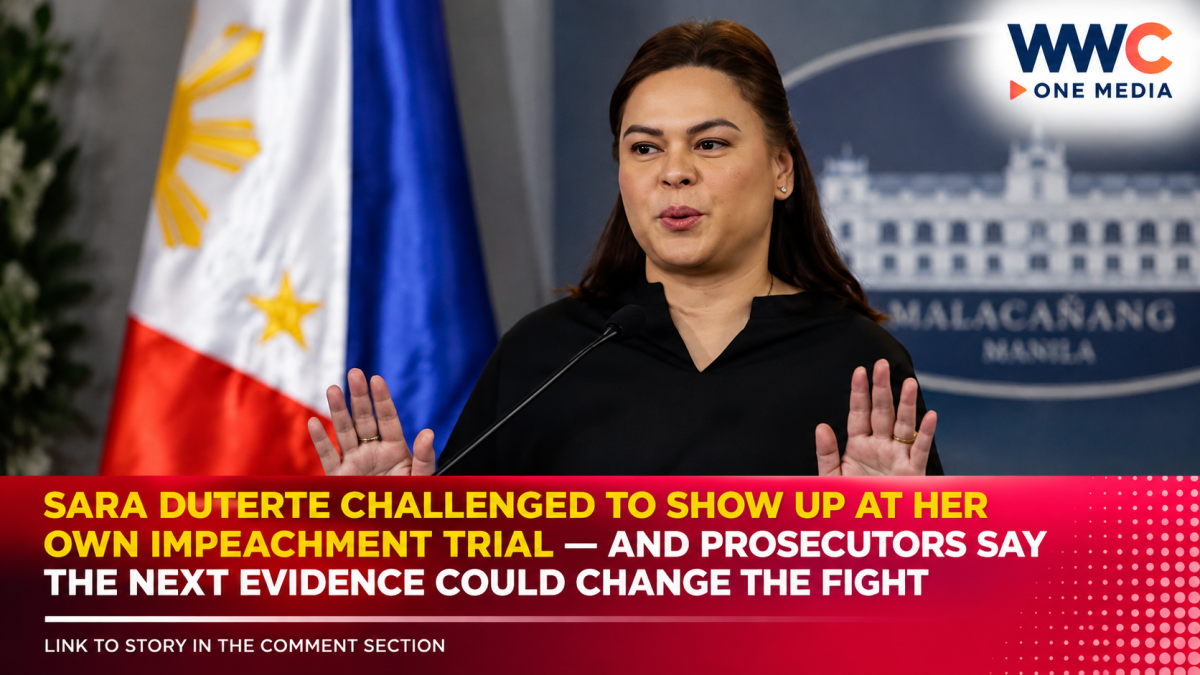
MANILA, Philippines — The impeachment battle involving Vice President Sara Duterte is entering another critical phase, with a House prosecutor publicly challenging her to personally appear before the Senate impeachment court on Monday as prosecutors prepare to present evidence concerning allegations of unexplained wealth.
House impeachment prosecutor and Bicol Saro party-list Rep. Terry Ridon issued the challenge on Saturday, September 12, after Duterte criticized the impeachment proceedings and described the complaints against her as baseless.
Ridon rejected her claim that the prosecution had failed to produce evidence.
“It is not true that there is no evidence presented,” Ridon said at the Saturday News Forum, according to GMA News.
He then directly challenged the Vice President to attend the proceedings.
“If she could show up” for the separate grave-threats case against her, Ridon argued, she could also appear before the impeachment court.
The prosecutor’s challenge comes as the House panel prepares to shift its focus to Article 2 of the impeachment case, which concerns allegations of unexplained wealth and questions surrounding Duterte’s financial disclosures.
Prosecutors are preparing a new round of evidence
The prosecution is scheduled to present evidence on Duterte’s alleged unexplained wealth when the impeachment trial resumes Monday.
Among the witnesses expected are retired Sandiganbayan Presiding Justice Amparo Cabotaje-Tang, Ombudsman Records Division officer-in-charge Karen Batu and Securities and Exchange Commission Company Registration and Monitoring Department Director Gerardo del Rosario, according to GMA News.
The prosecution has said Cabotaje-Tang will testify on principles involving public accountability, integrity in public office and mechanisms for addressing undisclosed or unexplained wealth and prohibited business interests.
The Ombudsman and SEC witnesses are expected to provide documentary and institutional evidence relevant to the allegations.
The prosecution has also retained the possibility of calling Manases Carpio, Duterte’s husband, as a hostile witness in connection with the wealth allegations, according to ABS-CBN News.
Why prosecutors want Sara Duterte herself on the witness stand
The push for Duterte’s personal appearance began earlier this week when the House prosecution panel said it intended to present the Vice President as a witness.
Private prosecutor Lorna Kapunan said the prosecution had decided to forgo its remaining 15 witnesses for Article 1, which deals with the alleged misuse of P612.5 million in confidential funds, and instead wanted Duterte herself to answer questions.
The prosecution has argued that Duterte’s subordinates had already testified about her knowledge of how the confidential funds were spent and that the Vice President herself should have an opportunity to explain the allegations.
House prosecutor Joel Chua subsequently characterized the proposal as part of due process, saying Duterte could answer questions from the senator-judges and the public.
But Duterte’s defense has strongly objected.
Defense: Sara cannot be forced to testify against herself
Duterte’s lead defense counsel, Sheila Sison, argued that the Vice President cannot be compelled to testify against herself.
Sison invoked Article III, Section 17 of the 1987 Philippine Constitution, which provides that no person shall be compelled to be a witness against themselves.
The defense also argues that Duterte is already participating in the proceedings through her lawyers.
This creates a major legal question for the impeachment court: Can the prosecution compel the respondent herself to take the witness stand, or is appearing and testifying ultimately her choice?
As of the latest reporting, the impeachment court had not yet ruled on a formal prosecution request to subpoena Duterte as a witness.
Impeachment court spokesperson Regie Tongol said oral arguments could potentially be held if prosecutors formally seek such a subpoena, given the opposing positions of the prosecution and defense.
Duterte has already called the impeachment case baseless
The latest confrontation followed Duterte’s public criticism of the impeachment proceedings after she appeared at the Quezon City Hall of Justice for her separate grave-threats case.
She has repeatedly denied wrongdoing and characterized the cases against her as politically motivated.
Ridon, however, argued that the existence of the Senate trial itself demonstrates that the allegations are being formally tested through evidence and proceedings rather than simply being dismissed.
He challenged Duterte to appear before the Senate impeachment court when the prosecution begins presenting its evidence on unexplained wealth.
The impeachment case has four major allegations
Duterte is facing four articles of impeachment involving allegations concerning:
- misuse of confidential funds;
- unexplained wealth;
- bribery involving Department of Education officials; and
- grave threats involving President Ferdinand Marcos Jr. and members of his family.
The House impeached Duterte on May 11, 2026, by a vote of 257-25, with nine abstentions, sending the Articles of Impeachment to the Senate for trial.
The Senate impeachment trial began in July.
The prosecution has since presented witnesses and documentary evidence concerning the different articles, including testimony related to the confidential funds and the allegations involving threats against Marcos.
Another battle is brewing over the conviction threshold
The courtroom fight is unfolding alongside a separate dispute over how many senator-judges are required to convict Duterte.
The Senate impeachment court’s initial ruling interpreted the constitutional requirement of a two-thirds vote as 16 of the 24 senators.
But the issue has become increasingly contentious because of changes in the number of senators available to participate in the proceedings.
The impeachment court recently clarified that 10 senator-judges could potentially overturn the earlier 16-vote ruling, while Presiding Officer Francis Escudero would not vote on the threshold issue because he issued the original ruling.
House prosecutors have said their focus remains on building a case strong enough to survive whatever threshold is ultimately adopted.
Philippine Star reported earlier that prosecution counsel Benjamin Tolosa Jr. said the panel’s priority was to establish an “airtight case” rather than engage in vote counting.
The stakes for Duterte are enormous
A conviction in the impeachment case could remove Duterte from the vice presidency and impose the constitutional penalty associated with impeachment.
The proceedings are therefore not merely another political confrontation between Duterte and the administration of President Marcos.
They could have major consequences for the country’s political landscape, particularly given Duterte’s status as one of the country’s most prominent political figures and her previously anticipated political ambitions.
At the same time, the prosecution’s allegations remain allegations being tested in an impeachment proceeding. They should not be presented as established criminal findings unless and until a competent authority makes such a determination.
The bigger question: Will Sara Duterte finally take the stand?
That is now becoming one of the most closely watched questions in the impeachment trial.
The prosecution says Duterte should personally explain the allegations against her.
Her defense maintains that she cannot constitutionally be forced to testify against herself.
And on Monday, the spotlight shifts again to the evidence concerning her alleged unexplained wealth.
For the prosecution, it is an opportunity to strengthen what it describes as its case against the Vice President.
For Duterte’s defense, it is another opportunity to challenge the evidence, its admissibility and the legal basis of the accusations.
The bigger question is whether Sara Duterte will eventually walk into the impeachment courtroom herself — and, if she does, what questions the senator-judges will ask her.




Leave a Reply