
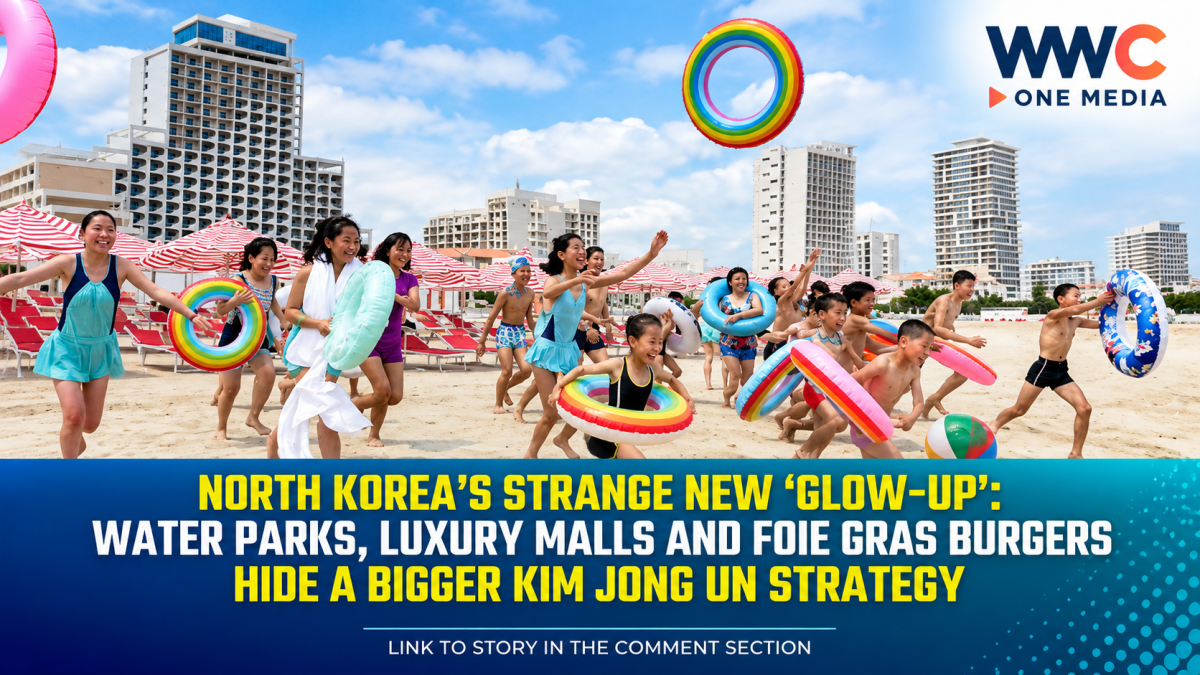
North Korea is pushing an unexpected new image: coffee bars, luxury shopping, water parks, beach resorts, pet shops and high-end restaurants are increasingly appearing alongside the country’s tightly controlled economy.
But behind the unusual consumer boom is a much bigger strategy by leader Kim Jong Un—one analysts say is designed not simply to give North Koreans more ways to spend money, but to pull more private wealth into state-controlled businesses and reduce the influence of informal markets.
The development was detailed in a Reuters investigation published Sept. 11 and republished by the South China Morning Post, which examined Chinese trade data, North Korean state media, verified social-media footage and interviews with recent visitors and defectors.
From deprivation to a state-sanctioned consumer culture
North Korea remains one of the world’s most isolated economies, but its consumer landscape has changed noticeably in recent years.
Chinese customs data reviewed by Reuters show that North Korea’s imports of massage equipment have increased about 40-fold over the past decade, while treadmill shipments have risen by more than 600%. Pianos, amusement equipment and bumper cars are also flowing into the country.
The expansion is visible in Pyongyang and other cities through new shopping complexes, cafés, restaurants, entertainment facilities, resorts and sports venues.
Reuters also found evidence of growing use of mobile payment and shopping applications resembling China’s Alipay, allowing consumers to make purchases electronically inside North Korea’s increasingly formalized retail system.
Foie gras burgers and luxury shopping
Some of the most eye-catching signs of the change are appearing in Pyongyang.
North Korean state media has described a new residential development featuring a gaming arcade, automobile dealership and a barbecue restaurant offering salmon belly and foie gras burgers.
At the Ryugyong Golden Plaza, which opened in 2023, Reuters found social-media footage showing shops displaying logos associated with luxury watch brands including Rolex, Omega and Herbelin.
However, the presence of those brands does not necessarily mean the companies officially operate stores in North Korea. Reuters reported that Omega and Herbelin said they have no official retailers or distributors in the country, while Rolex and Huawei did not comment.
That distinction is important because North Korea remains subject to extensive international sanctions, including restrictions involving luxury goods.
Kim Jong Un’s unusual pet-shop appearance
Another striking symbol of the changing consumer culture came in April, when Kim Jong Un visited a newly opened pet shop with his daughter, Kim Ju Ae.
State media images showed the pair looking at animals including puppies and kittens. The visit formed part of a broader pattern in which Kim has publicly promoted new leisure and consumer facilities.
The pet-shop appearance is notable not because pet ownership is entirely new in North Korea, but because it fits into a broader state campaign emphasizing consumption, leisure and a more affluent lifestyle for at least some sections of society.
Water parks and a giant beach resort
The biggest symbol of the transformation may be the Wonsan-Kalma Coastal Tourist Zone, a huge resort complex on North Korea’s east coast.
The resort officially opened in 2025 and was designed to accommodate as many as 20,000 visitors at a time. It includes hotels, villas, beaches and a large water park.
North Korean state media has portrayed the resort as a major achievement for Kim Jong Un.
Reuters reported that more than 300,000 domestic visitors reportedly went to Wonsan-Kalma during the second half of 2025, citing a post from China’s embassy in Pyongyang.
But independent observers have urged caution about interpreting official tourism claims.
NK News reported on Sept. 11 that the resort appeared to be winding down another relatively short summer season and that satellite imagery suggested authorities were using trips there in part as incentives or rewards for workers. The outlet also noted that North Korea remains largely closed to foreign tourists, apart from limited Russian tourism.
Foreign tourism remains heavily restricted
The resort’s development does not mean North Korea has suddenly become an open tourist destination.
The country imposed sweeping border restrictions during the COVID-19 pandemic and has only gradually allowed limited foreign tourism to resume.
The Wonsan-Kalma resort itself briefly attracted international attention after opening, but access for foreigners was suspended soon afterward. Russia has remained the most significant source of foreign visitors during the limited reopening.
A recent South Korean report on tourism conditions also noted that foreign visitors remain subject to strict controls, including guided movement and restrictions on independent activity.
China’s role could become increasingly important. Chinese-North Korean trade rebounded sharply in 2025, reaching near pre-pandemic levels, while transportation links between the two countries resumed in 2026.
Why Kim is encouraging people to spend
The most important part of the story is not the water slides or luxury burgers.
It is the money.
Analysts interviewed by Reuters argue that Kim’s government wants to channel wealth accumulated by North Koreans—particularly an emerging urban middle class—away from informal markets and toward businesses that can be monitored and controlled by the state.
That could give Pyongyang several advantages.
More consumption can stimulate domestic economic activity. State-controlled shops and leisure facilities can capture money that might otherwise circulate through unofficial markets. Electronic payments can also give authorities greater visibility into transactions.
Ruediger Frank, an East Asian economy professor at the University of Vienna, described the emerging situation as a middle class with substantial savings but limited places to spend them. Reuters reported that his assessment is that consumption can reduce frustration and generate domestic demand.
One analyst summarized the strategy with a particularly striking warning: consumption may buy the government time, but it does not guarantee permanent loyalty.
The economy is changing—but inequality remains
North Korea’s economic picture has also improved according to South Korean estimates.
The Bank of Korea estimated that North Korea’s economy expanded 3.5% in 2025, marking the third consecutive year of growth above 3%. The growth was attributed largely to increased economic cooperation with Russia, greater trade with China and state-led development projects.
But that does not mean prosperity is widespread.
A former North Korean resident interviewed by Reuters said many ordinary people remain excluded from the new restaurants and leisure facilities. The consumer boom is therefore concentrated among people with sufficient income and access to Pyongyang’s growing commercial infrastructure.
A new strategy behind the Kim regime’s ‘glow-up’
The images of cappuccinos, luxury malls, puppies and enormous water parks may look like a dramatic departure from the North Korea traditionally seen by the outside world.
But analysts say the transformation is more complicated.
Kim Jong Un appears to be building a state-managed consumer economy that allows selected citizens to enjoy greater access to leisure and luxury while simultaneously bringing more private spending into official channels.
That could strengthen the government’s grip over commerce while providing new sources of domestic economic activity.
And there is an important geopolitical dimension.
North Korea’s economy grew as its relationships with Russia and China deepened, while the country continued to face extensive international sanctions.
So the surprising sight of North Koreans riding water slides or shopping in luxury malls may represent more than a simple lifestyle change.
It could be part of Kim Jong Un’s attempt to reshape how money moves through one of the world’s most tightly controlled economies.
Leave a Reply