
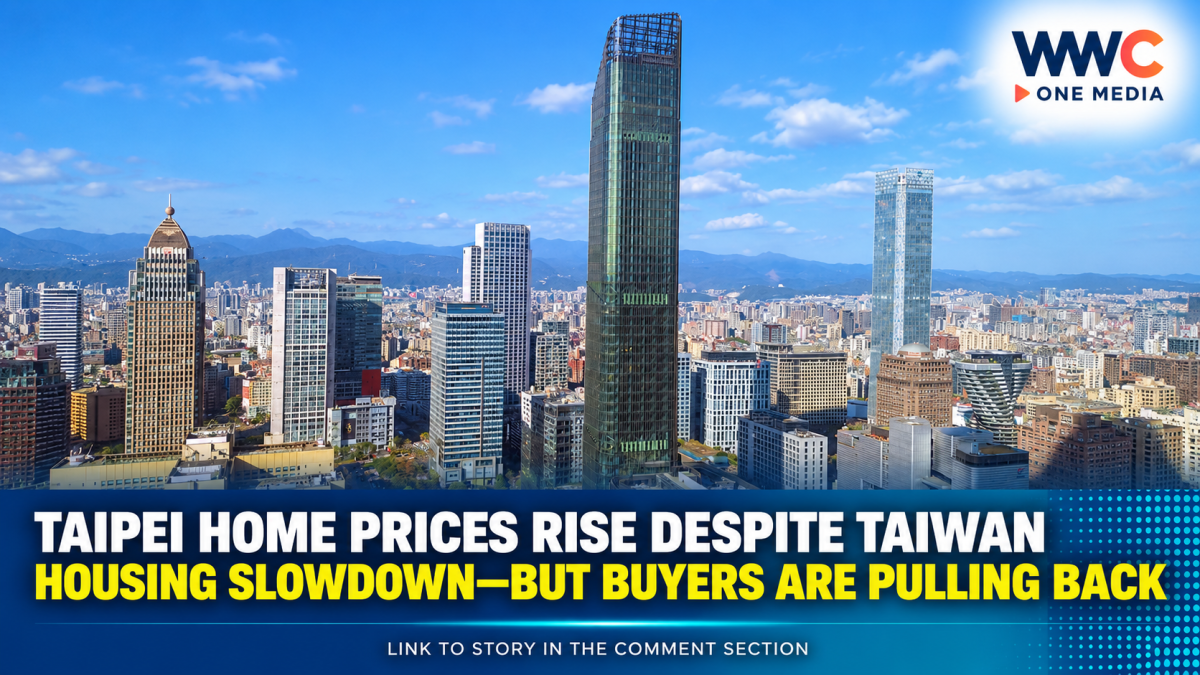
TAIPEI, Taiwan — Taiwan’s housing market is showing a striking divide: home transactions have fallen sharply, yet property prices in Taipei have remained resilient and even increased.
The latest figures show just how unusual the situation has become.
Taipei’s average residential transaction price reached NT$839,000 (about US$26,500) per ping, or roughly 3.3 square meters, in 2025—an increase of 2.69% from the previous year, according to Taipei City government data.
But at the same time, the number of residential transactions plunged 29.56% to 10,662, the lowest level recorded since 2013.
In other words, fewer homes are changing hands, but prices have not collapsed.
That disconnect is becoming one of the defining features of Taiwan’s housing market.
Taipei is bucking the broader slowdown
Across Taiwan, housing activity has weakened substantially following years of rapidly rising prices and tighter lending restrictions.
Nationally, the number of homes sold fell 25.5% year-on-year to about 261,000 in 2025, the lowest level in nine years, while Taiwan’s national housing price index subsequently declined from its late-2024 peak.
Taipei, however, has been more resistant to the downturn.
The capital’s average residential price continued climbing even as transactions collapsed.
That does not mean Taipei’s housing market is booming.
Instead, it suggests that owners and developers have been reluctant to make large price concessions, while buyers have become increasingly selective.
Fewer buyers, stubborn prices
The latest Taipei data reveal the unusual combination.
Residential transaction volume fell nearly 30% in 2025, while the average transaction price per ping increased 2.69%.
The average total price of a residential property also reached NT$29.53 million, a record high in the city’s historical series covered by the report, rising 3.83% year-on-year.
The city’s presale market showed an even sharper contraction.
Presale residential transactions fell 37.73%, while the average presale price per ping nevertheless increased 1.14%.
That suggests the market is not experiencing a simple supply-and-demand collapse.
Instead, buyers and sellers appear to be meeting only when properties, locations and prices are considered attractive enough.
Mortgage restrictions are changing who can buy
One of the biggest forces reshaping Taiwan’s property market is tighter mortgage access.
The Central Bank has maintained selective credit controls after years of rapid housing-price increases.
The bank’s latest assessment says housing transactions have slowed and price growth has eased, but affordability remains strained because housing prices have undergone substantial cumulative increases.
The central bank also noted that expectations for further housing-price increases remain subdued.
Yet prices have not fallen enough to restore affordability for many potential buyers.
That creates a difficult situation:
Buyers face tougher financing conditions, while sellers remain reluctant to cut prices dramatically.
Cash buyers are gaining an advantage
The changing mortgage environment is creating a particularly important divide between buyers who need financing and those who can pay largely with cash.
According to Sinyi Realty, cash purchases now account for around 20% to 30% of high-end Taipei property transactions, compared with approximately 10% to 20% in 2020.
That gives wealthy buyers a significant advantage.
They can negotiate directly and complete purchases without waiting for banks to approve large mortgages.
Taiwan News, citing Nikkei Asia, reported one Taipei buyer who purchased a secondhand condominium in the city’s Da’an District for NT$120 million in cash, securing a discount of about 4%.
The example highlights a growing feature of the market: cash-rich buyers can still transact even when credit-dependent buyers are being pushed to the sidelines.
Banks are becoming more cautious
The financing squeeze has already changed purchasing decisions.
Taiwan News reported the case of a Taipei couple who expected to obtain financing equivalent to roughly 80% of a property’s value, only to have their bank approve around 70% after a stricter assessment.
The larger required down payment ultimately caused the couple to abandon the purchase.
For ordinary buyers, that difference can amount to millions of Taiwan dollars.
It helps explain why transaction volumes can collapse without triggering an equivalent decline in headline prices.
Central bank has begun easing—but cautiously
Taiwan’s central bank has not completely maintained the same level of restrictions.
In March, it raised the maximum loan-to-value ratio for second-home purchases from 50% to 60%.
The adjustment signaled a cautious shift away from aggressive cooling measures and toward stabilizing the housing market.
But officials and analysts do not expect a rapid return to the previous housing boom.
The central bank says transaction activity remains subdued and housing affordability continues to be a concern.
Taipei’s property market is becoming more selective
The slowdown is also changing where buyers are willing to spend.
Analysts cited by Taiwan News said the market has shifted from broad-based price increases toward greater differences between locations and property types.
Properties supported by transportation projects, employment centers and industrial development may remain relatively resilient.
Meanwhile, expensive properties without strong growth drivers could face greater downward pressure.
That creates a more fragmented housing market rather than a uniform national decline.
New housing launches are also being cut
Developers are responding to the weaker environment.
Taipei Times reported that the combined value of new residential projects launched in northern Taiwan during the first half of 2026 fell 36% year-on-year to NT$461.6 billion.
Taipei experienced one of the sharpest contractions, with new project launches falling 50.2% to NT$77.07 billion.
Developers are therefore becoming more cautious about bringing new projects to market.
This restraint could also help prevent a sudden oversupply from pushing prices down much more rapidly.
But there are signs the market may be stabilizing
The slowdown is not necessarily becoming worse everywhere.
In July, transactions across Taiwan’s six special municipalities increased 12% from June and 8.8% from a year earlier, according to data reported by Taipei Times.
Taipei recorded 2,352 transactions that month.
Earlier, Evertrust Rehouse reported that existing-home transactions in the first half of 2026 had increased by about 5% year-on-year, while home prices across Taiwan’s seven largest metropolitan areas were broadly stable to slightly higher.
Those figures suggest the market may be moving from a sharp slowdown toward a more stable—but still subdued—phase.
Why Taipei remains different
Taipei has structural advantages that help explain its resilience.
The capital remains Taiwan’s principal center for government, finance, business and high-value services.
Prime neighborhoods also face limited land availability, while properties near major transportation networks continue to attract demand.
This means that even when overall housing demand weakens, sellers of desirable properties may have less incentive to accept steep discounts.
That is especially true when owners have substantial equity and are not forced to sell.
The affordability problem isn’t going away
The biggest contradiction in Taiwan’s housing market is that prices remain high even while demand has weakened.
Taiwan’s central bank has acknowledged that affordability remains strained despite the recent moderation in housing prices.
For younger buyers and households relying heavily on mortgages, the combination of high property prices and stricter lending remains a major barrier.
For cash-rich households and investors with substantial assets, however, the same environment can create opportunities to negotiate with sellers who need to close deals.
The result is an increasingly two-speed property market.
What happens next?
A broad-based housing rebound does not appear imminent.
Taipei Times reported in early September that analysts did not see a strong nationwide recovery in the remaining months of 2026, with developers continuing to resist major price cuts and transactions concentrated in established developers and prime locations.
That makes Taipei’s price resilience particularly interesting.
The city may continue to outperform the broader market—but that does not necessarily mean prices will accelerate.
Instead, the most likely story is one of low transaction volumes, selective buying and stubborn prices, particularly in sought-after districts.
For buyers, that could mean more negotiating opportunities without necessarily delivering the dramatic price collapse some have been waiting for.
For sellers, it could mean holding out for the right buyer rather than accepting deep discounts.
And for policymakers, it presents a difficult balancing act: cool speculation and protect financial stability without making housing even less affordable for ordinary households.
Taipei’s housing market may be slowing—but so far, prices are refusing to follow the downturn.
The real question now is whether that resilience can survive if weak transactions persist and financing remains tight.
If buyers continue disappearing while sellers keep refusing to cut prices, something eventually has to give.




Leave a Reply