
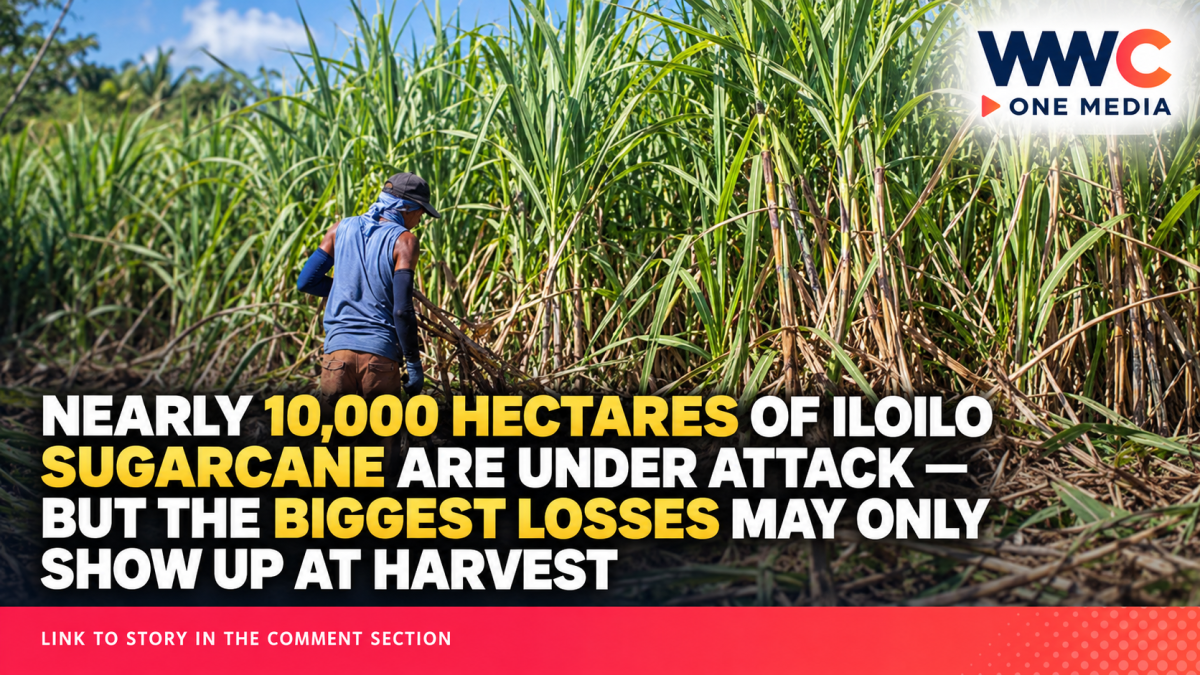
ILOILO, Philippines — A pest small enough to hide beneath a sugarcane leaf is creating a potentially enormous problem for one of Western Visayas’ most important agricultural industries.
The red-striped soft scale insect, or RSSI, has now affected 9,908.57 hectares of sugarcane in Iloilo, according to the province’s Sept. 3 assessment, with 9,432 farmers across 27 local government units caught in the expanding infestation.
The figures represent a sharp escalation from July, when provincial authorities reported 7,021 hectares affected and began treating the outbreak as an increasingly serious agricultural emergency.
Now the crisis has pushed Passi City, one of Iloilo’s biggest sugarcane-producing areas, to declare a state of calamity.
And with much of the affected cane already approaching harvest, the immediate concern is no longer simply stopping the insect.
It is determining how much sugar — and farmer income — has already been lost.
Almost 10,000 hectares affected across Iloilo
The latest provincial Damage Assessment Reporting System recorded 9,908.57 hectares of affected sugarcane, consisting of 556.82 hectares classified as totally damaged and another 9,351.75 hectares partially damaged.
The assessment covered 13,409.27 hectares of standing sugarcane, including approximately 2,168 hectares of newly planted cane and 11,241 hectares of ratoon crops — sugarcane regrown from previously harvested stalks.
That distinction is important.
Panay News described the affected acreage against roughly 13,409 hectares of plantations, but earlier official provincial figures placed Iloilo’s overall sugarcane area at about 20,749.88 hectares. The newer 13,409-hectare figure refers specifically to the standing crop included in the latest damage assessment rather than necessarily the province’s entire sugarcane footprint.
Among the hardest-hit areas are Passi City, San Enrique, Anilao and Dueñas.
The provincial assessment placed Passi’s affected area at 2,286 hectares, followed by San Enrique at roughly 1,428 hectares, Anilao at 1,414 hectares and Dueñas at more than 1,040 hectares.
Why Passi’s numbers look different in some reports
Passi’s own earlier assessment produced a substantially larger number.
The City Agriculture Office estimated on Aug. 15 that 3,337.85 hectares, or about two-thirds of the city’s roughly 5,058 hectares of sugarcane land, had been affected. That assessment helped underpin the city government’s decision to declare a state of calamity.
The later provincial assessment lists 2,286 hectares.
Those figures should not be presented as if one automatically disproves the other. They come from different assessments, dates and reporting systems, and provincial officials have been validating affected areas as the outbreak develops.
Panay News also reported that RSSI has reached 49 of Passi City’s 51 barangays.
The declaration gives the local government greater flexibility to mobilize disaster-response resources and assistance for farmers and workers whose incomes have been disrupted. Under the disaster framework cited by provincial officials, a local state of calamity can allow access to quick-response funding and activate other emergency mechanisms.
What exactly is RSSI?
RSSI is not simply an insect that chews holes in leaves.
It is a sap-sucking pest that attaches itself to sugarcane, draining nutrients from the plant. It also produces a sticky substance known as honeydew, which encourages the development of black sooty mold on the leaves.
That dark fungal coating interferes with sunlight and photosynthesis, weakening plant development and potentially reducing both cane yield and sugar content.
The pest was first detected in the Philippines in 2022 and has since spread into major sugar-producing areas. The Department of Agriculture has warned that severe infestations can reduce the sugar content of affected cane by as much as roughly 50 percent.
That does not mean every affected farm will lose half its sugar output. Damage varies significantly depending on infestation intensity, plant age, treatment and other conditions.
But it helps explain why authorities are treating the outbreak seriously.
Timing could make the Iloilo outbreak especially painful
A major concern is the age of the affected crop.
Provincial authorities said much of the sugarcane assessed in Iloilo is already around eight to nine months old and nearing harvest. The first infestation reports emerged when much of that cane was only five to six months old.
That means some of the economic damage may become clearer only when farmers begin harvesting and mills measure actual cane weight and sugar recovery.
For farmers, an infestation does not have to completely destroy a field to cause financial damage.
A crop that survives but produces less cane — or cane with a lower sugar content — can still mean substantially lower earnings.
Government is fighting the pest with fungi, insects and drones
Authorities are increasingly turning to biological controls instead of relying solely on chemical pesticides.
Iloilo has been distributing Metarhizium, a naturally occurring fungus that infects and kills certain insect pests. Other potential natural enemies, including earwigs and Trichogramma wasps, are also being assessed.
Another beneficial fungus, Beauveria, has also been identified among biological tools being used against RSSI.
But producing enough biological control material has become a bottleneck.
Provincial officials said multiplication of the fungus can take about 45 to 60 days, while local production capacity remains far below what would be needed to immediately treat thousands of hectares.
At the national level, Agriculture Secretary Francisco Tiu Laurel Jr. ordered expanded production of biological controls with a goal of having enough material to cover at least 75,000 hectares.
The DA and SRA have also deployed or planned drone spraying, chemical treatments, surveillance and geotagged monitoring in heavily affected sugar-producing regions. In July, the DA said it had earmarked ₱35 million for chemical treatment and drone operations, initially targeting 25,000 hectares nationally.
The outbreak is much bigger than Iloilo
Iloilo is only one front in a wider Philippine sugar-industry problem.
By late July, the Department of Agriculture said 93,898 hectares out of 421,606 hectares planted to sugarcane nationwide had been affected by RSSI, with almost all of the recorded affected acreage concentrated in the Visayas, particularly Negros and Western Visayas.
That matters because the Panay-Negros sugar belt supplies a major share of Philippine raw sugar.
The concern is therefore not limited to individual farms. A severe and prolonged decline in production could eventually affect milling activity, rural employment, domestic sugar supply and prices.
However, it would be premature to claim that the Iloilo infestation alone will cause a nationwide sugar shortage or major consumer price spike. Actual production losses still need to be measured after harvest.
Farmers are also facing an income emergency
Behind the hectare counts are thousands of families whose livelihoods depend on sugarcane.
Iloilo’s latest assessment lists 9,432 affected farmers. Provincial authorities are considering food assistance, livelihood programs, employment support, cash-for-work initiatives, skills programs and help accessing Philippine Crop Insurance Corporation coverage.
The national government has also been providing assistance in affected sugar-producing regions. The DA said in July that government agencies planned ₱10,000 in cash assistance for each validated affected farmer, with thousands of beneficiaries undergoing validation.
For Iloilo, however, the decisive test may come after the current harvest.
Officials are already shifting part of their attention toward protecting the next planting cycle — tightening biosecurity, restricting the movement of potentially infested planting materials and expanding biological-control capacity.
That is because RSSI is increasingly being viewed not as a one-season emergency, but as a pest the Philippine sugar industry may have to manage repeatedly.
The Department of Agriculture itself has said the infestation is becoming a recurring production risk, requiring sustained surveillance and stronger local capacity rather than a one-time spraying campaign.
And that may be the larger story behind Passi City’s calamity declaration.
The immediate fight is over nearly 10,000 hectares of damaged Iloilo sugarcane.
The bigger battle is making sure the pest does not become a permanent threat hanging over every future harvest.


Leave a Reply