
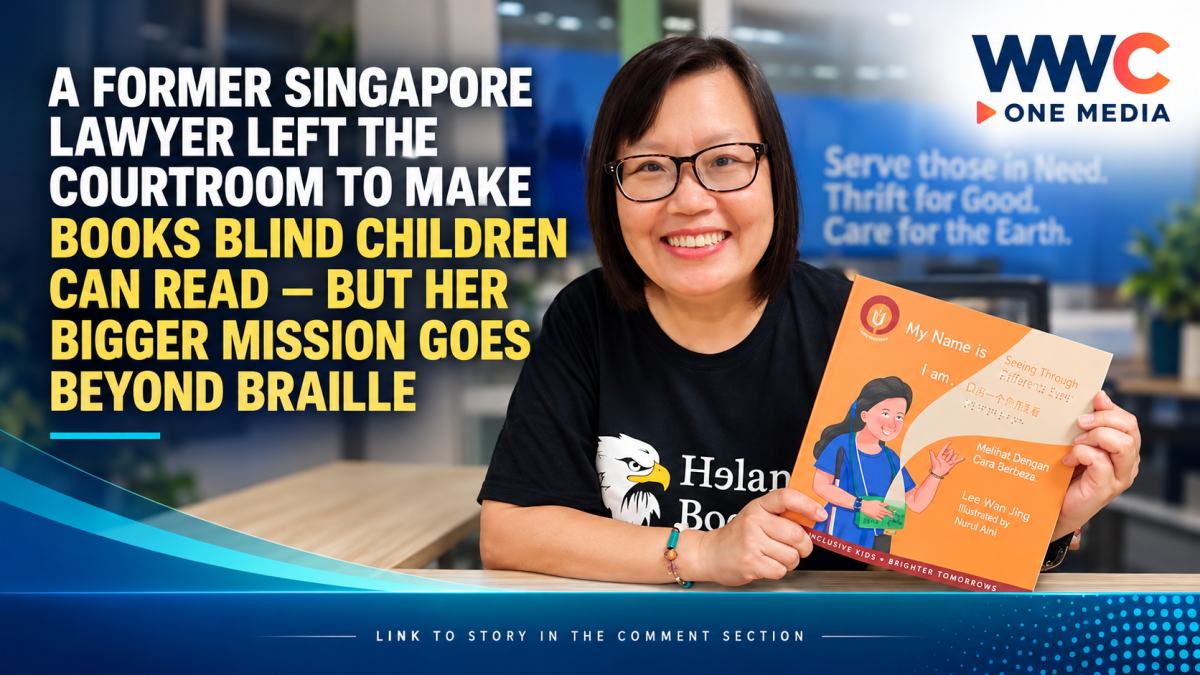
SINGAPORE — A question raised over lunch more than a decade ago has grown into a Singapore community initiative trying to change not simply what children read, but who gets to read alongside them.
Former lawyer Lee Seow Ser, together with publisher Hidayah Amin and arts and design educator Tan Ai Khim, is behind To SIR (Socially Inclusive Reads) With Love, a ground-up initiative producing children’s books designed so readers with different abilities can experience the same stories. Its books combine features including Braille, tactile illustrations and dyslexia-friendly typography, while its community programmes bring children and adults into direct conversations about disability and inclusion.
The idea began during a major transition in Lee’s life. In 2014, after roughly 15 years in legal practice, she took a sabbatical. CNA reported that she became ill and underwent surgery and treatment during that period. Lee has previously been more specific: in a 2024 first-person essay for Our Better World, she said she received a cancer diagnosis, an experience that pushed her to reconsider how she wanted to spend her time and eventually leave legal practice.
But another question was already occupying her mind: Why were there so few books in ordinary bookstores that children with sight loss could enjoy?
During a lunch with Amin, founder of independent publisher Helang Books, Lee raised the possibility of making a children’s story accessible in Braille. They ultimately engaged the Singapore Association of the Visually Handicapped (SAVH) to transcribe Amin’s The Mango Tree. Copies were donated to Lighthouse School, while a tactile representation of the mango tree and its fruit allowed blind readers to explore part of the illustration through touch.
What began as one accessible book soon became something larger.
By 2015, Lee, Amin and Tan had formed To SIR With Love. Early reporting by The Straits Times documented the concept in action through Hang Nadim And The Garfish: a book containing Braille for blind readers, a typeface intended to help readers with dyslexia and embossed elements that could be explored by touch. The goal was straightforward but unusually ambitious — children with and without disabilities should not always need separate books. They should be able to encounter the same story together.
From accessible books to “one-for-all” reading
That philosophy shaped SIR’s Little Kids, Big Ideas series, which retells Asian stories and folktales while incorporating Braille, tactile story elements and dyslexia-friendly text. Its characters also come from different ethnic backgrounds, reflecting Singapore’s multicultural society.
One title, Lee’s Si Ma Guang and the Giant Jar, became an IBBY Outstanding Book for Young People with Disabilities in 2017. The book tells the traditional story of a resourceful boy who saves a friend in danger, but its physical design makes the story accessible across different reading needs. The recognition has since been cited by the Singapore Book Council’s Asian Festival of Children’s Content, where Lee has continued participating in discussions about tactile and accessible storytelling.
The initiative later expanded through the I Am Unique series, which moves beyond fictional and traditional characters to tell stories inspired by real people living with disabilities or medical conditions. CNA reported that seven titles had been published as of September 2026, addressing experiences including autism, Down syndrome, cerebral palsy, motor neurone disease, blindness and deafblindness. A title about thalassaemia was scheduled to follow later in September.
That distinction matters. These books are not merely changing printing formats. They are trying to place people whose experiences are often absent from mainstream children’s literature inside the story itself.
A new book puts deafblind life at the centre
One of the latest examples is My Name is Siew Ling. I am Deafblind., based on the life of Tan Siew Ling, who lost her sight during childhood and later her hearing.
The Singapore Association for the Deaf has supported community outreach around the book as part of the fifth year of its Deafblind Programme. The title, written by Lee and illustrated by Deaf artist Isaac Liang, follows Siew Ling’s experience of continuing to live independently and actively after becoming deafblind.
Tan’s experience predates the book. In a first-person article published by TODAY/CNA in 2020, she wrote about losing her sight at 11, later becoming deafblind and learning to use Braille, assistive technology and touch-based communication while continuing to work and participate in community life.
That real-world perspective gives Lee’s project an increasingly important dimension: people with disabilities are not being presented simply as subjects to feel sympathy for. Their experiences, skills, relationships and independence become part of the narrative children encounter.
The books are becoming only part of the story
SIR has increasingly moved beyond publishing into workshops, storytelling sessions and experiential programmes.
At Enabling Village, for example, a 2024 programme connected to Lee’s My Name is Ling. I am Blind. included activities where children decoded Braille messages with the help of Braille ambassadors. The intention was to turn accessibility from an abstract topic into something children could interact with directly.
That approach is increasingly visible elsewhere in Singapore. The National Library Board says Punggol Regional Library, which opened in 2023, became the country’s first public library to pilot a suite of services specifically for persons with disabilities. Its accessibility features include assistive technology and an accessible collection, putting SIR’s work within a broader national shift toward designing reading spaces around a wider range of users.
Lee has also tried to make the initiative more sustainable. She enrolled in the Specialist Diploma in Social Entrepreneurship at the Dr Richard K M Eu–SIM Social Entrepreneurship Centre, saying she wanted to develop stronger foundations for expanding SIR’s impact. SIM confirmed that she was among the programme’s inaugural graduates.
More than a decade after the first Braille experiment, that may be the most significant evolution of the project.
The original question was about access: How can a blind child read this book?
SIR’s work now asks something broader: How can children with very different abilities, backgrounds and life experiences participate in the same cultural space — and understand one another while doing it?
That difference turns accessible publishing from a technical problem into a social one.
And it explains why Lee’s project is no longer simply about adding dots of Braille to a printed page. It is about making sure that when children open a story, fewer of them are left outside it.



Leave a Reply