
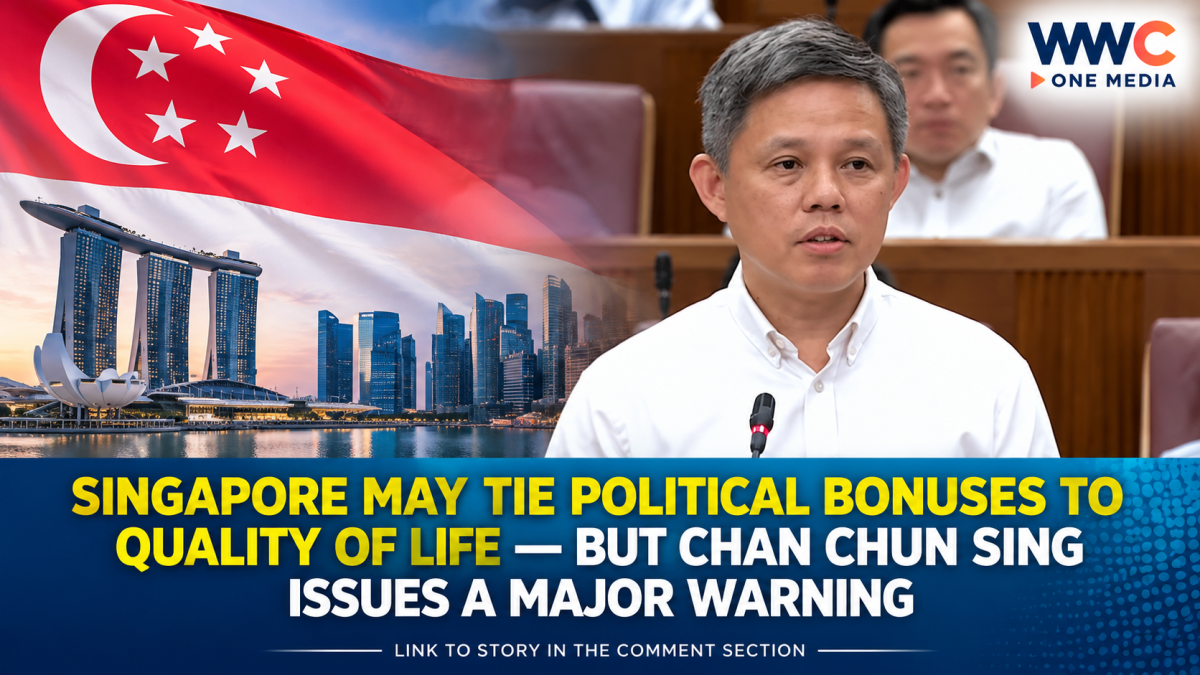
SINGAPORE — The Singapore government is exploring whether a broader measure of citizens’ quality of life could eventually be included in the framework used to determine part of the variable pay of political office holders, following a major debate over political salaries and how the performance of the country’s leaders should be measured.
But Coordinating Minister for Public Services Chan Chun Sing has warned that creating the wrong set of key performance indicators, or KPIs, could produce unintended consequences.
Speaking in Parliament on Sep 10, Chan said the government would study how to broaden the indicators used to assess Singapore’s progress while ensuring that any new measure is robust, meaningful and does not encourage policymakers to pursue the wrong outcomes.
A Bigger Question: Are Singaporeans Actually Doing Well?
The discussion emerged during Parliament’s debate on the government’s response to the 2026 review of salaries for political appointment holders and Members of Parliament.
Currently, part of the variable pay package for political office holders is linked to a National Bonus, which is based on four national indicators:
- Unemployment
- Real income growth for median-income Singaporeans
- Real income growth for Singaporeans in the bottom 20 per cent
- Real GDP growth
The independent committee reviewing political salaries recommended exploring the addition of a broader quality of life measure to the National Bonus framework.
The idea could potentially shift the conversation beyond traditional economic indicators such as GDP growth, jobs and income.
Nominated Member of Parliament Kenneth Poon argued that a quality-of-life indicator would address a broader question: whether Singaporeans are genuinely doing well.
He suggested that policymakers consider areas including material adequacy, access to essential services, social connectedness and subjective well-being.
Another NMP, Dr Haresh Singaraju, raised questions about who would develop such a measure, when it could be presented to Parliament and whether it should be publicly released even before it becomes part of the political bonus system.
Chan Chun Sing: The Wrong KPI Can Drive the Wrong Behaviour
Chan said the government is open to broadening the framework, but stressed that developing a credible quality-of-life indicator would not be straightforward.
Before targets can be established, Singapore needs reliable data that can be collected consistently and organised into a stable series over time, he said.
The challenge is that some elements of quality of life are qualitative rather than purely numerical. Others may also need to be assessed over several years rather than judged through a single year’s performance.
The government, Chan said, must therefore avoid creating indicators that encourage the wrong behaviour.
The warning highlights a central problem in performance measurement: once a target becomes the main objective, decision-makers may focus excessively on improving the number rather than improving the real-world outcome behind it.
Political Pay Debate Expands Beyond Salaries
The debate over quality of life comes as Singapore undertakes its first major adjustment to the political salary framework in years.
The government accepted recommendations from an independent review committee to update the reference salary for an MR4 minister to S$1.8 million, although existing political appointment holders will not immediately move to the new benchmark.
Instead, existing office holders will receive a one-off adjustment of up to 9 per cent from Oct 15, 2026, depending on individual circumstances, including performance and when their salaries were last adjusted. Future adjustments will depend on individual performance and responsibilities.
The political salary framework had not been adjusted for about 15 years. Chan said the revised benchmark reflects the government’s effort to remain competitive in attracting capable individuals while maintaining a discount to reflect the public-service nature of political office.
Why Quality of Life Could Become More Important
Under the current framework, political office holders’ compensation is not entirely fixed.
Chan said about 65 per cent of the annual MR4 reference salary is fixed, while the remaining 35 per cent consists of variable components linked to individual performance and national outcomes.
The National Bonus can range from zero to six months and is tied to national socioeconomic indicators. The government has also accepted recommendations to revise the targets for the existing indicators and to explore adding a robust quality-of-life measure when one becomes available.
That means the debate is no longer simply about how much Singapore’s political leaders earn.
It is increasingly about another question: How should Singapore measure whether its leaders are delivering better lives for its people?
Government Tightens Existing National Targets
The government is also revising the targets used for the current National Bonus indicators.
According to Chan’s ministerial statement, targets linked to unemployment and real income growth for median- and lower-income Singaporeans are being tightened, while the GDP growth indicator is being recalibrated to reflect Singapore’s longer-term growth potential as a mature economy.
The move reflects the government’s position that political compensation should not be disconnected from national outcomes.
At the same time, Chan acknowledged that higher salaries alone do not guarantee stronger leadership or better performance.
That is why, he argued, the framework includes both fixed and variable components rather than simply setting a salary benchmark without considering performance and national results.
PM Lawrence Wong Defends the Broader Political Salary Changes
The wider salary review has generated significant public discussion in Singapore and international attention.
Prime Minister Lawrence Wong has defended the government’s approach, arguing that Singapore needs to maintain a system capable of attracting people with the character, competence and willingness to take on political leadership.
Wong said political leadership involves making difficult long-term decisions and that a strong civil service cannot substitute for effective political leaders who must ultimately make strategic choices and take responsibility for them.
International reports have also focused on the scale of Singapore’s political salary revisions. Reuters and the Associated Press reported that the government argues competitive political pay is intended to help attract capable leaders and support integrity, although the changes have also renewed public debate over the optics of high political salaries and the cost of living.
What Happens Next?
For now, Singapore does not have a final quality-of-life indicator that will determine part of political office holders’ National Bonus.
The government has committed to exploring the concept, but Chan made clear that any measure must first be supported by reliable data and developed carefully enough to avoid distorted incentives.
That could make the eventual process more complex than simply adding a survey score or happiness ranking to the existing system.
The bigger question now is whether Singapore can develop a measurement that captures what traditional economic data sometimes miss: whether people feel secure, connected, supported and genuinely better off as the country progresses.
If such a measure is eventually adopted, it could mark a significant shift in how Singapore evaluates national success — and potentially how part of its political leadership’s variable pay is assessed.
The next challenge may be even harder: Can the government measure quality of life without turning people’s lives into just another number to hit?




Leave a Reply