
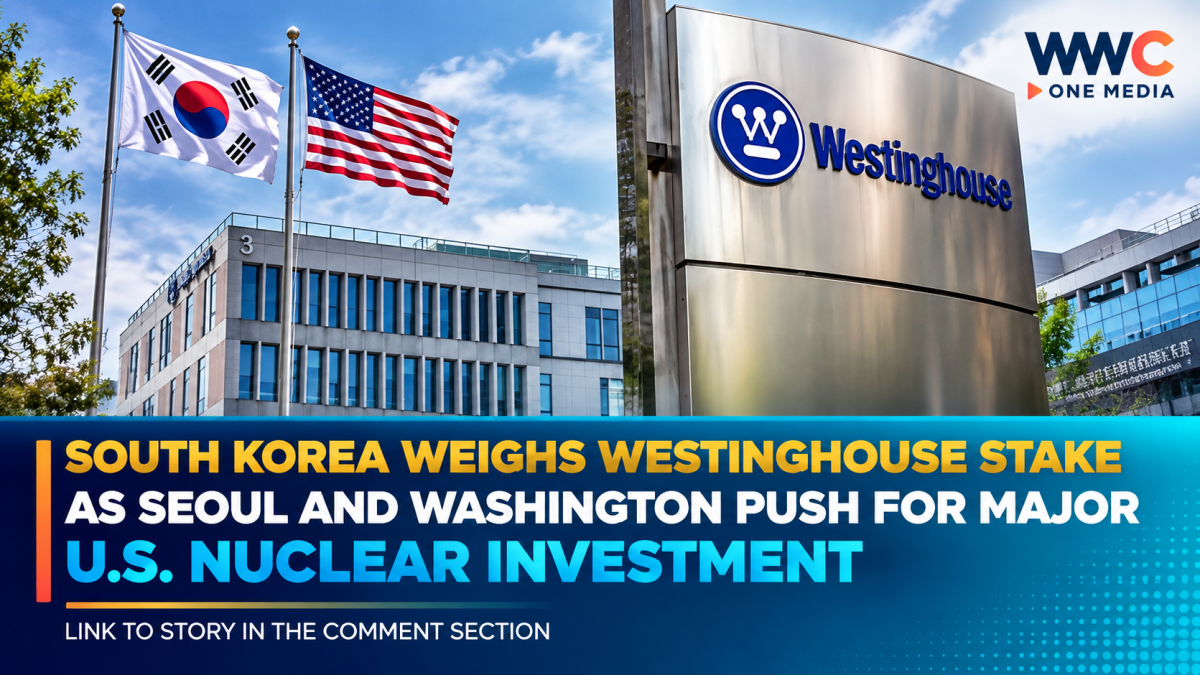
SEOUL — South Korea is considering a potentially significant expansion of its role in the U.S. nuclear-power industry, with reports that Seoul could invest in Westinghouse as part of its broader U.S. investment commitments.
The proposal could deepen cooperation between South Korea and the United States on nuclear power and potentially give Korean companies a larger role in America’s push to expand nuclear generation.
But there is a major caveat: the Westinghouse investment has not been finalized.
South Korea’s Ministry of Trade, Industry and Energy said September 9 that the two countries are discussing nuclear-power cooperation but that specific details have yet to be decided. The ministry also rejected reports that the timing and amount of the first investment under the broader U.S. investment package had already been finalized.
What Is Seoul Considering?
South Korean media have reported that the government and Korea Electric Power Corp. (KEPCO) are examining the possibility of acquiring part of Westinghouse.
Yonhap reported in August that U.S. officials had reportedly proposed that South Korea participate in a Westinghouse investment structure, potentially using part of Seoul’s planned U.S. investment commitments.
The proposal would potentially connect Korean financing and construction expertise with Westinghouse’s technology and position in the American nuclear market. However, South Korea’s industry ministry subsequently said reports describing a joint U.S.-Korean acquisition of Westinghouse were inaccurate.
That distinction is crucial.
A proposal or discussion is not the same as a government decision.
The latest reporting indicates that negotiations are continuing, while the final investment structure remains unsettled.
Why Westinghouse Matters
Westinghouse is one of the most important names in the U.S. nuclear industry.
Its AP1000 reactor technology is already operating at the Vogtle nuclear plant in Georgia, giving the company a major position in America’s effort to revive large-scale nuclear construction.
Westinghouse is currently owned by Brookfield Renewable and Cameco, which hold 51% and 49%, respectively, according to Yonhap reporting.
For South Korea, an investment could potentially provide greater access to the U.S. nuclear market while strengthening cooperation between American reactor technology and Korean construction and manufacturing capabilities.
Korea’s Nuclear Expertise Is a Major Factor
South Korea is not a newcomer to large nuclear projects.
KEPCO and its subsidiaries have developed substantial experience in designing, building and operating nuclear power plants, including the APR1400 reactor.
Korean companies also played a major role in constructing the Barakah nuclear power plant in the United Arab Emirates, one of the country’s most prominent overseas nuclear projects.
That experience has made South Korea an increasingly important potential partner as Washington looks to expand nuclear capacity.
The strategic question is therefore not simply whether Seoul invests money in the United States.
It is whether Korean companies can become long-term partners in America’s nuclear supply chain.
The Bigger Picture: A $350 Billion U.S. Investment Commitment
The Westinghouse discussion is unfolding within a much larger economic agreement.
South Korea previously committed to a $350 billion U.S. investment package as part of a trade agreement with Washington.
Reuters has reported that the package includes investments in areas such as shipbuilding and strategic industries, while semiconductor investments are also being discussed as the two countries work through trade and tariff issues.
The investment package has become increasingly important to the broader Seoul-Washington relationship.
Washington wants South Korean companies to expand their presence in the United States, while Seoul has sought to ensure that investments are commercially viable and strategically beneficial.
Nuclear Power Is Moving to the Center of the Deal
The potential nuclear component has become particularly significant because U.S. electricity demand is expected to rise sharply.
Artificial intelligence and the rapid expansion of data centers are creating enormous demand for reliable electricity.
Reuters reported this week that South Korea itself expects AI-driven semiconductor expansion and new data centers to increase domestic electricity demand by 25–30 gigawatts, equivalent to roughly the output of 20 nuclear reactors.
The same pressures are being felt in the United States, where technology companies and data-center developers are looking for reliable, large-scale power sources.
That makes nuclear energy strategically attractive.
Eight U.S. Reactors Are Also Being Discussed
Recent reports have linked the broader negotiations to a potential framework involving the construction of up to eight nuclear reactors in the United States.
The Wall Street Journal reported that South Korea is nearing a broader investment agreement that could include major nuclear projects, with potential use of both Westinghouse’s AP1000 technology and South Korea’s APR1400 design.
However, Seoul has stressed that the details remain under negotiation.
South Korea’s industry ministry specifically said that specific nuclear investment arrangements between Seoul and Washington have not yet been determined.
That means figures circulating in media reports should not be treated as final commitments until the governments formally announce the projects.
A Potential Win-Win—but Not Without Questions
A Westinghouse investment could offer benefits to both sides.
For Washington, Korean capital and industrial expertise could help accelerate domestic nuclear construction and strengthen the U.S. nuclear supply chain.
For Seoul, participation could provide Korean companies with deeper access to the American market while strengthening their position in the global nuclear industry.
But there are also questions over how much South Korea should invest, who would control any acquired stake, how intellectual-property rights would be handled and whether the projects would generate sufficient commercial returns.
Those issues are particularly important because the broader U.S. investment commitment is enormous.
The Deal Is Still Taking Shape
South Korea and the United States appear to be moving toward a deeper partnership in nuclear energy, but the final structure remains uncertain.
What is clear is that nuclear power has become one of the most strategically important pieces of the economic relationship between Seoul and Washington.
A Westinghouse stake could represent a major step toward integrating South Korea’s nuclear industry more deeply into the U.S. market.
But for now, it remains a possibility under discussion—not a completed transaction.
And that leaves the biggest question unanswered: If Seoul does secure a stake in Westinghouse, will it simply become an investor—or could it become one of the key players shaping America’s next nuclear era?


Leave a Reply