
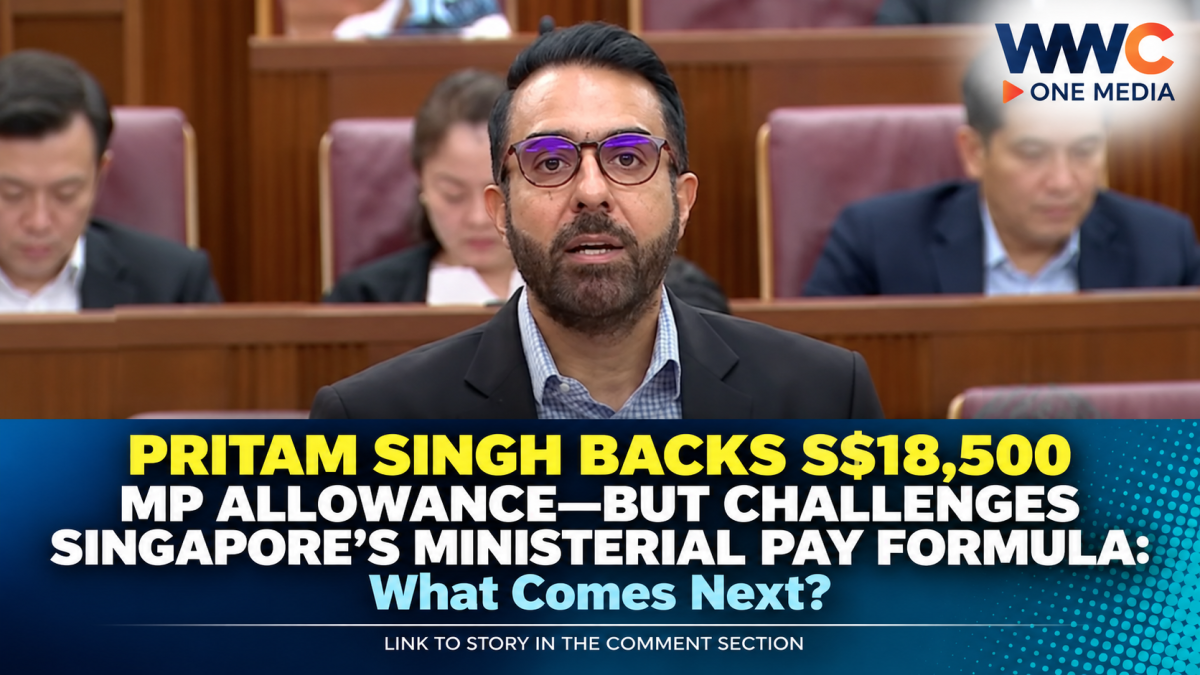
SINGAPORE — Workers’ Party (WP) secretary-general Pritam Singh has backed Singapore’s decision to raise Members of Parliament’s monthly allowances, while challenging the government’s long-standing formula for determining ministerial salaries.
Speaking in Parliament on September 10, Singh said the WP supports the increase in MP allowances because of inflation. He also agreed with Prime Minister Lawrence Wong’s decision to limit the immediate increase in ministerial salaries to up to 9%.
But Singh made clear that the WP still disagrees with the benchmark used to calculate ministers’ pay, setting up one of the most closely watched points of the latest parliamentary debate over political salaries in Singapore.
The big change: MPs will get S$18,500 a month
Under the government’s new framework, the monthly allowance for MPs will rise from S$13,750 to S$18,500, effective October 15, 2026.
The government has described the adjustment as an update for inflation after the allowance remained unchanged for 15 years. Prime Minister Lawrence Wong also argued that adequate MP allowances help both the ruling People’s Action Party and the Workers’ Party recruit candidates and support the demanding work MPs perform in Parliament and their constituencies.
Singh agreed with the increase, but said the WP’s position on how political salaries should be calculated remains different from the government’s approach.
Why Singh is challenging the ministerial salary formula
Singapore’s political salary framework uses the income of the country’s top 1,000 earners as a benchmark for the reference salary of an entry-level minister, known as the MR4 benchmark, with a 40% discount to reflect the principle of political service.
The 2026 review committee recommended raising that benchmark from S$1.1 million to S$1.8 million.
However, the government chose not to immediately move ministers to the new benchmark. Instead, existing political officeholders will receive a one-off adjustment of up to 9%, depending on factors including individual circumstances and performance.
For an MR4 minister currently earning the S$1.1 million reference salary, a full 9% adjustment would bring the amount to approximately S$1.2 million.
Prime Minister Wong said ministers would subsequently be paid within revised salary ranges, with future changes determined by performance and responsibilities rather than an automatic move toward the S$1.8 million benchmark.
Singh wants a different yardstick
Singh reiterated that the WP’s alternative proposal, first put forward in 2012, would link ministerial pay to a multiple of an MP’s salary, with the MP salary itself pegged to that of a senior public servant and combined with a more modest variable component.
He argued that this would provide a more accessible reference point for the public and result in more modest increases in ministerial compensation over time.
The disagreement, therefore, isn’t simply about whether politicians should be paid more.
It is about what their salaries should be measured against.
Singh questions whether money is really the problem
One of the sharper arguments in Singh’s speech was his challenge to the government’s claim that higher political salaries are necessary to attract high-quality talent from the private sector.
Singh pointed out that many ministers continue to come from the public sector and civil service. He questioned whether salary is actually the factor discouraging some people from entering politics.
His broader argument was that political service involves responsibilities—including grassroots work, constituency engagement and the realities of campaigning—that money alone may not overcome.
The WP chief also argued that people who enter politics through his party do not do so primarily because of remuneration. Rather, he said, WP candidates are motivated by the goal of achieving a more balanced political system and strengthening opposition representation in Parliament.
He wants ministers’ actual pay disclosed
Singh also called for greater transparency over what ministers actually receive.
Specifically, he asked for information showing how the actual total remuneration of MR4 ministers compares with the annual salary benchmark.
That would include figures involving the annual variable component, performance bonuses and national bonuses, which Singh said would give the public a clearer picture of what ministers actually receive rather than relying only on headline salary figures.
Singapore’s official framework includes fixed and variable components. The variable portion includes an annual variable component, an individual performance bonus and a national bonus tied to socioeconomic indicators.
And then there’s the mayor question
Singh also turned the spotlight on the role and pay of Singapore’s mayors.
He said it remains unclear to many Singaporeans why the position should remain tied to the political salary framework, particularly as some functions historically associated with Community Development Councils have been shifted to other government agencies.
The 2026 salary review committee itself recognized that community-related roles such as MPs and mayors may require different considerations from full-time political appointment holders.
The government has accepted a recommendation to study whether payments for these roles should be delinked from the MR4 ministerial benchmark.
Singh wants that study to also address a fundamental question: should the Office of the Mayor continue to exist, and if so, exactly what should its role be?
He also wants support staff paid more
Another issue raised by Singh was the allowances for legislative assistants and secretarial assistants who support MPs.
According to Singh, these allowances were last updated in 2007 and were not included in the latest political salary review.
He argued that their compensation and manpower support should also be reconsidered after nearly two decades, particularly because these staff members help MPs serve constituents and carry out parliamentary responsibilities regardless of political affiliation.
What happens next?
The government’s new political salary framework takes effect October 15, 2026.
MP allowances will rise to S$18,500 a month, while existing political officeholders will receive adjustments of up to 9%, subject to individual circumstances and performance. The new framework also introduces wider salary ranges for ministerial grades.
Meanwhile, the political argument over how Singapore should value political leadership—and whether money is the best way to attract it—clearly isn’t over.
Singh’s intervention puts the focus on three questions that could continue to dominate the debate:
How much should politicians be paid? Who should determine that amount? And does higher pay really guarantee better political leadership?
Those questions may prove more consequential than the headline salary increase itself.

Leave a Reply