
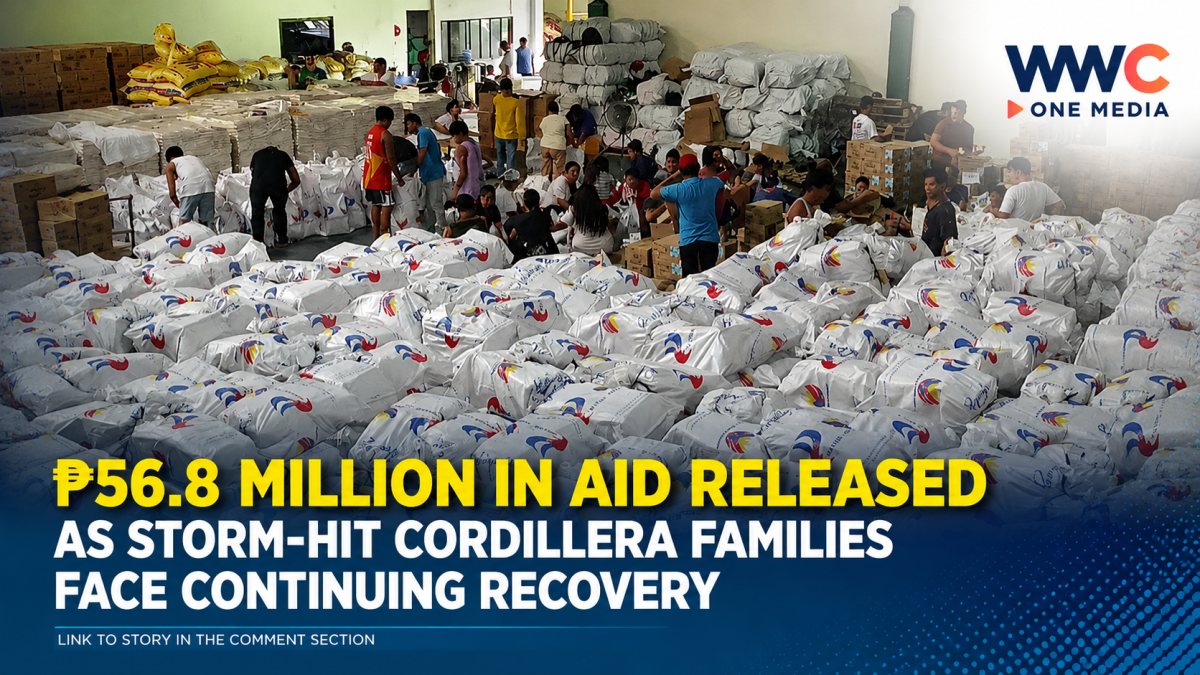
BAGUIO CITY, Philippines — The Department of Social Welfare and Development (DSWD) has released about ₱56.83 million worth of humanitarian assistance to families affected by recent storms and severe weather in the Cordillera Administrative Region, as government agencies continue to respond to communities hit by heavy rains, flooding and other hazards.
The latest assistance underscores the scale of the disaster response in the mountainous region, where several provinces and Baguio City have faced repeated weather-related disruptions in recent months.
According to the Philippine News Agency, the DSWD-Cordillera has distributed the assistance as part of continuing relief operations for affected families.
The response comes after weeks of severe weather that have left communities vulnerable to flooding, landslides, damaged homes and displacement.
Cordillera has faced repeated weather emergencies
Recent reports from the Philippine Information Agency show that the DSWD-Cordillera had already been providing millions of pesos in food, non-food items and cash assistance to communities affected by the Southwest Monsoon and tropical cyclones.
As of August 12, the agency had released approximately ₱6.11 million in assistance, including family food packs, ready-to-eat meals, drinking water, tents and other essential supplies. The assistance also included cash support for families whose homes were damaged.
The situation has also involved serious displacement. A separate August report said 25,540 families, or 67,589 individuals, had been affected by the combined impact of tropical cyclones and the enhanced Southwest Monsoon in the Cordillera.
Relief efforts go beyond evacuation centers
One important aspect of the government’s response is that assistance is not limited to families staying in evacuation centers.
Recent disaster-response operations in other parts of the country have likewise included food assistance for affected families who remained in their homes but were still impacted by flooding and severe weather. The approach reflects the broader DSWD strategy of providing support based on assessed needs rather than evacuation status alone.
For Cordillera communities, this is particularly important because the region’s mountainous terrain can make transportation and access difficult when roads are affected by landslides or heavy rainfall.
Why the ₱56.8-million figure matters
The latest release brings renewed attention to the continuing cost of disaster response in the region.
The DSWD-Cordillera has previously maintained substantial stocks of family food packs and other emergency supplies so assistance can be deployed quickly when local governments request augmentation.
In September 2025, for example, the agency reported having 24,914 family food packs prepositioned at local government storage facilities, in addition to nearly 55,000 family food packs stored across DSWD-managed warehouses in the region.
The agency’s 2026 regional program also has a broader mandate covering social protection and assistance to vulnerable residents, with the DSWD-CAR reporting a total 2026 fund allocation of roughly ₱6.24 billion for its regional operations and programs.
More than immediate relief
For families affected by storms, however, food packs and emergency supplies are only the first step.
Once immediate danger passes, communities must deal with damaged homes, disrupted livelihoods, transportation problems and the longer process of rebuilding.
That makes continued coordination between the DSWD, local governments and disaster-response agencies critical, particularly while weather conditions remain capable of triggering additional hazards.
The recent experience also shows why prepositioned relief supplies and rapid local assessments remain essential in Cordillera, where heavy rainfall can quickly create dangerous conditions in vulnerable communities.
For now, the ₱56.83-million relief effort provides immediate support—but the bigger challenge is helping storm-hit families move from emergency response toward recovery.



Leave a Reply