
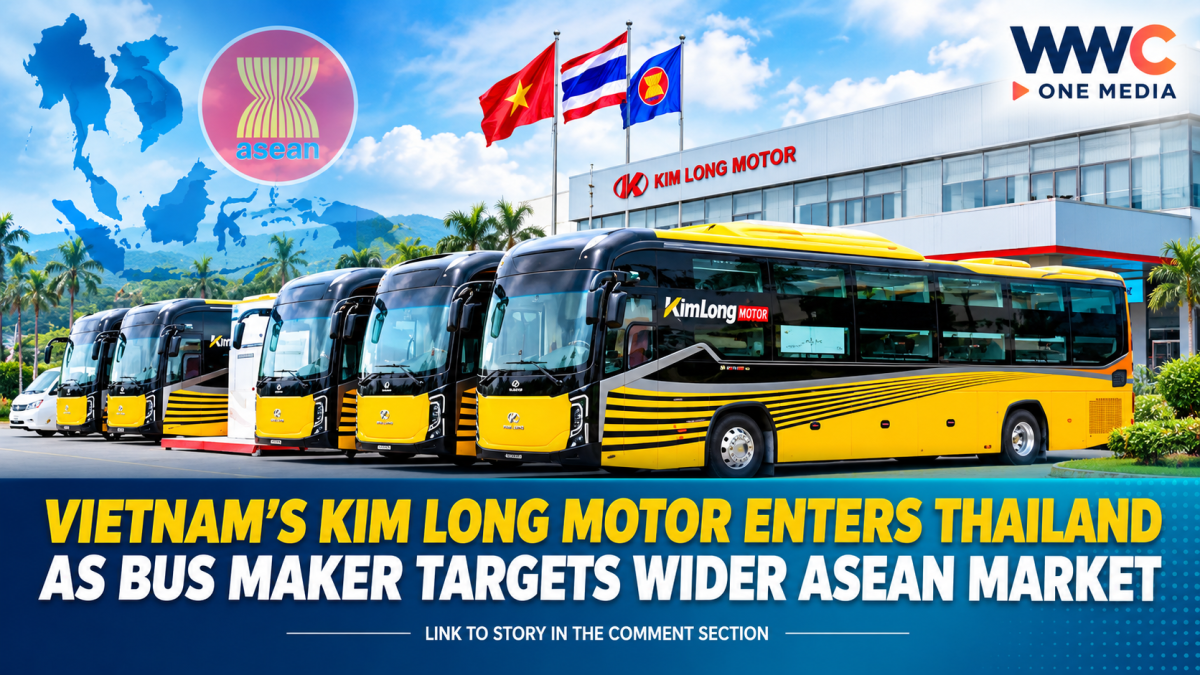
BANGKOK — Vietnam’s Kim Long Motor is stepping onto Thailand’s competitive commercial-vehicle market, officially launching its Vietnamese-made buses in Bangkok as the company looks to turn Thailand into a springboard for wider expansion across Southeast Asia.
The company and Thai partner KIJSETTHI Mobility held the official launch on Sept. 15, 2026, marking Kim Long Motor’s formal arrival in Thailand. KIJSETTHI became the company’s authorized Thai distributor in April and has been developing sales and after-sales networks across the country.
From Vietnam to Thailand
The Thailand push has already moved beyond a showroom launch.
In March, Kim Long Motor exported its first batch of 10 buses to Thailand, including both internal-combustion and fully electric models. That shipment was the first part of a 300-bus contract for 2026.
The company has since expanded its electric-bus deliveries. On Sept. 10, Vietnamese government news outlet Baochinhphu.vn reported that Kim Long Motor had handed over its first nine KIMLONGB30-EV city buses to Thai company INNOPOWER, under a contract covering 113 electric buses for delivery in 2026.
The electric buses are scheduled to be shipped through Vietnam’s Chan May port, adding another step to Kim Long Motor’s effort to establish its commercial EV business outside Vietnam.
Thailand is only the beginning
Kim Long Motor’s ambitions extend beyond selling finished buses in Thailand.
Vietnam News Agency reported Sept. 17 that the company is studying plans for bus production and assembly in Thailand, alongside its efforts to expand electric-bus operations.
That strategy could give the Vietnamese manufacturer a stronger regional manufacturing and distribution base as it pursues opportunities in other ASEAN markets.
Thailand is a particularly important market for that strategy because of its established automotive manufacturing ecosystem and extensive commercial-vehicle market.
A major supply agreement preceded the launch
The Thai expansion was already taking shape before the first vehicles arrived.
In December 2025, Kim Long Motor and KIJSETTHI Mobility signed an agreement covering the supply of 1,000 Kim Long-branded buses to Thailand. The agreement included the Vietnamese company’s plans to establish a stronger presence in the Thai commercial-vehicle market.
The companies later formalized KIJSETTHI’s role as Kim Long Motor’s first Southeast Asian distributor.
Kim Long Motor said the partnership would combine its vehicle development and manufacturing capabilities with KIJSETTHI’s experience in Thailand’s commercial-vehicle market.
Electric buses are becoming a key part of the strategy
Kim Long Motor isn’t entering Thailand solely with conventional diesel buses.
Its portfolio includes fully electric city buses, reflecting the growing focus on cleaner public transportation across Southeast Asia.
The company’s EV program is also backed by investment in local battery manufacturing. Kim Long Motor and BYD Battery began work in January on a US$130 million battery manufacturing project in Hue, designed initially to produce batteries for commercial vehicles including buses, trucks and minibuses.
The company has said its electric-vehicle products had surpassed 60% localization, with a target of reaching as much as 90% by the end of 2026.
Can a Vietnamese bus brand go regional?
Kim Long Motor’s Thailand launch represents a broader shift in Vietnam’s automotive ambitions — from primarily assembling vehicles toward developing and exporting more locally manufactured commercial vehicles.
The company is investing in engines, vehicle manufacturing, batteries and other parts of its supply chain in Vietnam while simultaneously building overseas distribution networks.
For Thailand, the immediate focus is establishing sales, service and customer support. For Kim Long Motor, however, the bigger objective appears to be regional: use Thailand as an entry point and build a commercial-vehicle brand capable of competing across ASEAN.
Whether that strategy can translate into large-scale regional sales will depend on the company’s ability to compete on price, reliability, service coverage, technology and local-market requirements.
But with its Thai launch now underway and electric-bus deliveries already moving forward, Vietnam’s homegrown bus industry is making a much more visible push onto the ASEAN stage.
WWC ONE MEDIA G,A



Leave a Reply