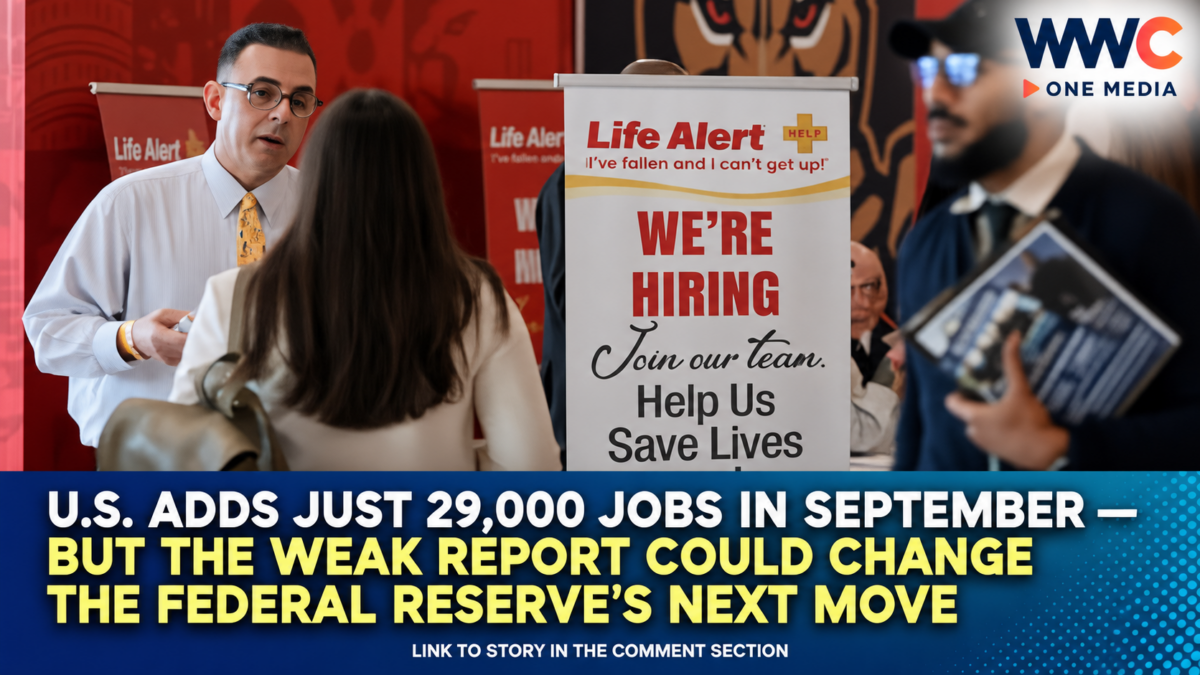
WASHINGTON — The U.S. labor market lost significant momentum in September, adding just 29,000 jobs as unemployment rose to 4.2%, delivering a major downside surprise that could force the Federal Reserve to rethink how aggressively it keeps interest rates high.
Nonfarm payrolls increased by a seasonally adjusted 29,000 jobs in September 2026, according to the U.S. Bureau of Labor Statistics.
That was far below the 84,000 jobs expected by economists surveyed by Dow Jones, while the unemployment rate increased from 4.1% to 4.2%, also coming in weaker than forecasts.
The headline number was weak enough on its own.
But revisions to previous months made the picture even softer.
The government revised July employment from a gain of 21,000 jobs to a loss of 10,000, while August was cut from 162,000 to 133,000.
Together, those revisions erased 60,000 jobs from earlier estimates.
That means the labor market was weaker through the summer than investors and policymakers initially believed.
September Hiring Missed Expectations by a Wide Margin
The gap between expectations and reality was substantial.
Economists had expected roughly 84,000 to 90,000 new jobs.
Instead, employers added only 29,000.
Reuters said the report showed job growth had slowed sharply, although it stopped short of indicating a full-scale deterioration in labor-market conditions.
The unemployment rate also remains historically low.
At 4.2%, joblessness is still within the narrow 4.1% to 4.3% range seen since March, according to government data.
So the story is not that companies are suddenly firing workers in massive numbers.
The bigger issue is that companies are increasingly reluctant to hire.
America Is Entering a ‘Low-Hire, Low-Fire’ Economy
That distinction may be the most important part of the September report.
Employers are not conducting widespread layoffs.
But they are also not adding many workers.
Reuters described the market as remaining in a “low-hire, low-fire” environment, where people who already have jobs generally keep them, but unemployed workers and new graduates face a harder time finding new positions.
The Wall Street Journal similarly noted that the labor market remains relatively stable despite weak hiring, partly because the labor force itself is growing more slowly.
That creates an unusual economy.
Job security for existing workers can remain relatively strong even while opportunities for job seekers deteriorate.
More Americans Entered the Labor Force
One reason unemployment increased was not simply job losses.
More Americans began looking for work.
The labor-force participation rate rose to 61.8% from 61.6%, according to September data.
That means a larger share of working-age Americans either had jobs or were actively looking for them.
When more people enter the job market faster than employers create positions, unemployment can rise even without a surge in layoffs.
About 7.1 million Americans were unemployed in September.
Wage Growth Also Cooled
There was another potentially important signal for the Federal Reserve.
Average hourly earnings increased just 0.1% from August, or five cents, to $37.81 per hour.
Compared with a year earlier, wages increased 3.0%.
That was a slowdown in wage pressure.
For the Fed, weaker wage growth can be encouraging because rapidly rising wages can contribute to inflation when companies pass higher labor costs on to customers.
But the picture is complicated.
Consumer inflation has remained elevated, meaning wage growth of 3% may not translate into significant improvements in purchasing power for workers.
The Wall Street Journal noted that wage growth was running below recent inflation readings, reinforcing concerns that households may still feel squeezed even if they remain employed.
Health Care Did Most of the Hiring
The September jobs gains were not broadly distributed.
Health care added about 17,000 jobs, according to industry breakdowns of the government report.
Construction added roughly 11,000 positions, while manufacturing increased by about 9,000.
Meanwhile, several sectors lost workers.
Financial activities shed around 7,000 jobs, while government, information and professional-services employment also weakened.
That matters because a healthy labor market usually shows employment growth across a wider range of industries.
When gains become concentrated in only a few sectors, economists become more cautious about the underlying strength of hiring.
July Actually Lost Jobs
Perhaps the most striking revision was July.
The government had previously estimated that the economy added 21,000 jobs that month.
The revised figure now shows the U.S. actually lost 10,000 jobs.
That means the recent employment pattern now looks like this:
July: -10,000
August: +133,000
September: +29,000
August increasingly looks like an unusually strong month sandwiched between two very weak ones.
That is considerably different from the picture investors had only several weeks ago.
Job Openings Were Already Falling
Other labor-market indicators were showing signs of cooling before the September payroll report arrived.
U.S. job openings declined to roughly 7.08 million in August, down from 7.34 million in July, according to Labor Department data reported by the Associated Press.
Hiring rates also remained subdued.
At the same time, layoffs stayed relatively low.
That reinforces the same underlying pattern:
companies are hesitant to expand payrolls, but they are not yet aggressively cutting existing workers.
For employees, that means holding onto a current job may be relatively safe.
For someone trying to switch careers or find work, conditions are considerably tougher.
Young Workers Could Feel It First
A low-hiring environment is particularly difficult for people trying to enter the workforce.
New graduates normally depend on companies expanding headcount.
If businesses replace only essential workers rather than creating new positions, entry-level opportunities shrink quickly.
AP noted that job seekers have increasingly struggled even though overall unemployment remains low.
That creates a labor-market paradox.
The economy can technically maintain low unemployment while still feeling weak to millions of people searching for jobs.
Immigration and Demographics Are Changing the Math
The U.S. may also need fewer new jobs each month than it did several years ago just to keep unemployment stable.
An aging population means more workers are retiring.
At the same time, slower immigration growth has reduced the expansion of the labor supply.
The Wall Street Journal noted that those demographic changes help explain why relatively weak job creation has not yet produced a dramatic rise in unemployment.
In earlier years, the economy might have needed well over 100,000 new jobs monthly to absorb population growth.
Today, the threshold may be considerably lower.
That is one reason economists are reluctant to interpret a single 29,000-job report as proof of recession.
But the Trend Is Clearly Slowing
Even with those demographic changes, the direction of travel matters.
Average job growth in 2026 has slowed substantially compared with the hiring boom following the pandemic.
AP estimates employers have added an average of around 68,000 jobs per month this year.
That is much stronger than the extraordinarily weak pace seen in 2025, but far below the job creation rates recorded earlier in the decade.
Employers are increasingly cautious.
High borrowing costs, elevated energy prices, trade uncertainty and geopolitical risks are all affecting corporate decisions.
The Federal Reserve Now Has a Bigger Problem
The September report immediately shifted attention toward the Federal Reserve.
Before the jobs data, investors had been debating whether policymakers might raise interest rates again to combat inflation.
The weak employment reading reduced those expectations.
Reuters reported that markets sharply lowered the probability of an October rate increase after the report.
That makes sense.
The Federal Reserve has two major responsibilities:
keeping inflation under control
and supporting maximum employment.
If inflation remains too high, policymakers normally want higher interest rates.
But if employment begins weakening sharply, higher rates can make that weakness worse.
September’s jobs report makes that balancing act significantly harder.
Inflation Has Not Gone Away
The Fed cannot focus only on jobs.
Inflation remains above its long-term 2% target.
That means policymakers face conflicting signals.
The labor market says:
be careful about tightening further.
Inflation says:
do not declare victory yet.
Reuters noted that inflation remains the central reason Fed officials are reluctant to pivot quickly toward easier monetary policy.
The next major piece of evidence will arrive with the September Consumer Price Index on October 14.
That report could determine whether the weak jobs number is enough to keep the Fed on hold.
Wall Street Initially Liked the Weak Number
Financial markets reacted to the report in a seemingly strange way.
Weak jobs data would normally be bad news for the economy.
But investors also interpreted the report as reducing the likelihood of another near-term Fed rate increase.
Treasury yields fell initially, while expectations for an October rate hike dropped sharply.
That reflects a recurring Wall Street dynamic:
bad economic news can sometimes become good news for financial markets if it leads investors to expect lower interest rates.
But the tradeoff only works up to a point.
If hiring slows too far, investors stop seeing weaker data as supportive for rates and begin worrying about recession.
September did not cross that line.
But it moved closer to it.
The Report Comes Just Before the U.S. Midterm Elections
The timing also makes the report politically important.
Americans are only weeks away from the November midterm elections.
Economic concerns — particularly prices, wages and employment — remain central issues for voters.
The September report gives both sides material to emphasize.
Critics can point to only 29,000 new jobs and rising unemployment.
The administration can point to unemployment remaining relatively low and the absence of mass layoffs.
Both claims can technically be true.
That illustrates how unusual the current labor market has become.
The Economy Has Not Collapsed — But Hiring Clearly Has
The September jobs report does not show an economy suddenly falling apart.
Unemployment remains low by historical standards.
Layoffs remain contained.
Labor-force participation actually improved.
But the report does reveal something increasingly difficult to ignore:
American companies have become much less willing to hire.
And the downward revisions make clear that weakness has been developing for longer than previously thought.
The next several months will determine whether September was simply another unusually soft reading — or the start of something more serious.
If hiring rebounds while inflation cools, the Federal Reserve may achieve the difficult outcome it has been seeking: lower inflation without a recession.
But if payroll growth continues weakening while unemployment rises, policymakers could soon face a completely different question.
Instead of asking how much further interest rates need to rise to defeat inflation, the Fed may have to ask:
how long can it keep policy tight before a low-hire economy finally turns into a high-layoff one?