
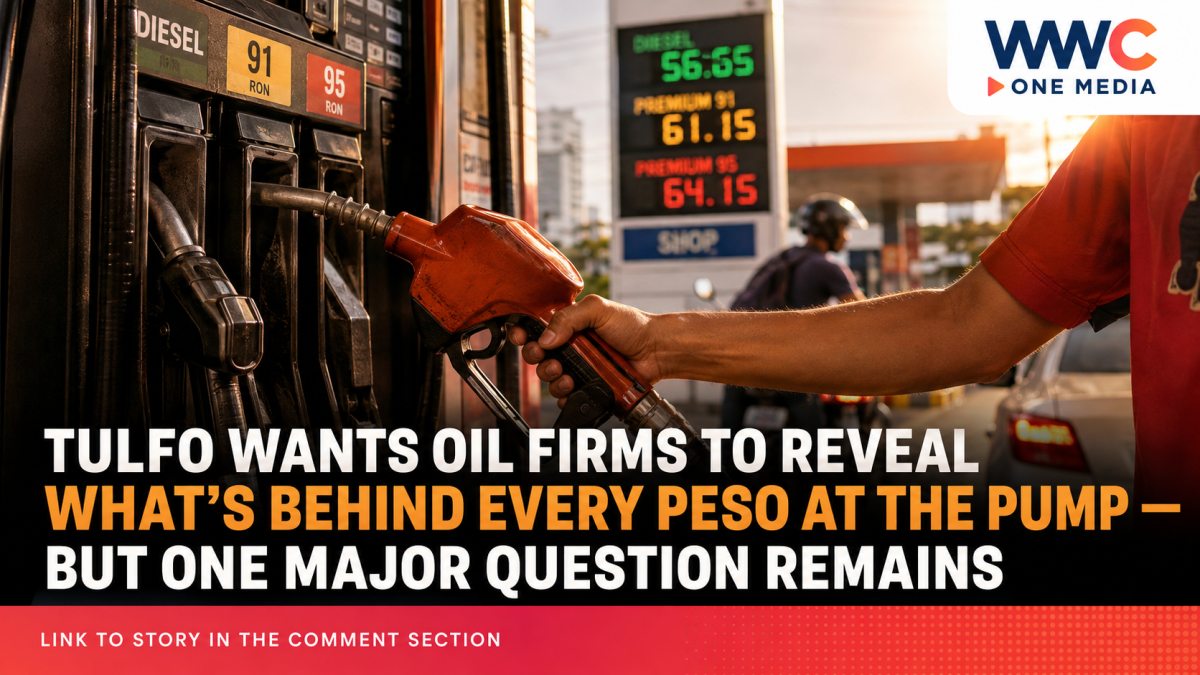
MANILA, Philippines — Filipinos see the final number glowing on gasoline-station price boards every week. But how much of every peso actually pays for imported fuel, freight, insurance, operating expenses — and how much becomes profit?
Senator Erwin Tulfo wants the government to get clearer answers.
Tulfo, chairman of the Senate Committee on Energy, is renewing his push to amend the Philippines’ decades-old Oil Deregulation Law to strengthen transparency in the way petroleum companies calculate and adjust pump prices.
The senator said the Department of Energy should have stronger and clearer authority to demand explanations from oil companies whenever fuel prices increase, arguing that motorists, public-transport drivers and consumers should not simply absorb higher costs without understanding what is behind the adjustment.
The issue reaches far beyond motorists.
When diesel and gasoline become more expensive, transportation and logistics costs can rise as well, potentially adding pressure to fares, food deliveries and the prices of other goods. That is why transport groups have repeatedly called for greater scrutiny of fuel pricing and, in some cases, changes to the country’s deregulation framework.
What Tulfo Wants Oil Companies to Reveal
At the center of the debate is Senate Bill No. 641, or the proposed measure institutionalizing transparency in the Philippine downstream oil industry.
The bill was filed by Senator Sherwin Gatchalian and Erwin Tulfo on July 15, 2025. It seeks to amend Republic Act No. 8479, better known as the Downstream Oil Industry Deregulation Act of 1998.
Instead of simply looking at the final pump price, proponents want regulators to have access to an “unbundled” breakdown showing the components that went into that price.
That could include information such as the acquisition cost of petroleum products and other costs affecting the price consumers eventually pay.
Tulfo has previously questioned whether Filipinos have enough visibility into those calculations, asking how much companies spend to obtain petroleum products, what additional costs are added and what their margins are per liter.
The proposal does not automatically mean the government would dictate what every gasoline station may charge.
Rather, its central goal is to give regulators greater visibility into the numbers behind price movements so they can better determine whether adjustments are justified.
The Proposed $80 Oil Trigger
A Senate committee report released during the 2026 energy crisis provides more detail on how the proposed transparency mechanism could work.
Under the version discussed in relation to Senate Bill 641, the DOE could require oil companies to submit actual cost components of their retail fuel prices when the average price of Dubai crude, based on the relevant regional pricing benchmark, stays at $80 per barrel or higher for three consecutive months.
The Senate report argued that having access to unbundled pricing information would give the government better data for consumer protection and enforcement during periods of unusually high oil prices.
But There’s a Twist: The Supreme Court Says DOE Already Has Significant Authority
The debate is more complicated than simply saying the DOE currently has no power to examine pricing data.
In a major Supreme Court ruling involving the Philippine Institute of Petroleum and several oil companies, the Court upheld the DOE’s authority to implement its 2019 fuel-pricing monitoring circular.
That circular requires oil companies to submit information including detailed computations and supporting documents covering components of their prices.
The Supreme Court rejected arguments that the circular amounted to government price control, noting that it did not impose either a price ceiling or a specific selling price.
The Court also affirmed that the DOE has authority under RA 8479 to collect relevant information needed to monitor the downstream oil industry.
That distinction matters.
Tulfo’s proposed amendments would therefore not be starting transparency oversight from zero. Instead, legislation such as Senate Bill 641 could put more explicit requirements directly into the Oil Deregulation Law and establish clearer conditions for demanding detailed cost information.
The Supreme Court also recognized safeguards for confidential or proprietary business information, meaning unbundling does not necessarily require every trade secret submitted to regulators to be publicly released.
Pressure for Transparency Has Been Growing
Tulfo is not alone in demanding more visibility.
Gatchalian has also pushed for unbundled petroleum pricing, saying regulators should be able to see how much companies paid for fuel and understand the components behind retail prices. The Philippine Star reported in March that Gatchalian argued greater transparency would help authorities examine whether unusual profit margins were emerging during periods of extreme market volatility.
Senator Imee Marcos separately filed Senate Bill No. 2007 in April, which also seeks mandatory unbundling and disclosure of petroleum prices while creating a rules-based pricing reference mechanism under the DOE.
The Department of Energy itself has supported amendments to RA 8479, although its proposals announced in July focused heavily on energy security rather than restoring direct government control of pump prices.
Energy




Leave a Reply