
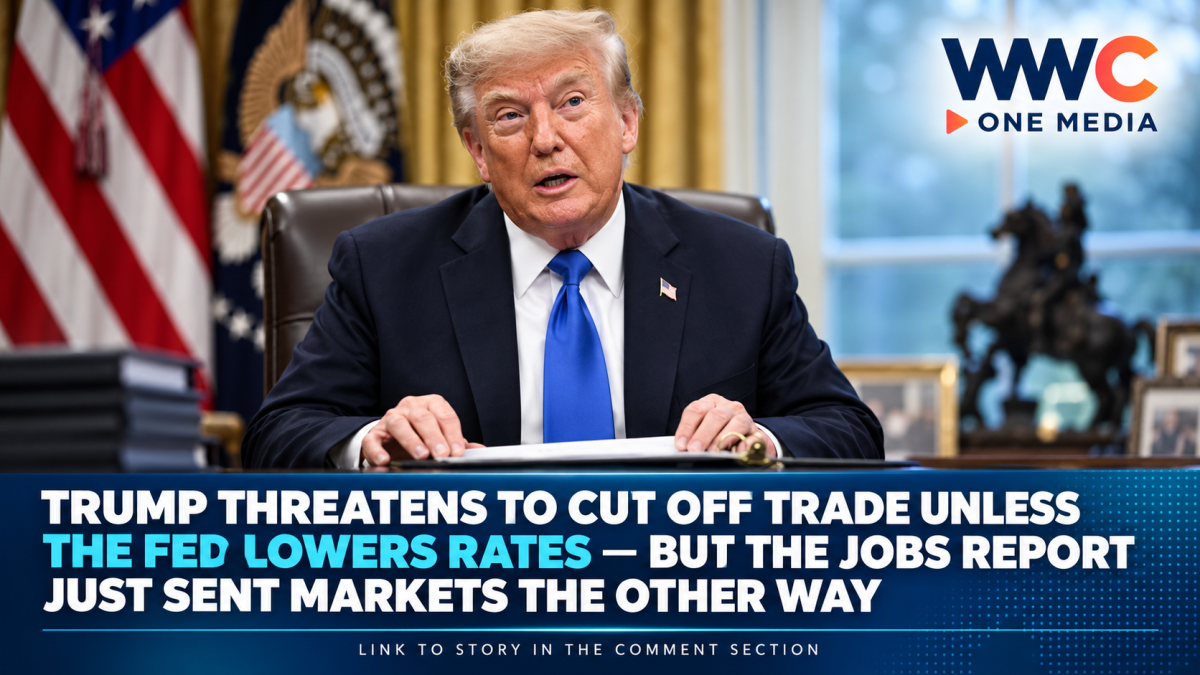
President Donald Trump escalated his pressure campaign against the Federal Reserve after U.S. employers added a surprisingly strong 162,000 jobs in August. But instead of strengthening the case for lower borrowing costs, the report sent financial markets in the opposite direction — toward growing expectations of another Fed rate hike.
WASHINGTON — President Donald Trump has dramatically raised the stakes in his battle with the Federal Reserve, threatening to stop trading with countries that run trade surpluses with the United States unless the central bank lowers interest rates.
The ultimatum came shortly after the Labor Department reported that U.S. employers added 162,000 jobs in August, far exceeding economists’ expectations, while the unemployment rate remained at 4.1%.
June and July payroll numbers were also revised upward by a combined 55,000 jobs, strengthening the picture of a labor market that has proved more resilient than many economists expected.
Trump celebrated the figures before turning his attention to monetary policy, arguing that America’s economic strength should translate into cheaper borrowing costs.
He then issued his most aggressive warning yet to the central bank, writing in a social media post:
“LOWER THE RATE OR I’LL STOP TRADING WITH COUNTRIES WITH WHICH WE HAVE A DEFICIT.”
The threat marks an extraordinary attempt to link two normally separate areas of economic policy: Federal Reserve interest-rate decisions and America’s trading relationships with the rest of the world.
The Problem for Trump: Strong Jobs Normally Make Rate Cuts Harder to Justify
Trump’s argument presents the Federal Reserve with an unusual economic contradiction.
A stronger economy can improve a country’s financial position, but the Fed does not primarily set interest rates according to America’s creditworthiness.
Its mandate centers on price stability and maximum employment.
When employment remains strong while inflation is still running above the Fed’s 2% objective, policymakers may have less reason to stimulate the economy by cutting rates.
That is exactly how financial markets interpreted Friday’s report.
Following the August payroll numbers, investors increased their expectations that the Fed could raise rates by a quarter percentage point at its September 15–16 policy meeting.
Reuters reported that market-implied odds of a September increase climbed toward roughly 60%, while some economists said additional increases later in the year remained possible depending on inflation.
In other words, the economic report Trump cited as justification for lower rates may have strengthened the argument for doing the opposite.
Wall Street Immediately Felt the Impact
Investors reacted quickly.
The S&P 500 fell about 0.4%, the Dow Jones Industrial Average dropped roughly 0.5%, and the Nasdaq Composite declined about 0.3% as Treasury yields climbed.
The two-year Treasury yield — particularly sensitive to expectations about Federal Reserve policy — rose as traders reconsidered the likelihood of near-term monetary easing.
The reaction illustrates why the August jobs report matters beyond employment.
A labor market that remains strong gives the Fed more room to concentrate on inflation rather than worrying that tighter monetary policy could trigger a sharp deterioration in employment.
Even Trump’s Own Economic Adviser Stopped Short of Calling for a Cut
The president’s demand also went further than comments from White House economic adviser Kevin Hassett.
Hassett said the jobs data strengthened the case for the Federal Reserve to hold rates steady, rather than immediately lower them, while emphasizing respect for the central bank’s independence.
That distinction is significant.
Trump is not merely arguing against another rate increase. He is explicitly demanding lower rates — and threatening major trade consequences if policymakers refuse.
Kevin Warsh Is Now at the Center of the Fight
The pressure is particularly notable because Federal Reserve Chair Kevin Warsh was Trump’s own choice to lead the central bank.
Trump had repeatedly attacked former Fed Chair Jerome Powell over interest rates. Expectations that those confrontations might ease after Warsh took over are now being tested.
Warsh must balance political pressure from the White House against the Fed’s long-standing commitment to making monetary-policy decisions independently.
Reuters noted that the August employment numbers intensified the dilemma facing policymakers because labor conditions remain strong while inflation continues to sit above the central bank’s target.
Trump’s Trade Threat Could Be Even More Consequential Than His Rate Demand
Trump’s warning goes well beyond criticism of the Fed.
Stopping trade with countries where the United States runs deficits could potentially affect a vast portion of America’s international commerce.
Trade deficits simply mean the United States purchases more goods and services from a country than it sells to that country. They exist with many major trading partners and are deeply embedded in global supply chains.
Economists quoted by MarketWatch warned that abruptly cutting those trade relationships could create supply disruptions inside the United States and potentially push prices higher.
That creates another potential contradiction.
If restricting imports raises prices, additional inflationary pressure could make it harder, rather than easier, for the Fed to lower interest rates.
There Are Legal Questions, Too
Trump suggested that existing presidential authority would allow him to stop trade with deficit countries, pointing to a previous Supreme Court ruling involving his tariff powers.
But reporting from the Los Angeles Times/Bloomberg noted that any broad attempt to impose trade embargoes on that scale would almost certainly invite legal challenges.
The president therefore faces not only economic questions over whether such a policy would achieve his stated objective, but potentially significant constitutional and statutory disputes over how far presidential trade authority extends.
Inflation Data Could Decide What the Fed Does Next
The next major test comes from upcoming U.S. inflation reports.
Investors will closely watch the Consumer Price Index and Producer Price Index before the Federal Reserve begins its September 15–16 meeting.
If inflation shows renewed acceleration, pressure for another rate increase could strengthen.
If price growth cools more sharply than expected, policymakers would have more room to leave rates unchanged and potentially reconsider cuts further down the road.
Citigroup has already pushed back its forecast for the Fed’s next rate cut into 2027 following the unexpectedly strong August jobs figures.
The Bigger Story: A Battle Over Fed Independence
Trump’s latest comments turn what might otherwise have been a straightforward jobs report into a much larger confrontation over the boundaries between presidential power and central-bank independence.
Presidents routinely express opinions about interest rates.
But tying Federal Reserve decisions to threats involving international trade represents a much more aggressive form of political pressure.
For consumers and businesses, the stakes are substantial.
Fed policy affects mortgages, credit cards, business loans, government borrowing costs, currencies and financial markets around the world. Trade restrictions can simultaneously influence prices, supply chains, corporate investment and employment.
Trump wants America’s economic strength to deliver dramatically lower borrowing costs.
The Fed may look at the same economic strength — and reach exactly the opposite conclusion.
And with inflation data arriving just days before the Fed’s September meeting, the biggest question is no longer whether Trump wants lower rates. It is whether the economic numbers will give Kevin Warsh any reason to deliver them.
WWC ONE MEDIA M.J.E




Leave a Reply