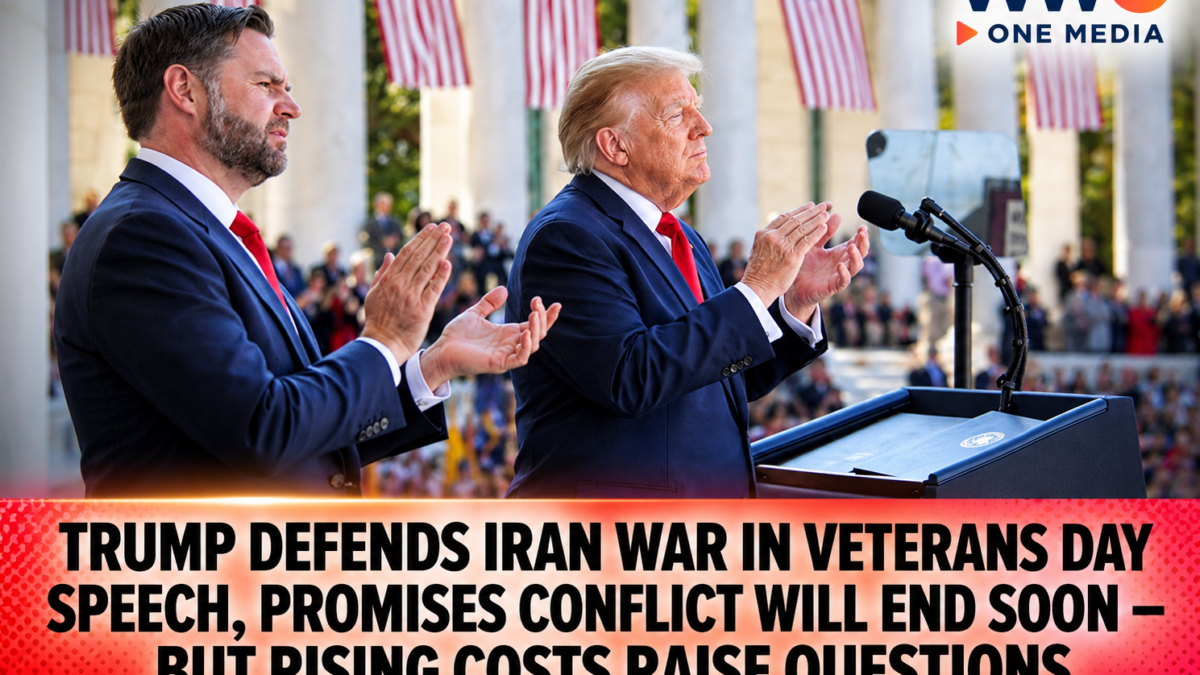
WASHINGTON, United States — November 12, 2026 — President Donald Trump has renewed his defense of the United States’ military campaign against Iran, telling veterans and military officials that the conflict will end soon while insisting that Washington must secure a complete victory.
Speaking during the Veterans Day commemoration at Arlington National Cemetery in Virginia on Wednesday, November 11, Trump argued that the United States did not initiate the conflict and accused Iran of conducting hostile actions against America dating back to the 1979 Islamic Revolution.
“When this conflict is over, and it will be soon, the entire world will be a much safer and better place,” Trump said.
His remarks come as the prolonged conflict faces increasing scrutiny over American military casualties, economic consequences, diplomatic uncertainty and its growing impact on domestic politics.
Despite Trump’s confidence that the United States has prevailed militarily, questions remain over what a final victory would look like and whether Washington and Tehran can reach an agreement that prevents another escalation.
Trump Says America Did Not Start the War With Iran
During his Veterans Day address, Trump rejected criticism that his administration was responsible for starting the war.
He argued that Iran had been waging war against the United States for decades and pointed to the history of attacks involving Iranian-backed groups as part of his justification for the military campaign.
“America did not start a war with Iran,” Trump said, maintaining that American forces were responding to longstanding threats.
The president also emphasized that preventing Iran from developing a nuclear weapon remains a central objective of the military operation.
Trump described the American campaign as a successful military effort and said the United States should not settle for an incomplete outcome.
“We must have a total victory,” he declared.
The president’s remarks reinforced his administration’s position that military pressure is necessary to weaken Iran’s capabilities and prevent future threats to American security.
However, his characterization of the conflict represents the administration’s position, rather than an independently established conclusion about the war’s origins or its eventual outcome.
Iran War Has Cost American Lives as Pentagon Reports Mounting Casualties
One of the most significant issues surrounding Trump’s speech was the human cost of the conflict.
According to the latest Pentagon figures cited by Agence France-Presse, the war has resulted in the deaths of 23 American service members, with several hundred others wounded.
The conflict began on February 28, 2026, when the United States and Israel launched strikes against Iran.
Trump also acknowledged American military losses during his address, referring to 18 service members killed in the conflict.
The figures differ: the president cited 18 deaths in his remarks, while the latest Pentagon total reported by AFP was 23. The official military count is the appropriate figure to use when reporting the overall casualties.
The growing number of casualties has intensified questions about the duration of the military operation, the administration’s objectives and the risks faced by American personnel.
For military families, veterans and the wider American public, the promise of a quick end to the conflict carries particular significance.
However, Trump did not provide a specific timetable or a detailed roadmap explaining how the United States intends to achieve the promised conclusion.
Veterans Day Speech Comes Amid Growing Political Pressure
Trump’s defense of the Iran war also comes at a difficult political moment for his administration.
The conflict has become an increasingly unpopular issue among American voters, with concerns about military spending, casualties and the cost of living contributing to public frustration.
According to reporting by The Associated Press, an Election Day survey found that roughly six in 10 voters believed the decision to use military force against Iran was wrong.
The war has also become a political liability for Republicans, with recent midterm election results handing Democrats control of Congress.
Trump has previously acknowledged that the conflict played a role in the election outcome.
The political consequences could become more significant as lawmakers debate military authorization, government spending and the administration’s strategy toward Iran.
The issue is particularly sensitive because the president must balance national security objectives against growing demands for accountability and a clearer explanation of how the war will end.
Defense Secretary Pete Hegseth Faces Controversy During Arlington Ceremony
The Veterans Day event also attracted attention because of an incident involving Defense Secretary Pete Hegseth.
According to Agence France-Presse, an Army sentinel guarding the Tomb of the Unknown Soldier publicly reminded a small group that included Hegseth, his wife and several aides to maintain silence and respect at the memorial.
The incident happened after members of the group reportedly laughed while posing for a photograph near the sacred site.
The sentinel interrupted his patrol to remind visitors of the rules governing behavior around the tomb.
The moment drew additional attention because the Tomb of the Unknown Soldier represents America’s fallen military personnel and is treated as one of the country’s most solemn national memorials.
Trump, meanwhile, praised Hegseth during his speech, describing the defense secretary’s performance positively.
The remarks came just one day after House Republicans blocked an impeachment effort against Hegseth. The proposed action involved allegations that he had conducted military operations without congressional authorization and abused his position as Pentagon chief.
Those allegations remain political and legal claims, not established findings of wrongdoing.
Iran Conflict Continues to Threaten Middle East Stability and Global Shipping
Beyond American domestic politics, the conflict continues to create uncertainty across the Middle East.
The Strait of Hormuz remains particularly important because it is one of the world’s most strategically significant shipping routes for oil and liquefied natural gas.
Reuters reported on November 11 that shipping activity through the Strait had increased, but attacks on vessels had also reached a wartime high.
The International Maritime Organization had recorded 130 incidents and at least 25 seafarer deaths, according to the Reuters report.
These developments demonstrate that the consequences of the conflict extend beyond the battlefield.
Disruptions to commercial shipping can increase transportation costs, threaten energy supplies and create additional uncertainty for international markets.
For countries dependent on imported fuel, including the Philippines, prolonged instability in the Middle East is worth watching closely.
Higher international oil prices can eventually affect domestic fuel costs, transportation expenses and the prices of goods, although the actual impact depends on global supply, market conditions and local pricing adjustments.
The broader economic consequences make a peaceful and sustainable resolution important not only for Washington and Tehran but also for countries that rely on stable international trade.
Trump Raises Prospect of Total Victory as Diplomatic Questions Remain
Although Trump expressed confidence that the war would end soon, his speech did not provide a clear explanation of the conditions required to end the military campaign.
His demand for total victory raises important questions about the administration’s expectations.
Would victory mean permanently eliminating Iran’s nuclear capabilities? Would it require a diplomatic agreement? Or would Washington continue applying military and economic pressure until Tehran accepts American demands?
These questions remain central to understanding the next stage of the conflict.
Recent diplomatic developments and economic pressure have created opportunities for negotiations, but major disagreements remain over sanctions, Iran’s nuclear program and the future of regional security.
Reuters’ November 11 reporting also highlighted continuing tensions involving the Strait of Hormuz, Gulf shipping and the possibility of renewed military action.
A reduction in active fighting does not necessarily mean that the conflict has been resolved.
Without a comprehensive agreement, the possibility of renewed confrontation remains.
Trump Promises a Safer World, but the End of the Iran War Remains Uncertain
Trump’s Veterans Day address was intended to honor American service members while defending one of the most consequential military decisions of his administration.
He presented the Iran campaign as a necessary response to decades of threats and promised that its conclusion would make the world safer.
Yet the conflict continues to raise difficult questions about military casualties, political accountability, international stability and the economic consequences of prolonged fighting.
The administration’s promise that the war will end soon has yet to be accompanied by a publicly detailed timetable or comprehensive settlement.
For American families with loved ones serving in the military, the most important question is not simply whether Washington can claim victory.
It is whether the conflict can end without further loss of life and without creating another cycle of instability in the Middle East.