
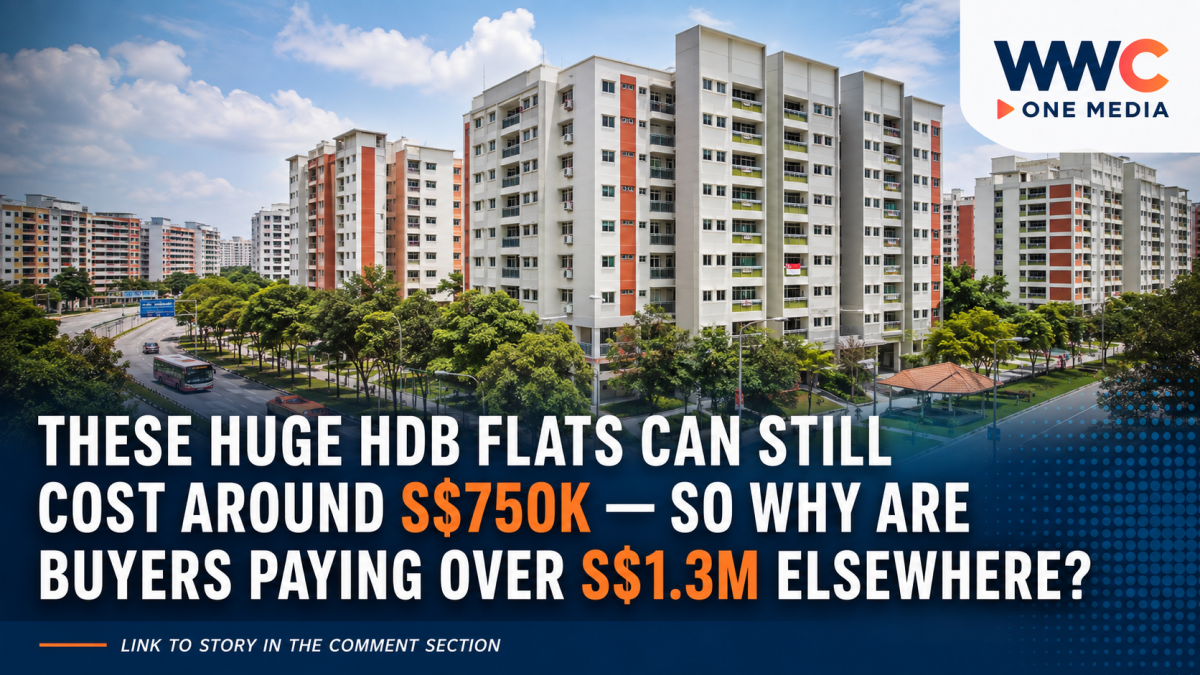
SINGAPORE — At a time when many homebuyers complain that newer flats are getting harder to stretch for growing families, one increasingly scarce category of public housing is attracting renewed attention: the HDB Executive Apartment.
These supersized flats can offer roughly 1,300 sq ft to as much as 2,400 sq ft of floor area, giving owners considerably more room than most conventional newer HDB layouts. But in 2026, buyers looking for that extra space face an extraordinary price divide: similar flat types can average below S$800,000 in some heartland towns while crossing S$1 million — and in rare cases S$1.3 million — elsewhere.
What exactly is an HDB Executive Apartment?
Executive Apartments, commonly called EAs, were introduced in 1984 as larger public housing options for households that wanted more living space without making the jump into private property.
They were eventually discontinued in the early 2000s, meaning even the youngest EAs are now more than two decades old. Typical layouts are on a single level and can include three or more bedrooms, large living and dining areas, utility or study spaces and, in some units, sizeable balconies.
That combination of size and limited future supply is what makes them unusual today: HDB is no longer building new Executive Apartments of this type.
Where are the Executive Apartments?
The biggest concentrations are found outside Singapore’s central region, particularly in established towns developed heavily during the late 1980s and 1990s.
According to transaction data analysed by Stacked Homes covering January 2025 to August 2026, Woodlands recorded the largest number of EA transactions, followed by Pasir Ris and Jurong West. EAs can also be found in areas such as Sembawang, Sengkang, Hougang, Tampines, Yishun and Choa Chu Kang.
The price differences, however, are striking.
| HDB town | Average EA resale price | Transactions in dataset |
|---|---|---|
| Sembawang | S$749,719 | 108 |
| Jurong West | S$785,601 | 152 |
| Choa Chu Kang | S$806,204 | 105 |
| Sengkang | S$840,014 | 141 |
| Pasir Ris | S$909,011 | 200 |
| Woodlands | S$940,938 | 207 |
| Tampines | S$963,714 | 113 |
| Ang Mo Kio | S$1,103,250 | 8 |
| Bishan | S$1,257,378 | 5 |
| Queenstown | S$1,281,417 | 6 |
| Bukit Timah | S$1,390,000 | 1 |
The figures show why location remains crucial. In the dataset, 10 of the 23 towns analysed recorded average EA prices above S$1 million, while Sembawang, Jurong West and Choa Chu Kang remained among the relatively more affordable markets.
There is an important warning about interpreting those numbers: transaction volumes in some premium locations are extremely thin. Bukit Timah’s S$1.39 million figure, for example, was based on just one transaction, while Clementi’s S$1.033 million average was also based on one transaction. By comparison, Woodlands recorded 207 deals and Pasir Ris 200, giving those averages a much broader transaction base.
Buyers can still find EAs below S$800,000
Current asking-price data also shows that large EAs have not universally become million-dollar homes.
PropertyGuru listings in August included an approximately 1,474 sq ft Executive Apartment in Sembawang asking S$690,000, while other Sembawang units were marketed in the S$700,000-plus range. Listings in Sengkang included EAs of around 1,399 to 1,518 sq ft at roughly S$780,000 to S$795,000.
Those are asking prices rather than completed transactions, so they should not be treated as final market values. But they reinforce the broader picture: buyers willing to consider northern, western and northeastern estates can still find very large HDB homes well below the seven-figure level.
Why could demand rise again?
Another major change arrived in July.
Singapore removed the 15-month wait-out period that had applied to private residential property owners and former owners seeking to buy certain HDB resale flats.
From July 28, eligible private-property owners can purchase a non-subsidised HDB resale flat without an HDB housing loan without first waiting 15 months after selling their private home. Private property owners using this route must dispose of their private residential property within six months of completing their resale-flat purchase.
That matters particularly for Executive Apartments.
Property analysts interviewed by CNA said former private-home owners who return to the HDB market are more likely to focus on larger five-room, executive and multi-generation flats, since these households may have more purchasing power and may be unwilling to sacrifice too much living space when moving out of a condominium or landed property.
However, analysts did not expect the rule change by itself to send the entire HDB resale market sharply higher.
The wider HDB market has actually been cooling
The renewed interest in larger resale flats comes against a surprisingly softer broader market.
HDB’s Resale Price Index stood at 202.8 in the second quarter of 2026, down 0.3 per cent from the first quarter. This followed a 0.1 per cent decline in the first three months of 2026 — the first quarterly drop in nearly seven years.
CNA reported that analysts expect the removal of the 15-month restriction to provide some additional support to larger resale flats, but an increase in flats reaching their Minimum Occupation Period and continued BTO supply should help prevent a broad-based price surge.
That could create something closer to a two-speed resale market: ordinary resale prices remain relatively stable while scarce, unusually large or exceptionally well-located homes continue commanding premiums.
The biggest catch: these flats are getting older
Space is the strongest argument for buying an Executive Apartment.
Lease age is the strongest argument for thinking carefully before doing so.
Many EAs are already around 25 to more than 40 years old. With Singapore’s HDB flats generally sold on 99-year leases, buyers have to consider not just today’s price but how many years will remain when they eventually want to sell.
Financing can also change as a flat ages.
HDB states that the amount of CPF savings buyers can use and, where applicable, the HDB housing loan-to-value limit depend partly on whether the remaining lease can cover the youngest buyer until age 95. If it cannot, CPF usage and the available HDB loan can be pro-rated.
That means a spacious older EA that looks inexpensive on a price-per-square-foot basis may require a different financing calculation from a much newer flat.
So are Executive Apartments still worth buying?
For families who genuinely need space, the attraction is easy to understand.
Finding a single-storey HDB home measuring 1,400, 1,500 or even more than 1,600 sq ft is increasingly unusual, while some of the largest Woodlands Executive Apartments approach or exceed 2,000 sq ft. The original transaction study recorded Woodlands EAs ranging from roughly 1,399 sq ft to 2,067 sq ft.
But buyers effectively face a trade-off.
A S$750,000 to S$900,000 EA in Sembawang, Jurong West, Choa Chu Kang or parts of the north may provide enormous living space for the money. A similarly large flat in Bishan, Queenstown or another highly sought-after location can move well into million-dollar territory.
And whichever estate buyers choose, the remaining lease may ultimately matter as much as the size of the living room.
With private-property owners now facing fewer barriers to entering part of the HDB resale market, Singapore’s Executive Apartments could attract another wave of interest.
The question is whether buyers will see these increasingly scarce giant flats as value-for-money homes that can no longer be replaced — or ageing leasehold assets whose biggest selling point is also hiding their biggest long-term risk.




Leave a Reply