
For years the checks arrived on time.
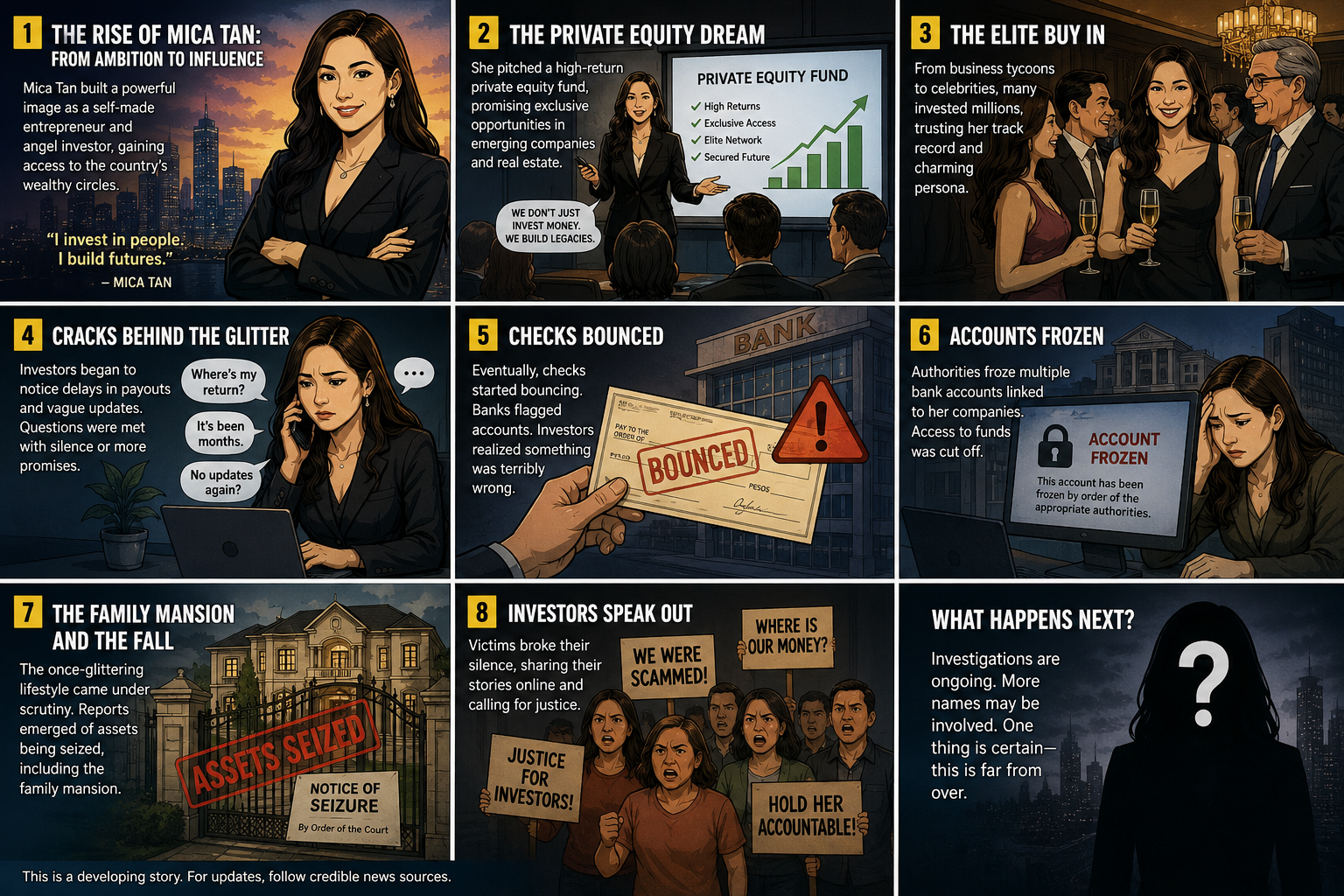
They came on good paper, often carrying the signature of Maria Francesca “Mica” Tan herself or one of a small circle of trusted associates. The amounts were steady: 1 to 1.5 percent a month, packaged as interest on what investors were repeatedly told were private loans. The accompanying story was elegant and exclusive. This was not a public offering. It was angel money. Bridge financing for “sure projects” — diagnostic machines bound for government hospitals, purchase orders that traditional banks were too slow to fund, strategic capital for family legacy businesses being modernized by a young operator who claimed she had been trading stocks since she was thirteen.
The people who wrote the larger checks were not the typical targets of online investment frauds. Many were professionals, entrepreneurs, and high-net-worth individuals introduced through personal networks, business circles, or quiet referrals. Some placed ₱1 million to ₱5 million. A smaller number went higher. One investor later told reporters he had committed ₱14 million. On the Philippine investing subreddit r/phinvest, participants described groups of friends pooling significantly larger sums; one circulating claim spoke of a circle that had committed around ₱120 million. Minimum tickets sometimes dropped to ₱100,000 for those who knew the right people. Nondisclosure agreements were common. For high performers who brought in new capital, there were travel incentives — Balesin Island, Cambodia, and teased destinations farther afield. Company newsletters once showed staff enjoying the same amenities.
Tan’s public image made the pitch land. She appeared as a judge on The Final Pitch, the local version of Shark Tank. She made Tatler’s Gen.T list. As late as 2022 she was nominated for EY Entrepreneur of the Year. Contemporary profiles described a millennial private-equity operator who had formalized her activities into the MFT Group of Companies in 2014, growing it from purchase-order financing roots into a firm that claimed assets of roughly ₱3.2 billion by mid-2018 and operations spanning multiple countries. The language was consistent: non-traditional lending, strategic equity, restructuring of family businesses, capital that moved faster than the banks.
Then, gradually and then all at once, the paper stopped clearing.

The Origin Story That Sold Itself
The public narrative Tan cultivated began early. In interviews she described learning the stock market as a teenager and, around age 17, launching a small purchase-order financing operation with older friends. The activity was later formalized in 2014 as the MFT Group of Companies, based in Bonifacio Global City. The stated mission was to take stakes in family legacy businesses, inject operating capital, and restructure operations across healthcare, food and beverage, financial services, and lifestyle sectors. Company materials and media profiles at the time listed interests ranging from medical-equipment suppliers and kidney-care facilities to restaurant brands and an online pawnshop partnership.
By 2018 the group was publicly claiming a portfolio valued at about ₱3.2 billion and a growth rate of nearly 50 percent year-on-year. Tan spoke of offices or presence in Singapore, Hong Kong, and New York, and of a workforce that had expanded significantly from its early days. The image was of a young, decisive capital allocator who understood both the old-money networks of Manila and the language of modern private markets. Reality-television appearances and magazine features reinforced the perception that this was a legitimate, high-performing private-equity platform rather than a high-yield lending operation dependent on continuous new inflows.
That perception mattered. In the years that followed, the fundraising mechanism that regulators would later scrutinize relied heavily on trust, personal introductions, and the absence of the usual red flags associated with public solicitations.
How the Money Was Raised
According to the Securities and Exchange Commission and subsequent prosecutorial findings, the core structure was consistent across multiple years. Prospective participants were presented with borrower-lender agreements or memoranda of agreement that converted into promissory notes. In exchange for capital they received a series of post-dated checks promising monthly interest of 1 to 1.5 percent — annualized returns of 12 to 18 percent. The funds, they were told, would finance purchase orders and short-term working capital for portfolio companies that could not wait for conventional bank facilities. The arrangements were repeatedly framed as private commercial lending rather than the sale of securities.
The SEC later concluded that the model’s viability depended on continuous inflows of new money to meet earlier obligations — the defining characteristic of a Ponzi-type scheme. Investor funds, regulators said, were not properly recognized in the companies’ books as either liabilities or share capital. Financial statements from 2018 to 2021 contained dividend income declarations that the commission found to have no basis. The Philippine affiliate of PwC, which had audited certain statements, was also charged in connection with the matter; the firm denied any involvement in illicit activity.
Investor accounts gathered by reporters and circulating on forums describe a process that felt exclusive rather than promotional. Meetings with directors or associates discussed healthcare and food-sector opportunities. Interest rates were positioned as only modestly higher than certain bank instruments, reducing the sense of extraordinary risk. Some participants signed nondisclosure agreements that, in retrospect, limited public discussion even as problems mounted. High performers who recruited additional capital were rewarded with travel and recognition inside the network.
Early Cracks and the Cascade of 2022
On Reddit and in private investor conversations, some participants date the first bounced checks as early as 2018 and 2019 — years before the pandemic became a frequent explanation. One investor told Bilyonaryo of multiple dishonored checks from East West Bank, Security Bank, and Metrobank accounts, with varying reasons cited at the time. A five-year program accompanied by an NDA was presented around that period, with maturity expected in 2023.
By mid-2022 the problem became systemic. Checks due that year and onward began bouncing. Replacement checks were issued, sometimes with different signatories including Tan and associates from the Agbayani circle. Those, too, were returned as unfunded or drawn on closed accounts. Follow-ups produced variations of the same response: the company was working on it. Months passed with limited concrete communication. In early 2023 a Zoom presentation was held that participants later described as a briefing rather than a genuine meeting — questions were not entertained despite an audience that included angry and distressed creditors. Face-to-face encounters with Tan herself, according to some accounts, produced standard expressions of understanding and promises to return with solutions that did not materialize on the promised timeline.
A former employee posted on r/phinvest that government-mandated benefits had been deducted from salaries but never remitted to the relevant agencies. After resigning, the employee said final pay remained unpaid more than a year later. Other accounts described internal pressure to continue raising new capital even as existing obligations slipped. One group of friends claimed on the same forum that they had invested a collective ₱120 million and had already filed court cases, noting that checks had begun bouncing as early as 2019. Recovery programs and revised schedules were circulated; many participants reported receiving little or nothing under them.
One investor who eventually recovered a substantial portion of principal plus interest and legal costs did so only after meticulously compiling contracts, bank transfer proofs, original bounced checks with bank confirmations, acknowledgment receipts, and screenshots of conversations. Most others did not possess the same combination of documentation, persistence, and resources.
Regulatory Intervention
By late 2023 the volume of complaints reaching the Securities and Exchange Commission had become impossible to ignore. On January 16, 2024, the SEC issued a cease-and-desist order against MFT Group of Companies Inc. and Foundry Ventures I Inc. for illegally soliciting investments from the public under the guise of loan contracts. The commission’s Enforcement and Investor Protection Department found that the group had organized events and used promissory notes and post-dated checks to raise capital without the required registration or secondary license under the Securities Regulation Code. The order was made permanent in April 2024 after the companies’ motion to lift it was denied.
That same month the SEC filed a criminal complaint with the Department of Justice. The complaint alleged unauthorized sale of securities and material misrepresentations in the groups’ audited financial statements. Investigators said the structure bore the hallmarks of a Ponzi-type operation: success and viability depended on additional investments from existing or new participants rather than actual business profits from the underlying projects.
In June 2025 the DOJ found sufficient evidence to indict Tan and associates for violations of the Securities Regulation Code. Parallel tracks continued to escalate.
The Criminal Escalation
In March 2026 Taguig City prosecutors issued a 48-page joint resolution consolidating 19 complaints from 32 individuals seeking a total of ₱83.92 million in damages. The panel recommended the filing of non-bailable syndicated-estafa charges under Presidential Decree 1689 against Maria Francesca Dela Fuente Tan-Cancio and four co-respondents: Charles Edward Tan, Enrique Eduardo Tan, Christian Konstantin P. Agbayani, and Roxanne Agbayani. The resolution stated that the respondents had acted with a single criminal intent in forming and managing the companies to defraud the complainants through false pretenses and unauthorized investment schemes, and that the operation bore the hallmarks of a Ponzi-type scheme. Complaints against 35 other individuals were dismissed for lack of prima facie evidence.
A separate Lipa City court in Batangas had already issued a non-bailable arrest warrant for syndicated estafa. The Court of Appeals, acting on a request from the Anti-Money Laundering Council, ordered the freeze of 138 bank accounts together with securities and insurance accounts after finding probable cause that the assets were related to unlawful activity. In May 2026 Interpol published a red notice at the request of Philippine authorities, asking law-enforcement agencies worldwide to locate and provisionally arrest Tan pending extradition or similar proceedings.
The House in Kawilihan Village
While the legal cases advanced, the personal consequences became visible on the property rolls. Wealth Development Bank listed the family’s house in Kawilihan Village, Pasig City, as a foreclosed asset available for sale. The property sits on a 264-square-meter lot with a floor area of approximately 1,015.5 square meters and was priced at ₱64 million on the bank’s acquired-assets roster as of May 2026. Foreclosure in the Philippines typically follows a prolonged period of default and collection efforts; the listing indicated that process had run its course.
Multiple family members appear in the charging documents. The public record of earlier civil disputes — including partner-company allegations of unauthorized stock-and-transfer books and direct client dealings, as well as 2018 arrest warrants in Pasay that were later contested or settled — added to the picture of accumulating legal pressure that predated the SEC’s major intervention.
The Defense and the Settlement Attempts
Throughout the unfolding crisis, Tan and her legal team have maintained a consistent position. The arrangements, they argue, were ordinary private loan obligations rather than investment contracts or securities. The funds, they say, were used for legitimate operating businesses. The characterization of the activity as a Ponzi or pyramiding scheme is, in their view, incorrect. In June 2026 Tan told the Philippine Daily Inquirer that she was prepared to return to the Philippines to face the legal process and clear her name. Her counsel, Argee Guevarra, stated that the decision to return had been made months earlier and was not a reaction to the passport-cancellation move by the SEC.
In communications and video conferences with creditors, Tan has warned that detention would disrupt the leadership necessary for any recovery plan and has continued to propose restructuring ideas, including new ventures in solar panels, batteries, and electric vehicles. The Securities and Exchange Commission has publicly set conditions for any discussion of settlement: surrender first, demonstration of real funds that can be placed in escrow, and a concrete payment plan for investors. SEC Chairperson Francis Lim has stated that without those elements the commission will not entertain talks.
Investor Voices and the Question of Scale
The human texture of the story appears most clearly in the accounts of those who wrote the checks. Some describe years of prompt payment followed by sudden silence. Others recount the psychological weight of nondisclosure agreements that made public discussion feel risky even as private losses mounted. A minority who documented every transfer, every bounced check, and every conversation managed to recover portions of their capital through individual legal pressure. The majority remain in a prolonged waiting posture.
No single public court filing has yet established a definitive total of all capital raised across every channel and every year of the operation. The largest consolidated criminal batch sits at ₱83.92 million from 32 complainants. Individual reported exposures range from six figures to the low eight figures. Earlier company claims spoke of assets in the billions. SEC officials have referred, in the context of restitution, to obligations “in the billions.” The precise overall scale remains a matter for ongoing forensic work and judicial determination.
The Cliff That Has Not Yet Been Resolved
As of late August 2026 the situation stands in a state of suspended animation. The Interpol red notice is active. The non-bailable warrants from Taguig and Lipa remain outstanding. The 138 bank accounts and related assets stay under freeze order. The Kawilihan Village house continues to appear on the bank’s list of properties for sale. Public Zoom updates to the broader creditor group have largely ceased. On investor forums the tone has shifted from urgent coordination to weary documentation and dark humor.
Tan says she is coming back to clear her name.
The warrants require her appearance.
The frozen accounts and the empty house in Pasig say the story is no longer solely under her narrative control.
Whether the next movement is a voluntary surrender and structured settlement, a contested extradition process, a prolonged legal stalemate, or another cycle of revised recovery promises is the single detail that no promissory note, no post-dated check, and no five-year schedule ever managed to guarantee. For the investors who once received those checks on time, that unanswered question is now the only instrument still outstanding.



Leave a Reply