
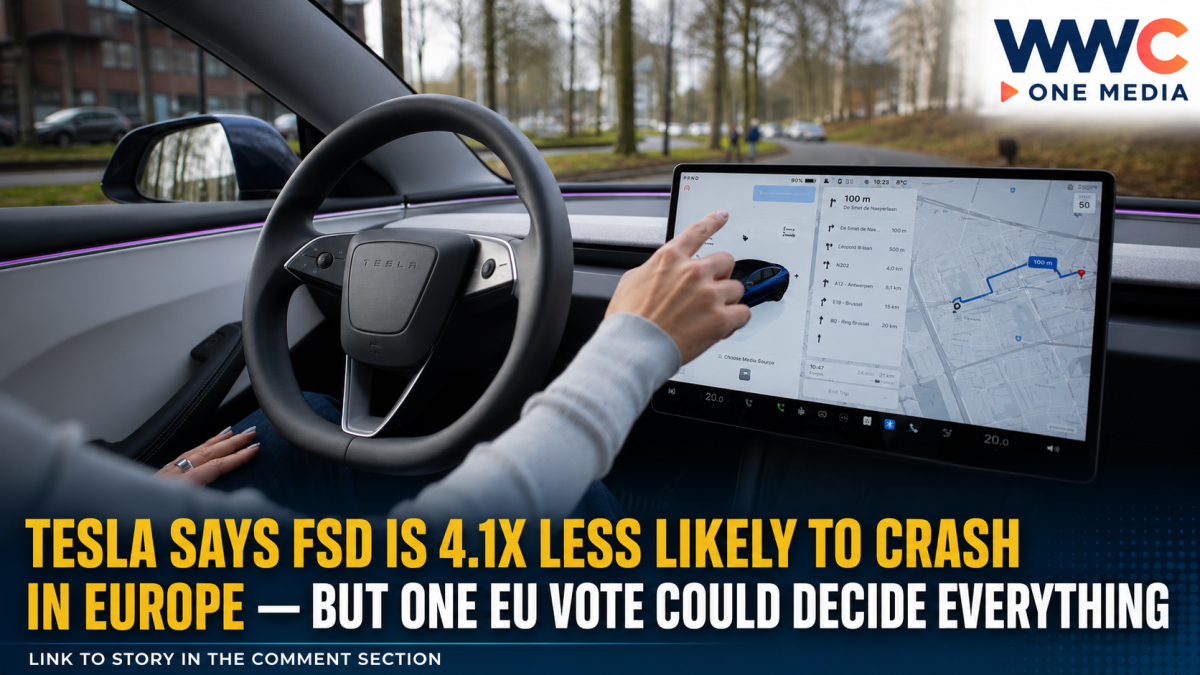
Tesla has released one of its strongest arguments yet for bringing Full Self-Driving across the European Union: more than 100 million kilometres of real-world driving and a claimed collision rate dramatically below that of manually driven Teslas.
But with a potentially decisive EU vote approaching, the biggest question is no longer whether Tesla has numbers.
It is whether European regulators trust what those numbers actually prove.
Tesla said on September 1 that its Full Self-Driving (Supervised), or FSD Supervised, technology was 4.1 times less likely to be involved in a collision than Teslas driven manually across the five European Union countries where the system has already been permitted.
The company said the comparison was based on more than 100 million kilometres, or about 62 million miles, of driving between April and August 2026 in the Netherlands, Belgium, Denmark, Estonia and Lithuania.
According to figures reported by Reuters, vehicles operating with FSD were involved in three reported collision events on highways and nine on non-highway roads during the measurement period. Tesla reported 137 highway collisions and 490 non-highway collisions involving manually driven vehicles in its comparison dataset.
The headline numbers are powerful.
The regulatory fight surrounding them is considerably more complicated.
Tesla Opens Its Safety Case as Europe Nears a Crucial Decision
Alongside its latest European driving figures, Tesla has made public an extensive FSD Supervised safety-evidence dashboard that the company says formed part of the material supporting its regulatory case.
The dashboard includes collision-rate studies, road-type comparisons, automatic emergency braking measurements, European engineering-fleet testing and fixed-route evaluations in major European cities.
Tesla describes FSD Supervised as using eight exterior cameras together with its onboard computer and additional systems for functions including localisation and driver monitoring. Its published methodology also says a collision can be classified as involving FSD when the system was active within five seconds before the event — an approach intended to capture incidents where a driver disengages shortly before impact.
However, there is an important distinction between the dashboard and Tesla’s newest 100-million-kilometre claim.
The detailed regulatory dashboard largely contains data collected before the system’s broader European customer rollout. Tesla says the dashboard had already been provided to EU member states in April, while the newly announced 100-million-kilometre figure reflects subsequent public-road usage in the five countries where FSD Supervised became available. Automotive outlet Eletric-Vehicles also highlighted that the dated measurement periods in the publicly released regulatory file predate the current European rollout.
That means Tesla is effectively presenting regulators with two layers of evidence: the testing and statistical work that helped secure the initial Dutch approval, and a rapidly growing body of customer-driving data accumulated since then.
The Netherlands Put Tesla Through More Than 18 Months of Testing
Tesla’s strongest counterargument to claims that Europe is relying solely on company-generated statistics may come from the Netherlands.
Dutch vehicle regulator RDW approved FSD Supervised on April 10, 2026, following more than a year and a half of examination on test tracks and public roads.
RDW later disclosed that its evaluation included more than 3,000 hours of testing, over 1,000 test runs and data involving 1.8 million kilometres driven in Europe with FSD Supervised.
The regulator said its own data specialists reviewed Tesla’s statistical methods and that RDW did not rely only on information supplied by the automaker.
After that work, RDW concluded that the system met the applicable requirements and said FSD Supervised, when properly used, could make a positive contribution to road safety.
The Netherlands’ provisional approval subsequently opened the door for Belgium, Denmark, Estonia and Lithuania to permit the technology as well.
Yet one misconception remains important.
Despite its name, Full Self-Driving Supervised is not considered a fully autonomous driving system in Europe.
FSD can steer, accelerate, brake, change lanes and handle numerous driving situations, but the person behind the wheel remains responsible for the vehicle and must be prepared to intervene.
RDW explicitly describes it as a driver-assistance system rather than a self-driving vehicle.
The 4.1x Safety Claim Comes With Baggage
Tesla’s latest statistics arrive after months of controversy surrounding some of its earlier safety claims.
A Reuters investigation published in June found that independent road-safety researchers questioned previous statistics Tesla had supplied or promoted during its European approval campaign.
Researchers cited by Reuters said some of the company’s comparisons mixed datasets that were not sufficiently comparable — for example, contrasting Tesla FSD crash measures with broader driving populations or differently defined collision categories — potentially exaggerating the apparent safety advantage.
Tesla did not respond to Reuters’ detailed questions for that investigation.
The Dutch regulator, however, pushed back against the implication that its decision depended on Tesla’s marketing statistics.
RDW said it checked whether Tesla’s European data was complete, verifiable and accurate, independently reviewed the statistical analysis and conducted its own extensive road and track testing before granting approval.
That distinction could become central to the next phase of the debate.
The question facing European policymakers is therefore not simply whether Tesla can produce impressive statistics.
It is whether the testing methodology, driver populations, road types, collision definitions and exposure measurements allow regulators to conclude that those statistics translate into a genuine safety improvement across the EU’s vastly different driving environments.
European Regulators Still Have Concerns
Not every European regulator has been convinced.
Correspondence reviewed by Reuters earlier this year showed authorities in several countries raising questions about FSD Supervised, including concerns about speed-limit behaviour, performance on icy roads and whether drivers might circumvent monitoring features intended to discourage mobile-phone use while the system is operating.
Those concerns matter because Tesla is seeking something much larger than approval in five countries.
It wants FSD Supervised available throughout the European Union.
Tesla has pursued approval through Europe’s regulatory process for new technologies, including exemptions connected with rules governing Driver Control Assistance Systems. Its safety dashboard says the evidence was prepared to support the company’s case under the relevant European Article 39 procedure.
For EU-wide acceptance, the proposal would need a qualified majority: at least 15 of the EU’s 27 member states representing at least 65% of the bloc’s population.
Tesla says a vote could take place as early as October 6, 2026, although the timing should be treated as a potential rather than guaranteed vote date unless formally confirmed by EU authorities.
Why Tesla Needs Europe to Say Yes
The regulatory battle comes at a critical moment for Tesla’s European business.
August registration figures painted a sharply divided picture.
Tesla registrations increased 279% year-on-year in France and 104% in Denmark, according to industry data reported by Reuters, while registrations fell 79% in Norway and Spain and 41% in Sweden.
More broadly, Tesla’s European sales have been recovering in 2026 following two consecutive years of annual declines, helped by factors including stronger EV demand in some markets, incentives, fuel prices and more competitive Tesla pricing.
FSD could therefore become more than another software feature.
For Tesla, it is potentially a major differentiator in an increasingly crowded European EV market, where established manufacturers and rapidly expanding Chinese brands are competing aggressively for customers.
Unlocking the software across the EU would also allow Tesla to sell a higher-value digital product to a much larger pool of existing and future owners without building an entirely new vehicle.
That helps explain why the regulatory decision carries such strategic weight.
The Numbers Are Growing — The Scrutiny Will Grow With Them
Tesla now has something it lacked when its European campaign began: a rapidly expanding population of ordinary customers using FSD Supervised on European public roads.
More kilometres should eventually provide regulators and researchers with stronger statistical evidence.
But larger datasets do not automatically settle the safety debate.
How collisions are defined, how highway and urban driving are weighted, which vehicles and drivers are compared, when FSD is considered responsible for an event and how differences in road conditions are controlled can dramatically affect the final safety ratio.
That is why Tesla’s 4.1-times-lower collision claim should be reported as Tesla’s finding, rather than an independently established fact about autonomous-driving safety across Europe.
The Dutch regulator’s extensive testing provides meaningful regulatory support for the technology, while previous criticism of Tesla’s statistical comparisons provides an equally important reason for continued scrutiny.
And that sets up the real cliffhanger.
Tesla has already persuaded regulators in five EU countries that FSD Supervised can operate on their roads.
It has accumulated more than 100 million kilometres of European customer driving.
And it has now put part of its regulatory safety case into public view.
But persuading five countries was only the first battle.
The next one could determine whether Tesla’s most ambitious driver-assistance technology finally reaches the rest of Europe — or whether regulators decide that even 100 million kilometres are not yet enough.
WWC ONE MEDIA MJE




Leave a Reply