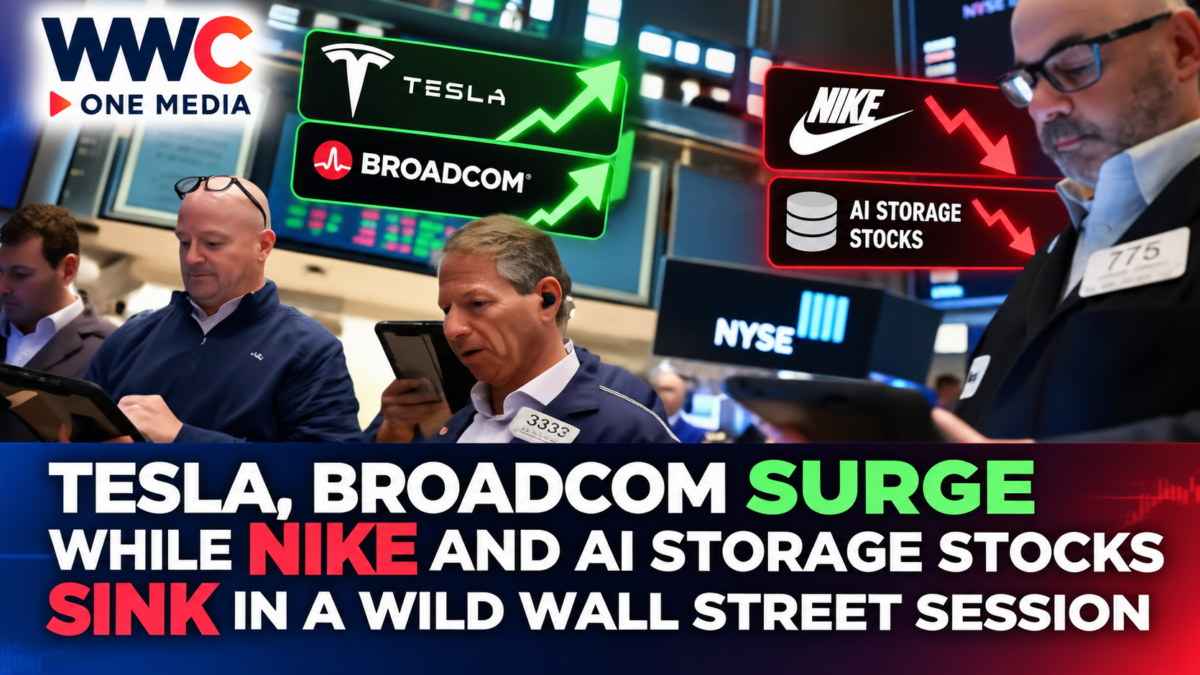
NEW YORK — Wall Street ended Friday higher after a surprisingly weak U.S. jobs report cooled expectations for another Federal Reserve interest-rate hike, but beneath the broader rally some of America’s biggest companies moved violently in opposite directions as Tesla deliveries, an enormous Broadcom-AI financing deal, Nike’s troubled turnaround and a new Philippine-linked storage expansion reshaped investor bets.
The major indexes finished October 2 in positive territory:
Dow Jones Industrial Average: +0.49%
S&P 500: +0.73%
Nasdaq Composite: +1.19%.
But the individual-stock moves were far larger.
Tesla jumped almost 5%.
Broadcom gained more than 3%.
ON Semiconductor surged around 6%.
Synaptics climbed by double digits.
Meanwhile:
Nike fell.
Seagate plunged.
Western Digital sank.
The moves showed how quickly investors are separating companies benefiting from the artificial-intelligence investment boom from those facing weaker demand—or suddenly stronger competition.
TESLA JUMPS AFTER DELIVERIES BEAT WALL STREET EXPECTATIONS
Tesla was one of the biggest large-cap winners.
Shares closed approximately:
4.7% higher.
The catalyst was stronger-than-expected third-quarter vehicle deliveries.
Tesla delivered:
486,532 vehicles
during the July-to-September period.
That comfortably exceeded Wall Street expectations.
Analyst forecasts varied by survey, but were generally around:
457,000 to 461,000 vehicles.
The result was important because Tesla’s core automotive business had struggled through several quarters of uneven demand.
TESLA MAY FINALLY RETURN TO ANNUAL DELIVERY GROWTH
Tesla’s latest quarter puts the automaker in position to reverse two consecutive years of declining annual deliveries.
The company now needs fewer than approximately:
312,000 Q4 deliveries
to surpass its 2025 annual total.
That would represent an important symbolic recovery.
Tesla’s valuation increasingly depends on businesses beyond cars, including:
Robotaxis
Artificial intelligence
Full Self-Driving software
and
Humanoid robots.
But vehicle deliveries still generate most of the company’s current revenue.
That means the stronger quarter matters.
EUROPE HELPED TESLA RECOVER
European demand contributed to the rebound.
Tesla registrations improved in several markets, helped by:
Government incentives
Stronger EV demand
and
Improved product availability.
France and Denmark were among markets showing better momentum.
That follows a much weaker period for Tesla in Europe, where the company had faced:
Chinese EV competition
Aging models
and
Political backlash surrounding Elon Musk.
The latest results do not eliminate those pressures.
But they suggest the automotive business is stabilizing.
TESLA DELIVERED MORE CARS THAN IT PRODUCED
Tesla produced roughly:
464,000 vehicles
during the quarter.
Yet it delivered more than:
486,000.
That means the company reduced some inventory already sitting in its system.
That can be positive because excess vehicle inventory ties up cash.
But investors will still watch:
Automotive margins
Discounting
Inventory levels
and
Pricing
when Tesla releases full quarterly earnings on:
October 21.
A delivery beat is important.
The profitability of those deliveries matters even more.
BROADCOM RISES AS ITS ANTHROPIC BET GETS MUCH BIGGER
Broadcom climbed more than:
3%
as investors digested an extraordinary new financing arrangement involving artificial-intelligence company Anthropic.
Broadcom has agreed to provide financing of up to:
$42 billion
to support Anthropic’s infrastructure requirements.
The money will help finance access to huge amounts of:
AI computing power
and
Custom chip infrastructure.
The arrangement highlights Broadcom’s rapidly expanding role in the AI boom.
ANTHROPIC COULD BECOME BROADCOM’S BIGGEST CUSTOM-CHIP CUSTOMER
Anthropic—the company behind Claude—is spending extraordinary amounts of money building AI infrastructure.
Its long-term commitments reportedly exceed:
$500 billion
across multiple technology partners.
Broadcom is becoming one of the most important of them.
By 2027, Anthropic could become Broadcom’s largest customer in its custom artificial-intelligence semiconductor business.
Broadcom’s projected AI semiconductor revenue could potentially reach:
$115 billion in 2027
and
$230 billion in 2028
under scenarios disclosed around the Anthropic relationship.
Those estimates illustrate how radically the AI infrastructure market has expanded.
BROADCOM IS BECOMING NVIDIA’S MOST IMPORTANT ALTERNATIVE
Nvidia still dominates advanced AI accelerators.
But hyperscalers increasingly want custom silicon.
Companies including:
Meta
Anthropic
and other major AI operators
are developing or using specialized chips designed for specific workloads.
Broadcom is one of the world’s leading designers of those custom chips.
That gives it a valuable position.
Instead of trying to sell exactly the same type of GPU as Nvidia, Broadcom helps large customers build silicon optimized for their own AI systems.
THE FINANCING DEAL ALSO SHOWS HOW CAPITAL-INTENSIVE AI HAS BECOME
There is another side to Broadcom’s rise.
AI companies are spending so much money on infrastructure that chip suppliers are increasingly helping finance their customers.
Broadcom’s commitment resembles a broader trend across the industry.
Chipmakers and investors are helping finance:
Data centers
Computing leases
Networking equipment
and
AI accelerators.
That can accelerate demand.
But it also creates financial links between:
Chip suppliers
AI developers
and
Capital providers.
If AI revenue eventually disappoints, those connections could become a risk.
ON SEMICONDUCTOR SURGES ON SYNAPTICS DEAL
ON Semiconductor was another major winner.
Shares rose around:
6%.
The semiconductor company revised its planned acquisition of:
Synaptics.
ON Semiconductor now plans to pay:
$123 per share in cash
for Synaptics.
The deal values Synaptics at approximately:
$5.7 billion.
The revised structure replaces an earlier all-stock transaction worth roughly:
$7 billion.
SYNAPTICS JUMPS ABOUT 14%
Synaptics shares rose approximately:
14%.
Investors responded positively to the revised cash offer.
The acquisition gives ON Semiconductor more exposure to technologies used in:
Edge AI
Industrial devices
Robotics
Automotive systems
and
Connected electronics.
Edge AI refers to artificial-intelligence processing happening directly on devices instead of entirely inside distant cloud data centers.
That market is becoming strategically important as AI moves into:
Cars
Factories
Robots
and
Consumer electronics.
NIKE MOVES THE OTHER WAY
Nike was one of Friday’s most closely watched losers.
The shares fell roughly:
3.6% by the close
after trading much lower earlier in the session.
Nike warned investors that its turnaround remains difficult.
The company projected a steeper-than-expected decline in full-year revenue.
It also announced:
More job cuts
and
A reorganization of global business divisions.
The announcement raised fresh questions about how long CEO Elliott Hill will need to restore growth.
NIKE’S CHINA PROBLEM IS GETTING HARDER
China remains one of Nike’s biggest weaknesses.
The region historically represented one of the company’s most important growth markets.
But sales have deteriorated amid:
Weak consumer demand
Local competition
and
Changing fashion preferences.
Chinese brands including:
Anta
and
Li-Ning
have become much stronger.
At the same time, global competitors such as:
Adidas
On
and
Hoka
have taken share in important footwear categories.
Nike is trying to rebuild product excitement while reducing its dependence on older retro sneaker franchises.
NIKE’S TURNAROUND COULD TAKE UNTIL 2029 OR 2030
Investors received another uncomfortable message.
Some of Nike’s restructuring benefits may not fully appear until:
2029 or 2030.
That is a long time for shareholders already waiting for the company’s recovery.
Hill is working to:
Repair wholesale relationships
Reduce excess inventory
Rebuild running products
Strengthen innovation
and
Fix China.
But several of Nike’s biggest businesses remain under pressure.
China, Jordan and lifestyle products collectively account for a substantial portion of sales.
NIKE SHARES HAVE FALLEN TO LEVELS NOT SEEN IN YEARS
The stock’s decline reflects investor frustration.
Nike shares have fallen dramatically from their pandemic-era highs.
The company has lost market share in global athletic footwear for several consecutive years.
That decline means Wall Street wants more than cost cuts.
Investors want evidence consumers are returning to the brand.
Nike’s November Investor Day is therefore becoming a crucial event.
Management will need to explain how it intends to create sustainable sales growth.
SEAGATE AND WESTERN DIGITAL GET HIT BY A PHILIPPINE-LINKED SURPRISE
One of Friday’s most dramatic market stories came from the hard-drive industry.
Seagate and Western Digital both plunged approximately:
10% by the closing bell.
At points during trading, losses were even larger.
The catalyst was a Nikkei report involving:
Toshiba.
The Japanese company reportedly plans to invest approximately:
¥60 billion
or roughly:
$380 million
to expand hard-disk-drive production.
And the expansion has an important Philippine connection.
TOSHIBA PLANS TO EXPAND ITS PHILIPPINE HDD FACTORY
Toshiba reportedly plans to significantly increase production capacity at its hard-drive manufacturing operations in:
the Philippines.
The objective is to roughly double capacity for high-capacity drives used by:
Artificial-intelligence data centers.
The investment would be Toshiba’s first major hard-drive capacity expansion in about:
five years.
That immediately worried investors in Seagate and Western Digital.
Both companies had benefited enormously from tight industry supply.
TOSHIBA WANTS TO TRIPLE ITS STORAGE MARKET SHARE
The hard-drive industry is unusually concentrated.
Three companies dominate:
Seagate
Western Digital
and
Toshiba.
Toshiba currently holds slightly more than:
10%
of the market when measured by storage capacity.
But the company reportedly wants to increase that to approximately:
30%
over the medium term.
If Toshiba achieves that goal, it would have to take substantial share from its two much larger rivals.
That possibility explains why Seagate and Western Digital shares reacted so violently.
AI CREATED THE HARD-DRIVE SHORTAGE IN THE FIRST PLACE
Artificial intelligence does not only require expensive GPUs.
AI data centers also need enormous storage capacity.
Training and operating large AI systems produces massive quantities of data.
That has created strong demand for high-capacity:
Hard disk drives.
AI infrastructure growth pushed the storage industry from oversupply toward scarcity.
That improved:
Pricing
Margins
and
Profitability
for Seagate and Western Digital.
Their stocks soared.
SEAGATE HAD RISEN ROUGHLY 200% BEFORE FRIDAY
The selloff needs context.
Before Friday’s drop, Seagate shares had gained roughly:
200% during 2026.
Western Digital had risen approximately:
140%.
That means expectations were extremely high.
When Toshiba announced the possibility of major new supply, investors quickly reassessed how long the current pricing environment could last.
The reaction demonstrates one of the biggest risks in cyclical industries:
high prices eventually encourage competitors to add capacity.
ANALYSTS SAY THE MARKET MAY BE OVERREACTING
Not everyone believes Toshiba can dramatically change supply conditions.
Several analysts pointed out that Toshiba depends on external suppliers for components including:
Drive heads
and
Storage media.
Those suppliers would also need to increase capacity.
That could limit how quickly Toshiba actually doubles output.
Seagate and Western Digital also have long-term supply commitments with major customers.
Those agreements could protect near-term economics.
So Friday’s stock collapse may reflect fear about future competition rather than an immediate collapse in current demand.
THE PHILIPPINES COULD BENEFIT EVEN IF U.S. STORAGE STOCKS SUFFER
For the Philippines, Toshiba’s investment tells a very different story.
A major expansion in high-capacity HDD production could strengthen the country’s role in the global:
AI
Electronics
and
Data-center supply chain.
The Philippines is already a major exporter of electronics and semiconductor-related products.
August exports reached a record:
$9.11 billion
with electronics accounting for:
$6.20 billion
or roughly:
68% of total exports.
An additional Toshiba investment could deepen that manufacturing base.
The same development hurting Seagate and Western Digital shareholders could create:
Manufacturing investment
Exports
and potentially
Jobs
in the Philippines.
AI IS NOW CREATING WINNERS AND LOSERS INSIDE THE SAME INDUSTRY
Friday’s market action revealed an important shift.
For years, investors often treated almost anything connected to AI as a winner.
That is becoming more complicated.
Broadcom rose because AI infrastructure demand is increasing.
ON Semiconductor gained because investors liked its edge-AI acquisition.
But Seagate and Western Digital fell because AI demand encouraged Toshiba to build more competing supply.
In other words:
AI growth can increase revenue opportunities while simultaneously intensifying competition.
That is a more mature stage of the investment cycle.
THE WEAK JOBS REPORT LIFTED THE BROADER MARKET
Company-specific stories dominated the stock movers.
But the broader rally came from economic data.
The U.S. economy added only:
29,000 jobs
in September.
Economists had expected substantially more.
The unemployment rate rose to:
4.2%.
Investors interpreted the report as evidence the labor market is cooling.
That reduced expectations that the Federal Reserve will raise interest rates again at its October meeting.
FED RATE-HIKE ODDS DROPPED SHARPLY
Before the jobs data, investors were worried the Federal Reserve might continue tightening monetary policy.
Inflation remains above the Fed’s target.
Energy prices have also been elevated.
But a weaker labor market makes another rate increase more difficult.
Following the report, futures markets put the probability of an October quarter-point rate hike at only around:
20% to 23%.
Lower interest-rate expectations typically help stocks—particularly growth companies whose valuations depend heavily on future profits.
THE NASDAQ HIT ANOTHER HIGH
The technology-heavy Nasdaq benefited most.
It rose:
1.19%.
The index also reached a new intraday record.
Nvidia gained around:
1.3%.
Tesla surged.
Broadcom advanced.
Chip stocks broadly strengthened.
That shows the AI trade remains one of the market’s dominant forces.
But the storage selloff shows investors are becoming more selective.
SMALL-CAP STOCKS ALSO BENEFITED
The Russell 2000 gained around:
0.9%.
Smaller companies tend to be especially sensitive to interest rates because they often rely more heavily on borrowing.
A reduced likelihood of another Fed hike therefore improves their financial outlook.
The combination of:
Softer employment
Lower bond yields
and
Reduced rate-hike expectations
supported risk assets broadly.
BUT WALL STREET IS STILL DEALING WITH HIGH BOND YIELDS
Despite Friday’s rally, the broader market remains under pressure from unusually high borrowing costs.
The 10-year U.S. Treasury yield recently reached approximately:
5.34%
its highest level in more than two decades.
High yields create competition for stocks.
Investors can earn attractive returns from relatively safer government bonds instead of taking equity risk.
High rates also make it more expensive for companies to finance:
Acquisitions
Data centers
Factories
and
Share buybacks.
That is particularly relevant as the AI industry attempts to fund hundreds of billions of dollars in new infrastructure.
THE FOURTH QUARTER IS STARTING WITH BIG QUESTIONS
Historically, the fourth quarter tends to be strong for U.S. equities.
But 2026 is unusual.
Investors are watching:
Interest rates
AI spending
Oil prices
Corporate earnings
and
The U.S. midterm elections.
The S&P 500 has still gained strongly this year.
But valuations remain elevated, particularly in technology.
That leaves little room for disappointment.
THE BIGGER STORY: WALL STREET IS NO LONGER BUYING EVERY AI STORY THE SAME WAY
October 2 offered an unusually clear snapshot of the market’s changing psychology.
Tesla delivered more cars than expected.
Its stock jumped.
Broadcom found another way to deepen its relationship with one of the world’s biggest AI companies.
Its stock rose.
ON Semiconductor restructured an acquisition that strengthens its edge-AI position.
Its shares rallied.
But AI infrastructure demand also convinced Toshiba to expand hard-drive production in the Philippines.
That sent Seagate and Western Digital tumbling.
Nike, meanwhile, reminded investors that old-fashioned consumer demand still matters—even in a market obsessed with artificial intelligence.
The result was a Wall Street session where the indexes rose, but fortunes diverged dramatically underneath the surface.
And that may be the more important signal.
The first phase of the AI rally rewarded almost anything connected to artificial intelligence.
The next phase may be much harder.
As billions more dollars pour into AI infrastructure, investors are beginning to ask not simply who benefits from the boom—but whose profits will survive once all that new competition arrives.