
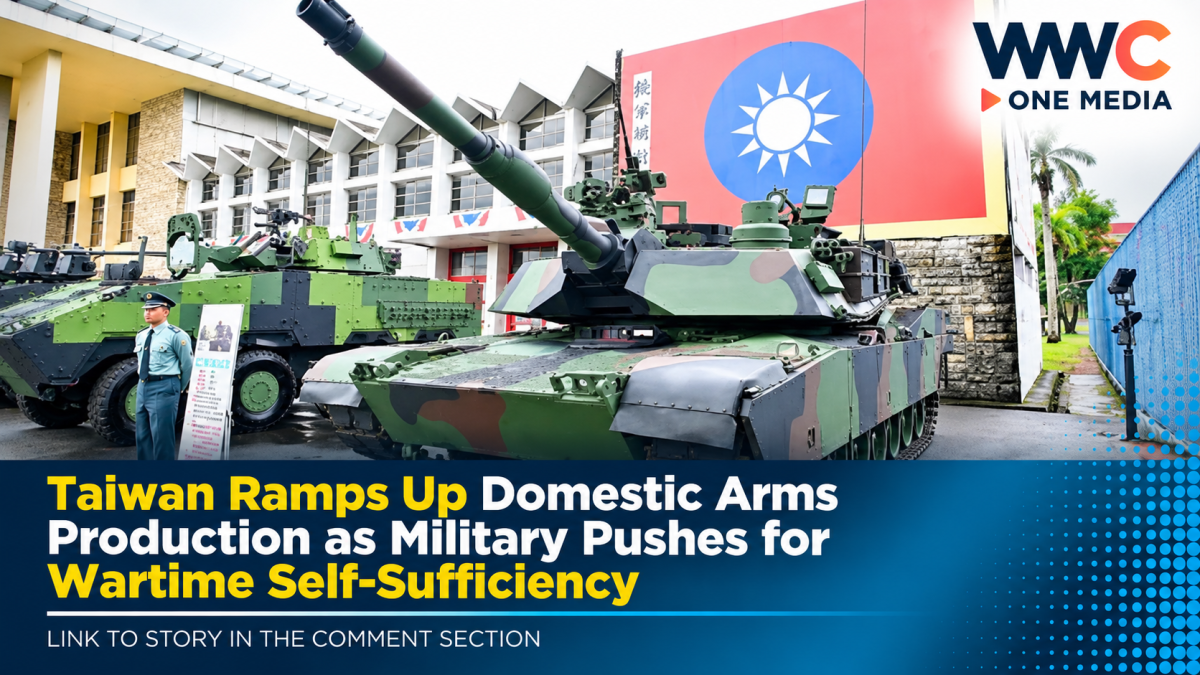
TAIPEI — Taiwan is preparing to significantly expand its domestic arms and ammunition production as the military moves to strengthen its ability to sustain operations during a potential wartime crisis.
New defense budget plans show that Taiwan’s military intends to invest billions of New Taiwan dollars in expanding and modernizing production facilities for ammunition, explosives, armored vehicles and other critical military equipment.
The move reflects a growing focus on one urgent question:
If Taiwan were cut off from foreign supplies during a conflict, could it keep producing the weapons and ammunition it needs?
Taiwan’s Ministry of National Defense appears determined to make sure the answer is increasingly yes.
More Than NT$14 Billion for Domestic Military Production
According to Taiwan’s proposed defense budget, the Armaments Bureau’s Production and Manufacturing Center plans to invest more than NT$14.15 billion (US$447.4 million) from this year through 2032 to establish or expand production capacity at four factories.
The expansion is expected to cover a wide range of military equipment and supplies, including:
- Armored vehicles
- Artillery ammunition
- Explosives
- Optical equipment
- Specialized batteries
- Chemical, biological, radiological and nuclear defense equipment
The military also plans to expand production lines for warhead bodies, cartridge cases, primers, propellants, explosives, gun barrels, optical equipment and gas masks.
New semi-automated and fully automated equipment is also expected to be introduced as Taiwan seeks to increase both production capacity and efficiency.
Taiwan Wants to Be Ready to Keep Fighting
The expansion is aimed at improving Taiwan’s ability to produce essential military equipment and ammunition domestically during wartime.
Demand for ammunition is expected to rise as Taiwan fields new weapons systems, expands troop numbers and strengthens reserve combat capabilities, according to the budget documents.
The concern is straightforward.
Modern warfare consumes enormous quantities of ammunition.
Artillery shells, rockets, tank rounds and other munitions can be used at a rapid pace during major combat.
Taiwan’s new production push is designed to reduce its dependence on external supply chains and ensure that critical equipment can continue to be manufactured domestically.
Spending Set to Surge Before 2032
Taiwan allocated more than NT$328.8 million to the project this year.
That funding is set to increase to more than NT$1.52 billion next year.
Budget payments are expected to rise sharply between 2028 and 2030, with spending projected to reach as much as NT$4.13 billion in 2029.
The overall project is scheduled for completion in 2032.
The scale and long-term nature of the investment suggest Taiwan is not treating domestic arms production as a short-term measure.
Instead, the military appears to be building a more permanent industrial base designed to support Taiwan’s defense needs for years to come.
New M1A2T Tanks Mean Taiwan Needs New Ammunition
One major reason for the expanded production capacity is Taiwan’s acquisition of 108 M1A2T Abrams tanks.
Taiwan already had the capacity to produce 105mm tank ammunition.
However, the newer M1A2T Abrams tanks use 120mm rounds, creating a need for new domestic production capabilities.
Taiwan plans to establish local production lines for 120mm tank ammunition through industrial cooperation, technology transfer and domestic development.
The Armaments Bureau also sought bids last year for a 120mm tank ammunition assembly system.
The move could give Taiwan greater flexibility in maintaining ammunition supplies for one of its most powerful ground combat systems.
Thunderbolt Rockets Get Major Ammunition Boost
Taiwan is also expanding ammunition reserves for its domestically developed Thunderbolt-2000 multiple-launch rocket system.
The army plans to allocate more than NT$691.7 million to commission the National Chungshan Institute of Science and Technology to produce high-explosive rockets for the system.
The procurement will include MK-30 and MK-45 rockets and is scheduled to be completed next year.
The Thunderbolt-2000 is considered an important part of Taiwan’s strategy to counter a potential amphibious landing.
The MK-30 has a reported range of approximately 15 to 30 kilometers, while the MK-45 can reach targets around 25 to 45 kilometers away.
The system is designed to deliver dense fire over large areas and could be used against troops, vehicles and other forces approaching or assembling near Taiwan’s coastline.
Taiwan’s Defense Strategy Focuses on the Coast
The rocket expansion highlights one of Taiwan’s biggest military concerns: defending against a potential amphibious assault.
Taiwan’s geography means that any major invasion force would likely need to cross the Taiwan Strait and establish a foothold on the island.
That makes coastal defense a central part of Taiwan’s military planning.
The Thunderbolt-2000 provides shorter-range area fire, while US-made High Mobility Artillery Rocket Systems, or HIMARS, offer longer-range precision strike capabilities.
The two systems are designed to complement each other.
The Thunderbolt-2000 can provide heavy area fire against approaching or landing forces.
HIMARS can strike targets farther away, including command positions, air-defense systems and assembly areas.
HIMARS Gives Taiwan Longer Reach
Taiwan is continuing to receive US-made HIMARS as part of its broader military modernization.
The system gives Taiwan a significantly longer-range precision strike capability than the Thunderbolt-2000.
According to the budget report, precision-guided HIMARS rockets can reach approximately 70 kilometers, while Army Tactical Missile System missiles can reach targets up to 300 kilometers away.
That creates a layered approach to Taiwan’s rocket artillery capabilities.
Thunderbolt-2000: Shorter-range area fire.
HIMARS: Longer-range precision strikes.
Together, the systems are intended to strengthen Taiwan’s ability to target forces approaching the island and support its wider defensive strategy.
A Bigger Defense Budget, But Funding Challenges Remain
The production expansion was originally intended to be financed through the Executive Yuan’s proposed NT$1.25 trillion special defense budget.
However, after the Legislative Yuan’s final version excluded some commercial procurement, contracted manufacturing and production-capacity projects, Taiwan’s Defense Ministry began seeking funding through supplementary budgets and regular annual government budgets.
The domestic production project was subsequently included in next year’s budget.
That funding shift highlights the political and financial challenges involved in Taiwan’s ambitious defense buildup.
Building weapons systems is one challenge.
Finding stable funding for them is another.
Why Domestic Production Matters More Than Ever
Taiwan has spent years purchasing weapons from abroad, particularly from the United States.
But modern conflicts have demonstrated the importance of domestic production.
Weapons can be destroyed.
Ammunition can run out.
Supply routes can be disrupted.
And foreign deliveries may not arrive quickly enough during a major conflict.
That is why Taiwan is increasingly investing in the ability to manufacture essential equipment at home.
The goal is not necessarily to replace foreign weapons.
Instead, Taiwan appears to be building a stronger domestic industrial base that can support imported systems and provide a more reliable supply of critical equipment and ammunition.
From Tanks to Rockets, Taiwan Is Building Capacity
The new plan covers much more than a single weapons system.
Taiwan is expanding capabilities across multiple areas of military production.
That includes:
Tank ammunition.
Artillery ammunition.
Explosives.
Rocket systems.
Gun barrels.
Optical equipment.
Protective gear.
Specialized batteries.
CBRN defense equipment.
The breadth of the project suggests Taiwan is focusing on the full chain of wartime logistics.
A military cannot operate on weapons alone.
It also needs ammunition, replacement parts, protective equipment and the industrial capacity to replace what is lost.
Taiwan’s Military Is Preparing for a Long Fight
The most significant message from the new budget may be the shift in thinking behind it.
Taiwan is not simply investing in new weapons.
It is investing in the ability to keep producing them.
That distinction could become crucial during a prolonged crisis.
The planned factories, automated production lines and expanded ammunition capacity are all part of a broader effort to improve military resilience.
For Taiwan, the question is no longer just how many weapons it can buy before a crisis.
It is increasingly about how long it can sustain its defenses if outside supply lines are disrupted.
A Major Shift Toward Self-Sufficiency
Taiwan’s domestic arms production push represents one of its most significant efforts to strengthen wartime self-sufficiency.
The investment will continue through 2032.
Production lines will be expanded.
Automation will be introduced.
And ammunition capacity will increase as Taiwan brings more tanks, rockets and other weapons into service.
The strategy is clear.
Buy advanced weapons from abroad.
Develop more systems at home.
Build enough production capacity to keep fighting if supplies are disrupted.
For Taiwan’s military planners, the clock is no longer just about acquiring new weapons.
It is about ensuring that when those weapons are needed, the ammunition will still be there.
And with billions now being directed toward domestic military production, Taiwan is preparing for a future where resilience could be just as important as firepower.
WWC ONE MEDIA J.M.D




Leave a Reply