NEW YORK — From a pink-and-blue Starbucks drink that disappeared for nearly a decade to TikTok shopping hauls and VIP athlete meet-and-greets, major U.S. brands are increasingly treating marketing less like advertising and more like entertainment.
The strategy is simple:
create something people actually want to talk about,
turn customers into unofficial promoters,
and then convert that attention into transactions, loyalty and repeat business.
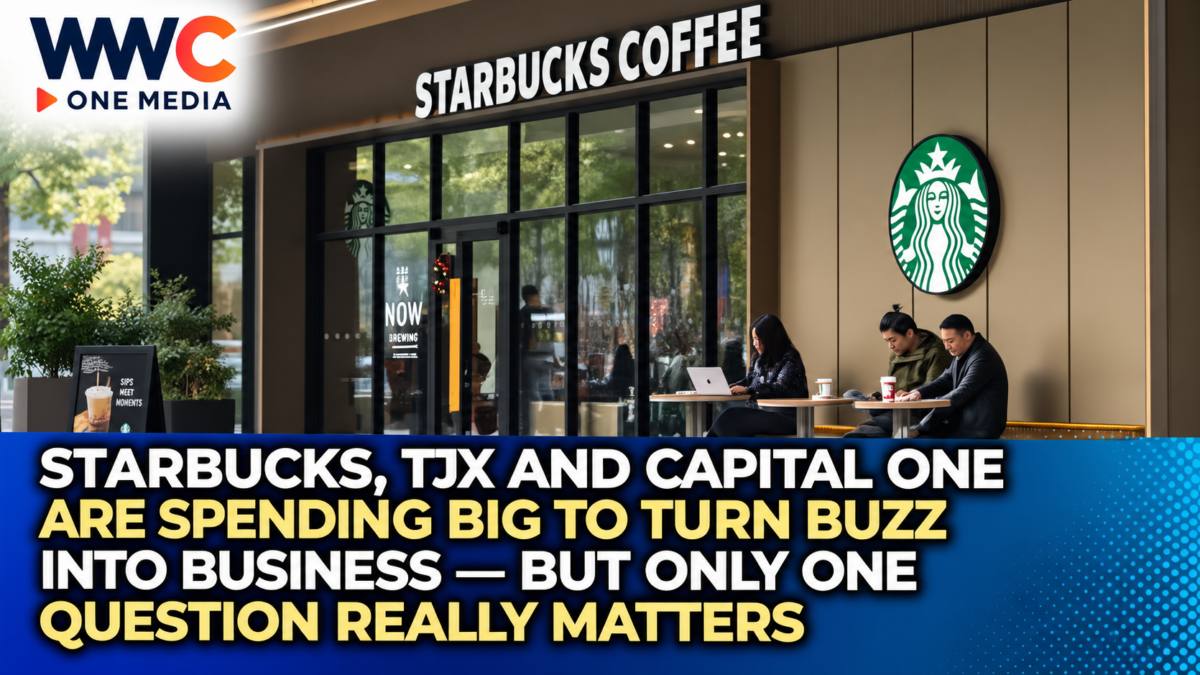
CNBC highlighted three companies taking very different versions of that approach: Starbucks, TJX Companies and Capital One.
Starbucks is using scarcity, nostalgia and employee creators.
TJX is leaning heavily into social video and the excitement of discovering unexpected bargains.
Capital One is spending billions to acquire customers and differentiate its credit cards through exclusive experiences.
The tactics look very different.
The business question is exactly the same:
Does the buzz eventually create more profitable customers?
Starbucks Brought Back a 2017 Viral Hit — and Broke a Sales Record
The clearest example came from Starbucks.
The company revived its famous Unicorn Frappuccino for a limited global return in August after renewed online interest in the colorful drink.
The product originally became a viral sensation during a short run in 2017.
Starbucks first tested the comeback at Coachella earlier this year before bringing it back internationally for one weekend beginning August 15.
The result exceeded ordinary promotional success.
Starbucks says it sold more than 2 million Unicorn Frappuccinos in its North American company-operated stores over the weekend.
August 15 became the company’s biggest Saturday sales day ever in that business, and the weekend became its best North America company-operated sales weekend on record.
That is the kind of result marketers spend years trying to create.
The Real Trick Was That Starbucks Did Not Need a Discount
That detail matters.
Many restaurant chains generate short-term traffic by offering lower prices.
Discounting can boost transactions.
But it also cuts margins.
Starbucks took a different approach.
It used scarcity and cultural nostalgia to convince customers to visit at full price.
The Unicorn Frappuccino was available only briefly, creating urgency.
Customers knew that if they waited, the product would disappear.
That turns limited availability into a marketing asset.
The customer is not thinking:
“Should I buy this because it is cheaper?”
They are thinking:
“Should I buy this before I miss it?”
That is a much more attractive economic equation for the company.
Starbucks Turned Customers Into the Advertising
The drink itself was designed for social media.
Bright colors.
A visually distinctive cup.
A recognizable name.
And a built-in nostalgia factor.
Customers photographed it.
They posted videos.
Friends shared the posts.
The result was a promotional loop in which people paid Starbucks for the product and then helped advertise it for free.
That is one reason visually distinctive limited-edition products can be so effective.
The merchandise becomes the media.
Starbucks Traffic Jumped During the Comeback
Independent traffic data also suggests the excitement translated into store visits.
Placer.ai data cited after the promotion showed Starbucks traffic on Saturday, August 15 running roughly 44% above the company’s average daily traffic level for 2026.
That provides an important second data point.
Selling two million drinks is impressive.
But the campaign was especially valuable if it attracted additional customers who bought food, coffee or other products during the same visit.
That is where a viral promotion can begin producing broader business value.
The Unicorn Was Also Marketing Starbucks’ Bigger Turnaround
The campaign was not operating in isolation.
CEO Brian Niccol has been trying to rebuild Starbucks around faster service, stronger stores, simplified operations and renewed cultural relevance.
The company’s fiscal third quarter showed measurable improvement.
Global comparable-store sales rose 7.9%, including a 4.2% increase in comparable transactions.
North American comps increased 8.1%.
Starbucks also delivered its fourth consecutive quarter of positive global comparable sales growth and its second consecutive quarter of margin expansion.
That makes the Unicorn promotion more meaningful.
It was not merely a one-week social-media stunt attached to a declining business.
It arrived during a broader turnaround that was already producing stronger customer traffic.
Marketing Is Becoming Part of the Product
This represents a broader shift.
Traditional marketing often looked like this:
make the product,
then advertise the product.
The newer model is different.
The campaign itself becomes part of the customer experience.
Starbucks did not merely run commercials saying its stores were exciting again.
It created an event that made customers experience that excitement.
That is a much stronger form of branding.
Starbucks Is Even Turning Baristas Into Creators
The company is also experimenting with employee-generated content.
Starbucks has operated a Green Apron Creator Program, which pays participating baristas to create social content during dedicated work time.
The logic is authenticity.
Consumers—especially younger ones—are increasingly skilled at identifying polished corporate advertising.
An employee showing what actually happens behind the counter can feel more genuine than a celebrity endorsement or conventional commercial.
Starbucks is also exploring creator programs that send employees and outside creators to stores around the world to generate social content.
That turns the workforce itself into part of the marketing network.
But Starbucks Still Has to Prove Viral Moments Create Habit
This is the biggest limitation.
A two-day sales record is not the same thing as sustainable customer loyalty.
A person may buy a Unicorn Frappuccino because it is trending on TikTok.
That does not necessarily mean they return three times a week for coffee.
The harder marketing challenge is moving someone through several stages:
awareness,
trial,
repeat purchase,
loyalty.
Starbucks therefore tracks metrics such as customer frequency, transactions, Rewards engagement, brand consideration and purchasing intent.
The company says several of those brand metrics recently reached five-year highs.
But the ultimate proof will remain sustained comparable sales and traffic.
TJX Is Building a Very Different Kind of Buzz
TJX Companies is taking almost the opposite approach.
Its brands—including TJ Maxx, Marshalls and HomeGoods—do not rely heavily on limited-edition branded products.
Instead, they sell discovery.
A shopper enters without knowing exactly what will be available.
A designer handbag might appear.
A high-end kitchen item might be deeply discounted.
A product seen today may be gone tomorrow.
That uncertainty creates what retail analysts often call the “treasure hunt” experience.
And TJX is increasingly using social media to broadcast that experience.
TJX Generated 1.4 Billion Paid Video Views
CEO Ernie Herrman revealed during the company’s most recent earnings call that TJX brands generated roughly 1.4 billion paid video views across social platforms during the first half of the year.
About 1.1 billion came from core TJX brands and more than 300 million from HomeGoods.
Platforms included Facebook, Instagram, TikTok, Pinterest and YouTube.
Herrman also said completion rates on TikTok and YouTube were significantly above industry benchmarks.
That suggests viewers were not simply scrolling past the advertisements.
They were watching them.
Social Media Is Perfect for the TJX Business Model
The off-price retail model has a natural advantage online.
Customers love posting “hauls.”
Someone visits TJ Maxx.
They discover an unusually good deal.
They make a TikTok showing what they found.
Millions of viewers may then see merchandise from the store without TJX directly paying for every impression.
That user-generated content reinforces one of the company’s strongest psychological triggers:
Maybe I can find something like that too.
The customer then has to visit the physical store to find out.
That is extremely valuable for a retailer whose sales remain heavily store-based.
TJX Does Not Need the Social Post to Produce an Online Sale
That is another important distinction.
Many digital advertisers judge campaigns based on whether someone clicks an ad and immediately purchases something online.
TJX can use a different measurement.
A TikTok video showing a designer-brand jacket can make a viewer drive to Marshalls the next afternoon.
The transaction happens offline.
That means the digital marketing is doing its job even without an e-commerce conversion.
In effect:
the social-media feed becomes the store window.
TJX Calls Marketing an ‘Offensive Weapon’
Herrman has described marketing as an “offensive weapon.”
The phrase reveals management’s mindset.
Marketing is not simply about protecting existing customers.
TJX wants to use it to:
attract new shoppers,
increase visit frequency,
reach younger audiences,
and take market share from other retailers.
The company still spends less than 1% of sales on marketing according to CNBC’s reporting, making the scale of its digital reach particularly notable.
That also means management has room to spend more if it believes the return remains attractive.
The Messaging Has Changed Too
Historically, TJX advertising emphasized straightforward value:
recognizable brands at lower prices.
Now the messaging increasingly emphasizes discovery.
That shift is important because price alone is easy for competitors to copy.
Walmart can advertise low prices.
Amazon can advertise discounts.
Outlet malls can advertise brand names.
The treasure-hunt experience is more difficult to replicate digitally.
Customers visit because inventory constantly changes.
That creates urgency similar to Starbucks’ limited-time drink, but through a different mechanism.
At Starbucks:
the product disappears.
At TJX:
the exact item you want may disappear.
Both create fear of missing out.
Social Buzz Can Help TJX Reach Wealthier Consumers
The treasure-hunt message also allows TJX to broaden its customer base.
A shopper does not necessarily need to be financially constrained to enjoy finding a premium product at a discount.
Higher-income consumers may visit because discovery itself is entertaining.
That makes TJX less dependent on being perceived purely as a low-income or bargain retailer.
It can become:
value plus entertainment.
That is a powerful combination during an uncertain economy.
But TJX Has a Different Problem: Execution
Marketing can drive customers to a store.
It cannot fix the wrong inventory once they arrive.
That became especially clear in TJX’s recent results.
Management acknowledged softness at Marmaxx, which includes TJ Maxx and Marshalls, and blamed part of the weakness on execution issues involving product placement and merchandise availability.
The company said corrective actions had already been taken.
That creates a fundamental retail reality:
great marketing can bring a shopper through the door once. Bad merchandise can stop them from returning.
TJX Is Also Putting Billions Back Into Shareholders
TJX remains a financially strong retailer.
Its SEC filing shows the company spent about $1.4 billion repurchasing 8.9 million shares during the first half of fiscal 2027 and currently plans approximately $2.75 billion to $3 billion in share repurchases for the full year.
That illustrates why efficient marketing matters.
TJX is not simply trying to grow awareness.
It wants marketing spending to produce enough incremental revenue and profit that the company can keep investing in stores while also returning substantial cash to shareholders.
Capital One Is Playing an Even Longer Game
The third company in CNBC’s analysis operates in a completely different industry.
Capital One is not selling coffee or clothing.
It is acquiring financial relationships.
That makes marketing economics radically different.
A coffee customer may be worth a few dollars during one visit.
A profitable credit-card customer could remain with a bank for years and potentially generate thousands of dollars through:
merchant fees,
interest,
travel bookings,
and other financial products.
That is why Capital One is willing to spend enormous amounts upfront.
Capital One Spent $1.7 Billion on Marketing in One Quarter
Capital One disclosed $1.7 billion in marketing expenses during the second quarter of 2026, up from $1.3 billion a year earlier.
That was a 23% year-over-year increase.
For the first six months of 2026, marketing expense reached approximately $3.2 billion.
Management said the increase reflected several factors:
the integration of Discover,
higher legacy Capital One direct marketing,
greater media spending,
and continued investment in premium customer benefits.
That is an extraordinary amount of money devoted to acquiring and retaining customers.
Capital One Is Buying Relationships, Not Clicks
This explains why analysts sometimes compare Capital One’s marketing spending with capital expenditure.
A factory requires a large upfront investment.
But once built, it can produce revenue for years.
Capital One views customer acquisition similarly.
Spend heavily today to acquire the right cardholder.
If that customer remains loyal and spends heavily for a decade, the economics may eventually look extremely attractive.
That makes the initial marketing cost less important than the lifetime value of the customer.
A Premium Credit-Card Customer Can Cost More Than $1,000 to Acquire
CNBC cited analyst estimates suggesting that acquiring a high-quality super-prime credit-card customer can cost more than $1,000.
That may sound extraordinarily expensive.
But premium customers can generate substantial long-term value.
They may:
spend heavily,
travel frequently,
pay annual fees,
use multiple financial products,
and remain customers for years.
The challenge is predicting which prospective customers will actually behave that way.
That is where data becomes crucial.
Capital One Is Competing With Experiences
Credit cards used to compete mainly on:
interest rates,
points,
cash back,
and annual fees.
Premium cards increasingly compete on experiences.
Capital One offers eligible customers access to:
airport lounges,
concert tickets,
dining events,
NCAA packages,
VIP experiences,
and athlete meet-and-greets.
Those perks are not simply rewards.
They are marketing.
A customer may choose a card partly because it provides experiences unavailable elsewhere.
That creates an emotional relationship with what would otherwise be a financial product.
VIP Access Makes a Commodity Feel Exclusive
This is strategically important because credit cards are difficult to differentiate.
A Visa payment works much like another Visa payment.
Interest rates and rewards can be copied.
Experiences are harder to replicate.
A VIP sporting package or chef dinner transforms a piece of plastic—or a digital wallet credential—into access.
The bank is no longer saying:
“Our card gives you points.”
It is saying:
“Our card gets you somewhere other people cannot go.”
That changes the psychology of the product.
Discover Makes Capital One’s Marketing Bet Even Larger
Capital One’s acquisition of Discover has significantly expanded the business.
Management said Q2 revenue reached about $15.9 billion, while the company continues integrating Discover into its card and payment ecosystem.
Marketing therefore serves two purposes.
Capital One wants to grow the legacy business.
It also wants to maximize the value of a much larger combined customer base.
That may explain why management is comfortable with spending rising dramatically in the near term.
But Capital One Has the Hardest ROI to Prove
Starbucks can count Unicorn Frappuccinos.
TJX can count traffic and sales.
Capital One’s return is less immediate.
A customer acquired today might look unprofitable initially because of:
sign-up bonuses,
advertising costs,
reward expenses,
and premium benefits.
The payoff may arrive years later.
That creates what analysts described to CNBC as a significant “trust us” component.
Investors cannot easily see the profit produced by one commercial, influencer partnership or VIP event.
They must evaluate broader evidence.
Are new accounts increasing?
Are premium customers spending more?
Are they staying?
Are credit losses manageable?
That is how the marketing thesis eventually has to be judged.
AI Could Make This Spending Much Smarter
All three companies also have something new that previous generations of marketers did not:
far better data.
Digital campaigns can measure:
views,
clicks,
completion rates,
customer identities,
repeat visits,
transactions,
and purchasing behavior.
Artificial intelligence can potentially make that targeting even more precise.
Instead of showing one commercial to everyone, companies can test thousands of variations and learn which message performs best with each audience.
Capital One can target potential cardholders differently.
TJX can tailor creative by platform.
Starbucks can identify which customers are most likely to respond to a limited-edition product.
That could dramatically improve marketing efficiency.
But Better Measurement Does Not Eliminate Bad Marketing
Data can show what happened.
It cannot guarantee a campaign will succeed.
Companies can still:
choose the wrong cultural trend,
hire the wrong influencer,
overspend on customer acquisition,
or create a promotion people discuss but never buy.
This is the difference between attention and commercial value.
A campaign with 100 million views can still be a failure if almost nobody changes their purchasing behavior.
That is why the biggest metric is not impressions.
It is incremental profit.
The Internet Has Made Attention Harder to Buy
Consumers now divide their time across:
television,
YouTube,
TikTok,
Instagram,
streaming services,
podcasts,
video games,
and countless other platforms.
There is no equivalent of buying one major prime-time television campaign and assuming the entire country will see it.
That fragmentation makes conventional mass advertising less reliable.
Brands therefore have to create content people choose to watch.
That is why entertainment, scarcity and experiences are becoming so valuable.
All Three Brands Are Using FOMO
Despite operating in completely different industries, Starbucks, TJX and Capital One are using essentially the same psychological trigger.
Fear of missing out.
Starbucks:
buy the Unicorn Frappuccino now because it disappears after the weekend.
TJX:
buy the item now because another one may never arrive.
Capital One:
hold the card because it may give you access to an exclusive experience other people cannot buy normally.
Each company creates scarcity.
Scarcity creates urgency.
Urgency can create transactions.
But Scarcity Works Only When the Brand Has Something People Want
A limited-time product nobody cares about does not create urgency.
It creates leftover inventory.
An exclusive event nobody values is not a premium benefit.
It is an expense.
A treasure hunt with poor merchandise is not exciting.
It is frustrating.
That means marketing cannot manufacture a durable business from a weak underlying product.
It can amplify a good one.
Starbucks Has the Strongest Immediate Proof
Among the three examples, Starbucks currently has the clearest direct evidence that buzz translated into transactions.
More than two million Unicorn drinks sold.
A record sales weekend.
A record Saturday.
Traffic well above normal.
And broader comparable-store sales already improving.
That does not prove the campaign will create years of growth.
But it does prove customers responded immediately.
TJX Has the Strongest Organic Social Advantage
TJX’s advantage is different.
Its customers naturally create marketing content because sharing bargains is part of the shopping experience.
That means every successful store visit can potentially create another social-media post that generates additional visits.
The company’s 1.4 billion paid video views demonstrate the scale of its deliberate advertising.
The harder-to-measure organic posts add another layer on top.
That is a potentially powerful flywheel.
Capital One Is Making the Biggest Financial Bet
Capital One is committing far more money directly.
Spending $1.7 billion on marketing in a single quarter means management clearly believes customer acquisition opportunities remain attractive.
But that also creates the biggest pressure to prove returns.
If customer lifetime value disappoints, billions in acquisition spending can become expensive very quickly.
If the strategy works, however, those customers may generate revenue for many years.
That makes Capital One’s marketing program potentially the most financially consequential of the three.
Marketing Is Starting to Look More Like Investment
This may be the larger lesson.
Companies traditionally treated marketing as an expense.
Spend the money.
Run the advertisement.
Measure the campaign.
Move on.
Increasingly, leading brands are treating marketing like an investment in a customer asset.
Starbucks wants repeat visits.
TJX wants recurring store traffic.
Capital One wants decade-long financial relationships.
The advertisement is merely the beginning.
The Next Marketing Battle Will Be Over Authenticity
Consumers are also becoming more suspicious of obviously manufactured content.
That favors brands capable of creating genuine participation.
A Starbucks barista making a video may feel more authentic than an actor in a commercial.
A shopper showing a Marshalls haul may feel more trustworthy than a polished advertisement.
A friend describing a Capital One lounge experience may carry more influence than a banner ad.
The more consumers distrust corporate messaging, the more brands will try to make marketing look like something other than marketing.
That Can Create Its Own Risks
There is a danger.
As advertising becomes harder to distinguish from ordinary content, consumers may become even more skeptical.
Influencer disclosures matter.
Paid partnerships matter.
Employee-creator arrangements need transparency.
Brands that appear to manipulate supposedly organic communities can quickly face backlash.
Authenticity is powerful partly because it is fragile.
Once customers believe it is fake, the advantage disappears.
The Bigger Question Is Whether Buzz Creates Habit
That is ultimately the test facing all three companies.
Starbucks can generate a record weekend.
TJX can generate billions of video views.
Capital One can buy premium experiences and recruit thousands of new cardholders.
But marketing only becomes valuable when those customers stay.
Do Unicorn buyers return for ordinary coffee?
Do TikTok viewers become repeat TJ Maxx shoppers?
Do people attracted by a large credit-card bonus keep the account after the first year?
Those questions decide whether marketing is generating economic value or merely creating expensive attention.
Viral Marketing Is Easy to See — Profitable Loyalty Is Harder
The modern consumer economy is overflowing with attention.
A product can trend worldwide in hours.
A campaign can generate millions of views overnight.
But virality alone has almost no value to shareholders.
What matters is conversion.
Then retention.
Then profitability.
That is why the Starbucks example is so powerful: the company can point directly to more than two million drinks sold and a record weekend.
TJX can point to engagement and continued traffic.
Capital One can point to strong customer originations.
But every one of those companies still has to answer the same question over time:
What did that marketing dollar actually earn?
And as brands spend more money trying to become part of culture rather than simply advertise inside it, that question will only become more important.