
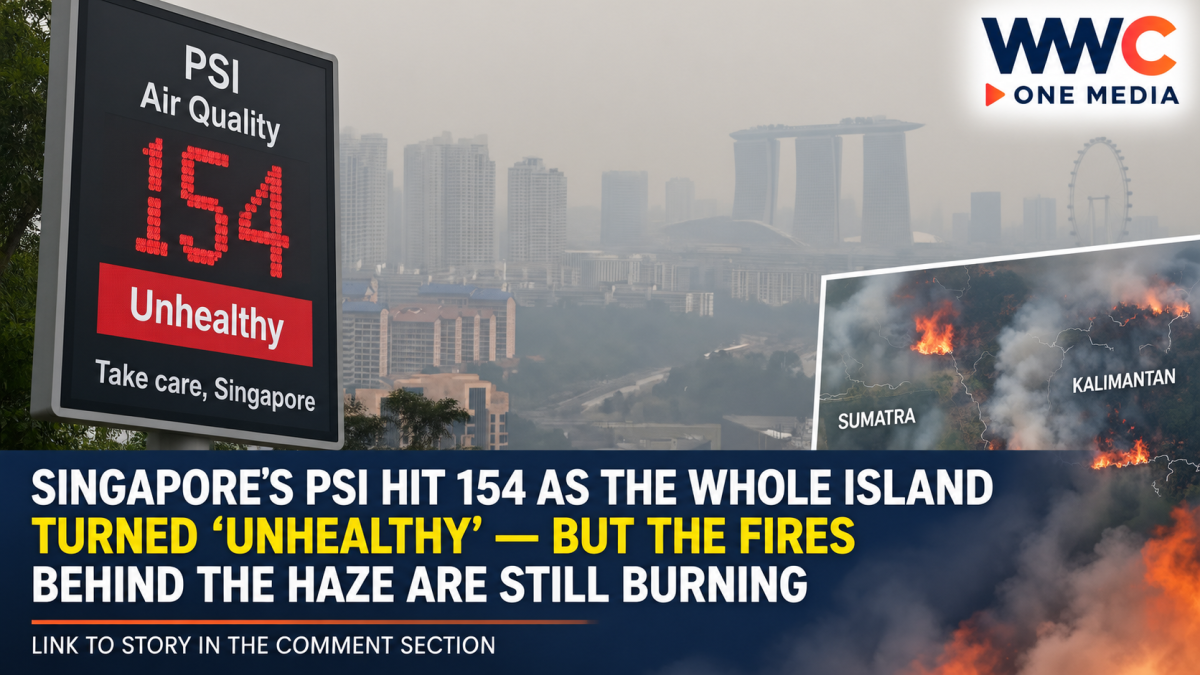
SINGAPORE — Singapore woke Tuesday to something it had not experienced on an islandwide scale for seven years.
Every one of the country’s five air-quality regions was officially in the Unhealthy range.
At 6am on Sept. 15, the 24-hour Pollutant Standards Index stood at 154 in central Singapore, 128 in the east, 128 in the west, 111 in the south and 104 in the north.
A PSI between 101 and 200 is classified as Unhealthy.
The deterioration marked the first time since September 2019 that all five regions had simultaneously crossed the 100-point threshold. In that earlier episode, islandwide readings entered the Unhealthy range in the early hours of Sept. 15, 2019.
The immediate reason is visible hundreds of kilometers away.
Large fires across parts of Indonesia’s Kalimantan and Sumatra have been generating smoke that regional winds are carrying toward Singapore.
And this time, the haze is arriving during one of Indonesia’s most serious fire seasons in more than a decade.
The number that grabbed Singapore’s attention: 154
The headline reading was central Singapore’s 24-hour PSI of 154.
That remains within the Unhealthy band rather than the more severe categories.
Singapore classifies PSI levels as:
0 to 50: Good
51 to 100: Moderate
101 to 200: Unhealthy
201 to 300: Very Unhealthy
Above 300: Hazardous.
So a reading of 154 is serious enough to trigger changes in outdoor activity, particularly for vulnerable groups, but it is still far below the Hazardous levels associated with Singapore’s worst historical haze episodes.
That distinction matters.
The current conditions should not be minimized.
They also should not be described as if Singapore has already returned to the extraordinary pollution of 2015.
It has not.
The deterioration happened quickly
Only a day earlier, conditions were much less severe.
At 5pm on Sept. 14, the Meteorological Service Singapore recorded 24-hour PSI readings ranging from 88 to 117, meaning some parts of the island were still in the Moderate band while others had crossed into Unhealthy territory.
One-hour PM2.5 concentrations ranged from 56 to 115 micrograms per cubic metre, which NEA placed in its Elevated band.
Then overnight, all five regions crossed 100.
That rapid deterioration demonstrates why haze forecasts depend so heavily on something Singapore cannot control:
wind direction.
The wind changed — and Kalimantan’s smoke came with it
NEA said the prevailing wind shifted to blow from the east-southeast, allowing moderate to dense smoke from fires in Kalimantan to drift toward Singapore.
Some smoke from southern Sumatra was also observed moving toward the island.
The agency forecast dry weather across Singapore and much of the surrounding region and expected winds to continue blowing from the southeast to east-southeast.
Its conclusion was straightforward:
Singapore would likely continue to be affected by smoke haze.
NEA’s 24-hour forecast put the PSI between the high end of Moderate and middle of Unhealthy.
That means Tuesday morning’s murky skyline was not simply the result of pollution generated locally.
The dominant haze threat is regional.
Kalimantan has become the biggest immediate concern
Kalimantan, the Indonesian portion of Borneo, has experienced major fire activity during the current dry season.
The ASEAN Specialised Meteorological Centre raised its southern ASEAN haze status to Alert Level 3 on Aug. 26, its highest level in the regional alert framework.
At the time, ASMC reported widespread moderate-to-dense smoke originating from clusters of hotspots in Kalimantan, with transboundary haze spreading beyond Indonesia.
Smoke was also covering substantial parts of southern and central Sumatra.
By early September, monitoring stations in parts of Borneo and Sumatra were reporting air quality ranging from Unhealthy to Hazardous.
Singapore is therefore receiving only part of a much larger regional pollution event.
Indonesia is facing a public-health emergency of its own
The conditions inside Indonesia are considerably more severe.
Reuters reported that Indonesian Health Ministry figures showed respiratory illnesses associated with the fires had more than doubled in little more than a week.
By Sept. 9, more than 113,000 cases of respiratory illness had been recorded, up from 50,891 on Sept. 1.
More than 12.5 million people across seven provinces had been exposed to smoke and haze, according to officials cited by Reuters.
Those figures offer important context whenever Singapore’s haze is described solely as pollution “coming from Indonesia.”
Millions of Indonesians are breathing the same smoke much closer to the fires.
They are often experiencing far higher pollution levels.
Some Indonesian cities have seen genuinely dangerous air
Pontianak in West Kalimantan has been among the areas hardest hit.
Reuters reported air-quality readings there reaching hazardous levels, while schools in some Indonesian regions have moved temporarily to remote learning as smoke blanketed communities.
The fires have also spread close to Nusantara, Indonesia’s planned new capital in East Kalimantan.
Around 400 hectares had burned in the broader area near the project by early September, including fires in Bukit Suharto forest park roughly 50km from the capital site.
That demonstrates the scale of the challenge.
These are not isolated patches of burning vegetation.
The crisis stretches across large areas of Sumatra and Borneo.
And this fire season is approaching uncomfortable comparisons with 2015
Indonesia’s disastrous 2015 fire season remains the benchmark against which major haze events are judged.
The current year has begun showing some disturbing similarities.
Reuters reported that from Sept. 1 to 7, Indonesia’s wildfire carbon emissions reached about 19.7 million metric tons, according to the EU’s Copernicus monitoring service.
That represented more than one-third of global wildfire emissions over that period and was about 273% above the seasonal average.
From Aug. 1 to Sept. 8, more than 13,400 hotspots had been recorded, compared with roughly 9,450 during the equivalent period in 2015.
Those comparisons do not mean 2026 will necessarily end up as destructive as 2015.
The total area burned, fire duration, peat involvement, wind patterns and eventual rainfall will determine that.
But the figures show why governments around the region are taking the current season seriously.
El Niño is making an already combustible landscape even drier
Weather is playing a major role.
A strong El Niño has brought unusually hot and dry conditions to much of Southeast Asia.
ASMC warned in August that El Niño was expected to strengthen and could further escalate hotspot activity and transboundary haze.
Indonesia’s meteorology agency has similarly said dry conditions have increased vulnerability to forest and peatland fires.
The problem becomes particularly severe in peat areas.
Peat contains large amounts of partially decomposed organic material.
When sufficiently dry, it can ignite not only on the surface but below ground.
Those underground fires can smolder for long periods, making them extremely difficult to extinguish and allowing smoke production to continue even when visible flames appear to subside.
That is one reason rainfall can matter as much as firefighting aircraft.
Indonesia has deployed aircraft — and Japan has sent helicopters
Jakarta has significantly expanded its response.
Reuters reported that Indonesia deployed more than 50 aircraft for operations including water bombing and cloud seeding as officials struggled with fires across Sumatra and Borneo.
Japan has also sent three CH-47 Chinook helicopters and around 180 personnel to assist firefighting operations in West Kalimantan.
The deployment was scheduled to conduct water-bombing operations from Sept. 12 through Sept. 19.
Thousands of Indonesian military, police and firefighting personnel have also been deployed on the ground.
The challenge is enormous because air operations need nearby water sources and cloud seeding requires suitable atmospheric conditions.
You cannot manufacture rain from a cloud that is not there.
Indonesia is also investigating who started fires
Weather explains why fires spread rapidly.
It does not explain how every fire began.
Indonesia’s government has launched both criminal and administrative enforcement actions.
Police announced the arrests of 72 people suspected of involvement in forest and peatland fires, linked to 89 fire cases across Kalimantan and Sumatra. Those people are suspects; arrests do not establish guilt.
Separately, Indonesia’s Forestry Ministry said 42 forest-fire cases were undergoing legal proceedings.
The ministry also imposed administrative sanctions on six concession holders after fires affected more than 1,500 hectares in areas they managed. Five were ordered to make corrections, while one company’s business licence was suspended over repeated and extensive fires.
That is a much more accurate way to discuss responsibility than simply claiming “companies are burning Indonesia.”
Some fires are under investigation.
Some individuals have been arrested.
Some concession holders have been sanctioned.
But responsibility has to be established case by case.
Why Southeast Asian fires keep becoming a haze problem
Forest and land fires can start for many reasons, but deliberate burning has historically been used in parts of Southeast Asia because it is a cheap way to clear vegetation.
When those fires reach dry peatland, they can become exceptionally difficult to control.
Strong dry-season conditions then amplify the damage.
Smoke rises into the atmosphere.
Regional winds carry fine particulate matter across national borders.
Singapore can therefore have relatively little fire activity of its own and still wake up under a grey blanket.
This is the essence of transboundary haze.
The pollution source and the people breathing it may be in different countries.
Malaysia has already experienced worse conditions
Singapore is not the first neighboring country hit during the current fire season.
Parts of Malaysia have suffered severe haze since August.
Sarawak’s Serian district was placed under an emergency declaration after air quality reached hazardous territory before the emergency was later lifted as conditions improved.
Sabah also recorded widespread unhealthy readings earlier this month, with several monitoring stations above 170.
Malaysian Prime Minister Anwar Ibrahim has called for stronger ASEAN cooperation to deal with recurring transboundary pollution.
The current crisis is therefore regional, not bilateral.
Smoke does not recognize national borders.
Singapore had already been warned that 2026 could be difficult
This haze did not arrive entirely without warning.
Back in June, the Singapore Institute of International Affairs issued its highest-risk “red” haze outlook, warning that Southeast Asia faced a high likelihood of severe transboundary haze during the remainder of 2026.
The think tank identified August and September as the peak danger period, citing strong El Niño conditions, potentially dry weather and other economic and policy factors affecting fire risks.
That forecast now looks prescient.
NEA had also warned during August that Singapore could be affected if fires in Sumatra and Kalimantan intensified while winds blew from favorable directions.
The missing ingredient was simply the right wind.
Singapore now has it.
But should everyone immediately put on an N95 mask?
Not necessarily.
Singapore’s Ministry of Health says short-term exposure to haze for otherwise healthy people will generally not cause serious health problems, although some may experience irritation of the eyes, nose and throat.
MOH specifically says N95 masks are generally not necessary for ordinary short-duration activities such as commuting between home and work or school, and they are not required indoors.
That does not mean masks never matter.
For people who must remain outdoors for several hours when air pollution becomes very severe, especially at Hazardous PSI levels, a properly fitted N95 can reduce exposure to fine particles.
But the more immediate recommendation at current Unhealthy levels is usually to adjust how long and how hard you exercise outdoors.
What should people do at an Unhealthy PSI?
At a 24-hour PSI between 101 and 200, NEA and MOH advise healthy people to reduce prolonged or strenuous outdoor physical exertion.
Children, pregnant women and elderly people should minimise prolonged or strenuous outdoor activity.
People with chronic heart or lung disease should avoid prolonged or strenuous outdoor physical exertion.
Those distinctions are useful.
“Unhealthy” does not mean every resident should lock themselves indoors.
It means exposure should be managed according to health status, pollution level and the intensity and duration of activity.
Someone walking five minutes to the MRT faces a very different exposure from someone running 20km outdoors.
And 24-hour PSI is not the best number for every decision
This is another point that often causes confusion whenever haze returns.
Singapore publishes both the 24-hour PSI and one-hour PM2.5 readings.
They are designed for different decisions.
NEA advises people to use the one-hour PM2.5 level when deciding what to do immediately, such as whether to exercise outdoors right now.
The 24-hour PSI and forecast are more useful when planning activities over the rest of the day or the following day.
That explains why a person can look outside and feel that conditions have suddenly improved or deteriorated while the 24-hour PSI appears to move only gradually.
The PSI incorporates pollution over a longer period.
It does not reset the moment the wind changes.
Singapore’s haze machinery is already activated
NEA began issuing daily haze advisories earlier this month after air quality first crossed into the Unhealthy range in parts of Singapore on Sept. 4.
On that day, central Singapore reached 123, while eastern and western areas later crossed 100.
The government’s Haze Task Force, involving 28 public agencies, had already been placed on standby to implement their haze-response plans if conditions worsened.
Those agencies cover issues ranging from schools and healthcare to workplace safety, transport and public services.
At current readings, Singapore remains well below the level associated with the most disruptive emergency measures.
But the institutional response is no longer merely precautionary.
The haze has arrived.
The bigger uncertainty is how long it stays
Singapore’s air can improve quickly when wind direction changes or rain arrives.
That happened repeatedly during previous haze years.
The opposite can also happen.
A dense smoke plume can reach the island and push readings higher within hours.
NEA’s Sept. 14 advisory pointed toward continued risk because dry weather was expected across much of the surrounding region while southeast to east-southeast winds persisted.
As long as fires keep generating large quantities of smoke, Singapore’s air quality will remain partly hostage to regional meteorology.
That makes the fire situation in Kalimantan more important than whether Singapore itself gets one brief afternoon shower.
Rain in Singapore can help — but it does not extinguish Indonesian peat fires
A local downpour can temporarily wash some particulate matter out of the atmosphere.
It may make the skyline clearer.
It does not solve the source problem.
For sustained improvement, several things can happen:
winds shift away from Singapore;
rain increases over the burning regions;
Indonesian firefighters contain the major fires;
or the seasonal dry conditions begin to break.
Until one or more of those occurs, haze can return even after short periods of clearer air.
That is why a single better-looking afternoon should not automatically be interpreted as the end of the episode.
And the worst part of the haze may still be invisible
The grey skyline attracts attention.
The most important pollutant is much smaller.
PM2.5 refers to particles with diameters of 2.5 micrometres or less.
Because they are so small, they can penetrate deep into the respiratory system.
That is why Singapore’s haze health advisories emphasize fine particulate matter rather than simply visibility or smell.
A hazy-looking skyline and a dangerous PM2.5 reading are often connected, but visibility is not a reliable substitute for actual measurements.
People should therefore rely on official readings rather than judging air safety solely by whether Marina Bay looks grey.
The seven-year milestone is significant — but it needs to be stated correctly
Singapore has experienced Unhealthy PSI readings since 2019.
For example, central Singapore crossed 100 this month before Tuesday.
What had not happened for seven years was all five regions being in the Unhealthy range at the same time.
On Sept. 15, 2019, the north, south, east, west and central regions all exceeded 100.
On Sept. 15, 2026, it happened again.
So the accurate headline is:
Singapore went islandwide Unhealthy for the first time in seven years.
Not:
“Singapore has had no unhealthy haze for seven years.”
Those are very different claims.
And Singapore is not yet at 2015 levels
Memories of 2015 still shape the way many Singaporeans react to the word haze.
That year produced exceptionally severe pollution during a massive Indonesian fire crisis.
The current fire season is alarming enough that emissions and hotspot counts are drawing comparisons with 2015.
But Singapore’s current PSI readings have not approached the most extreme levels seen during that historical episode.
The most responsible interpretation is therefore somewhere between complacency and panic.
This is a serious haze episode.
It is not yet Singapore’s worst.
The next 24 to 48 hours depend on three things
The first is whether Kalimantan’s fires continue producing dense smoke.
The second is whether dry weather persists over the source regions.
The third is whether winds continue carrying that smoke toward Singapore.
NEA’s latest available advisory says all three conditions remain sufficiently unfavorable that Singapore is likely to continue experiencing haze, with air quality forecast between High Moderate and Mid Unhealthy.
That means Tuesday morning’s PSI of 154 may not necessarily be the peak.
It also does not mean the reading will inevitably climb.
Wind changes can rapidly alter the situation.
Singapore’s haze problem has once again exposed an uncomfortable regional reality
Singapore has sophisticated air-quality monitoring.
It has haze contingency plans.
It has healthcare guidance.
It can stock masks and install air filtration.
What it cannot do from within its borders is extinguish a peat fire burning hundreds of kilometers away.
Indonesia, for its part, is deploying aircraft and troops, investigating suspected fire starters and sanctioning concession holders while millions of its own citizens breathe polluted air.
Malaysia has already faced hazardous conditions.
Japan has sent military helicopters to assist firefighting.
ASEAN’s regional haze warning is at Level 3.
That is what makes Singapore’s PSI reading bigger than an unpleasant morning skyline.
154 is not the beginning of the problem.
It is one downstream measurement of a fire crisis already consuming land, damaging health and generating smoke across Southeast Asia.
Singapore’s skies will eventually clear when the winds and fires allow it.
The harder question is whether the region can stop arriving at the same place whenever drought, peat and fire line up again.



Leave a Reply