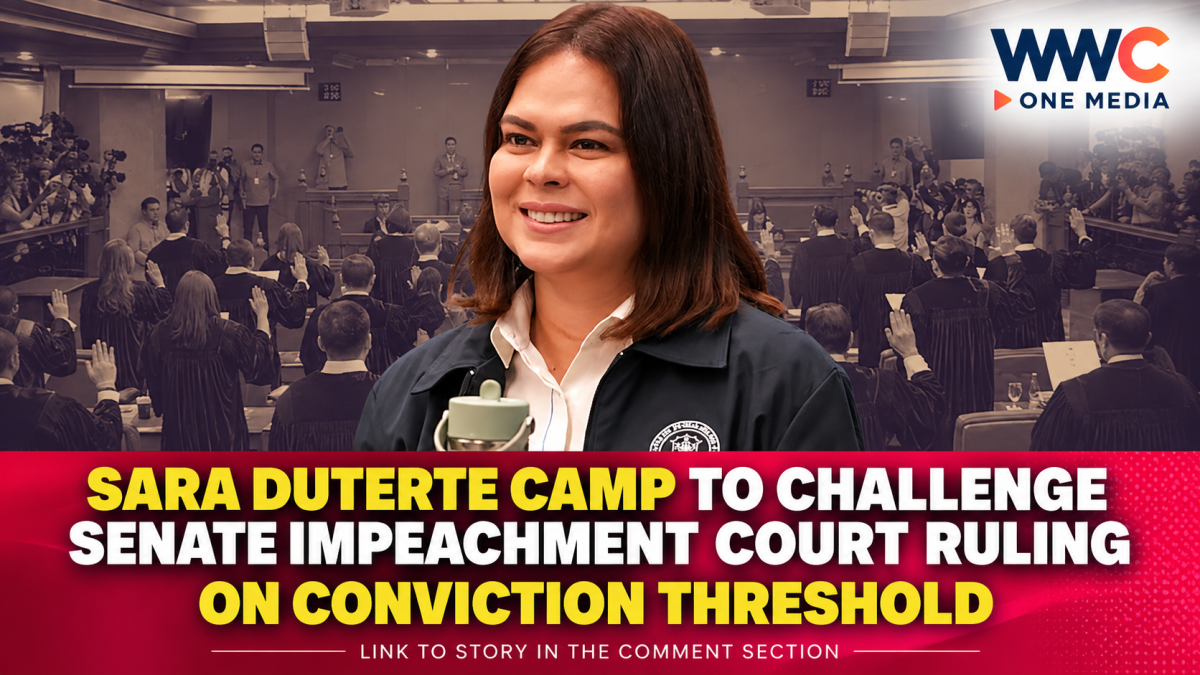
Vice President Sara Duterte’s legal team is preparing to challenge before the Supreme Court the Senate impeachment court’s decision to revise how the number of votes needed to convict her will be calculated.
The challenge centers on the impeachment court’s 13-1 vote on Sept. 23 to overturn an earlier ruling that required 16 votes for conviction. Under the new interpretation, only senators who are legally and factually capable of participating in the proceedings when the final vote is held will be included in the calculation.
Duterte’s spokesperson, lawyer Salvador Paolo Panelo Jr., said the defense is considering a petition for certiorari before the Supreme Court. The legal argument is based on Article XI, Section 3(6) of the 1987 Constitution, which states that an impeachment conviction requires the concurrence of two-thirds of all members of the Senate.
The Senate impeachment court did not establish a permanent replacement for the previous 16-vote threshold. Instead, the required number will depend on how many senator-judges are determined to be legally and factually capable of taking part when the judgment is rendered. Any fraction in the two-thirds calculation will be rounded up.
The ruling allows senators who are detained, suspended, physically or medically incapacitated, in hiding, beyond the Senate’s coercive processes, or otherwise legally unable to participate to potentially be excluded from the denominator. The court said those circumstances must be established through competent and sufficient evidence at the appropriate stage of the proceedings.
As an illustration, presiding officer Francis “Chiz” Escudero said that if only 20 senator-judges were legally and factually capable of participating at the time of judgment, two-thirds would be 13.33, requiring 14 votes after rounding up. This was an example rather than a final threshold for Duterte’s trial.
The defense has said it will continue participating in the impeachment proceedings while reserving its right to pursue legal remedies. Lead defense counsel Sheila Sison described the participation as “ad cautelam,” meaning the defense is appearing without conceding that the impeachment court’s jurisdiction over the proceedings remains valid.
The Senate’s ruling followed oral arguments from both sides and consultations with retired Supreme Court justices who were invited to provide views on the constitutional issue. The House prosecution has defended the decision, arguing that the ruling clarified how the constitutional two-thirds requirement should be applied rather than changing the requirement itself.
The threshold dispute is separate from the merits of the impeachment allegations. The prosecution is continuing to present evidence, with the trial scheduled to resume on Sept. 28. The senator-judges will ultimately determine whether Duterte is convicted or acquitted after the proceedings and evidence have been completed.
The possible Supreme Court petition could therefore add another legal dimension to an impeachment trial already facing disputes over the interpretation of the Constitution, while the Senate proceedings continue unless a court order changes their course.