
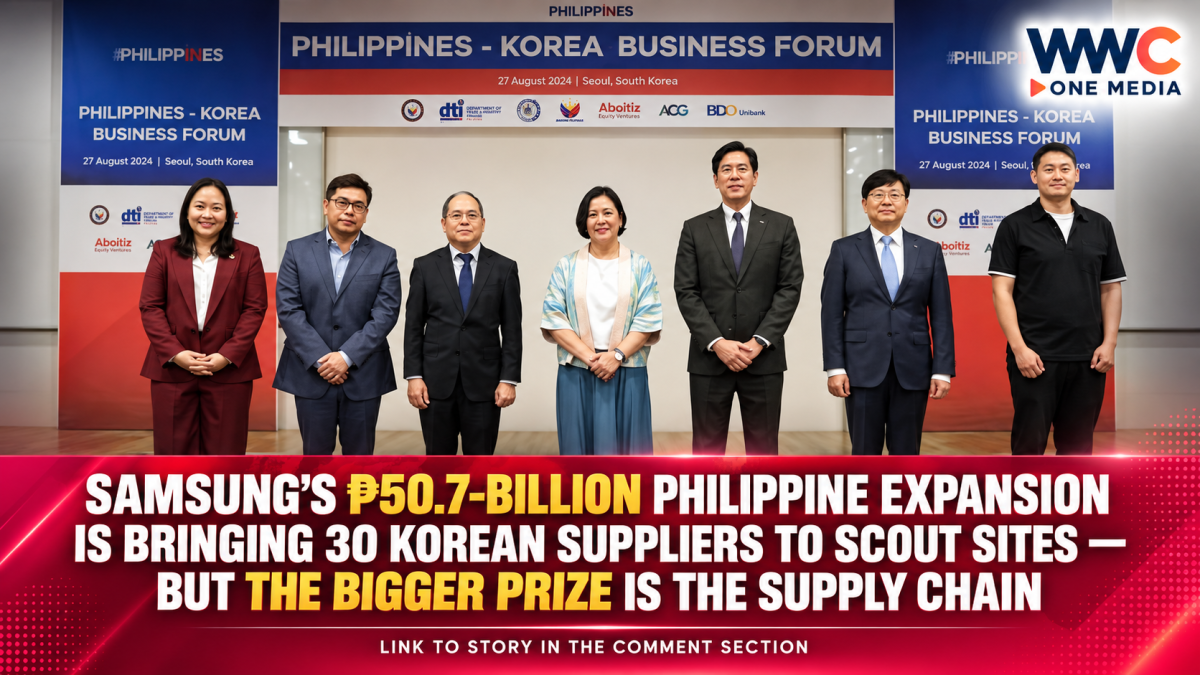
MANILA — Samsung Electro-Mechanics’ massive expansion in the Philippines may be about to trigger something potentially more important than one big investment: an entire ecosystem of suppliers following it into the country.
Around 30 Tier 1 suppliers of Samsung Electro-Mechanics Co. Ltd. are expected to visit the Philippines in October to conduct due diligence and evaluate possible investment sites, according to the Philippine Economic Zone Authority.
The companies are being courted as the government tries to turn Samsung Electro-Mechanics Philippines Corp.’s ₱50.7-billion expansion in Laguna into a much wider manufacturing cluster involving semiconductor chemicals, printed-circuit-board materials, precision components and other specialized electronics inputs.
And that may be the real story.
The Philippines is no longer trying only to land another multinational factory.
It is trying to persuade the suppliers surrounding those factories to come too.
Samsung’s ₱50.7-Billion Bet Is Becoming a Magnet
Samsung Electro-Mechanics Philippines, or SEMPHIL, is expanding its manufacturing operations at Calamba Premiere International Park in Laguna.
The project was announced at ₱50.7 billion and became the first investment granted presidential incentives under the CREATE MORE Act.
The new facility is intended to manufacture advanced multilayer ceramic capacitors, or MLCCs, tiny components found throughout modern electronics and increasingly important in electric vehicles, smart devices and high-performance industrial applications. The government has said the expansion is expected to create more than 3,000 high-value jobs, with commercial operations targeted for 2027.
But a large factory rarely operates in isolation.
It needs chemicals.
Specialty materials.
Cutting equipment.
Circuit-board inputs.
Cables.
Precision tools.
Packaging.
Logistics.
And dozens of other suppliers capable of meeting highly demanding electronics manufacturing standards.
PEZA now wants more of those companies physically located in the Philippines.
Around 30 Korean Suppliers Are Coming to Look
PEZA said roughly 30 first-tier suppliers of Samsung Electro-Mechanics are expected to travel to the country in October to conduct due diligence and determine whether establishing Philippine operations makes commercial sense.
Some of the industries represented are highly specialized.
During PEZA’s recent South Korea investment mission, officials engaged manufacturers involved in semiconductor and printed-circuit-board surface-treatment chemicals, including plating materials and organic solderability preservatives.
Another prospective supplier manufactures precision products such as MLCC cutting blades, slitter knives, cutting saws, wheel cutters and nickel mesh.
These are not necessarily household names.
But in an advanced manufacturing economy, companies like these can matter enormously because they form the industrial network that allows major manufacturers to produce efficiently at scale.
That is why attracting Samsung’s suppliers could carry an economic effect well beyond the initial ₱50.7-billion investment.
The AI Boom Is Part of the Equation
Samsung Electro-Mechanics itself has been signaling stronger demand for high-end components linked to artificial-intelligence servers, data centers and automotive electronics.
The company reported record annual revenue for 2025 and said its Component Solution business benefited from increased sales of higher-end MLCCs for AI servers and power applications.
For 2026, Samsung Electro-Mechanics said it expected continued demand growth from AI, server and automotive applications and planned to expand its supply of high-value components serving those markets.
That gives the Philippine expansion a broader strategic significance.
If global demand for AI infrastructure, electric vehicles and advanced electronics continues growing, a deeper Samsung supplier base in the Philippines could connect the country more tightly to industries that generate considerably more value than conventional low-cost assembly.
But getting suppliers to visit is only step one.
Getting them to invest is the real test.
PEZA Is Trying to Build a Korean Manufacturing Pipeline
The prospective Samsung suppliers are only part of the Korean companies PEZA has recently approached.
During its South Korea mission, PEZA also held discussions with Geumjeung Industrial Co. Ltd., a manufacturer of plastic films used by the food and beverage industry, as well as GAON Cable, which PEZA describes as South Korea’s oldest cable manufacturer.
Officials also met with a producer of PCB adhesives and specialty tapes and with companies exploring semiconductor-materials, information-technology and tourism projects.
PEZA Director General Tereso Panga said the strategy is to use the expansion of existing major Korean investors to draw their suppliers and business partners into Philippine economic zones.
The logic is straightforward.
One anchor manufacturer can attract multiple suppliers.
Those suppliers can then create additional jobs, increase exports, deepen domestic production capabilities and potentially develop business relationships with other manufacturers.
That is how an individual foreign investment can begin developing into an industrial cluster.
South Korea Already Has a Large Philippine Footprint
This push is not starting from zero.
PEZA says more than 180 companies with significant South Korean equity already operate inside Philippine economic zones.
Together, they have invested more than ₱120 billion and employ more than 43,000 Filipino workers.
South Korea was also the largest source of investment in PEZA zones in 2024, according to the agency.
And Korean capital remains important in 2026.
PEZA said South Korea ranked among its leading foreign investment sources during the first half of this year. By the end of August, total PEZA-approved investments from all sources had reached ₱216.46 billion, equivalent to just over 72% of the agency’s ₱300-billion full-year target.
That provides the government with a strong incentive to convert October’s supplier visits into signed projects rather than ceremonial meetings.
The Philippines-Korea FTA Gives Investors Another Reason to Look
The investment push is also occurring under a different trade environment.
The Philippines-South Korea Free Trade Agreement took effect on December 31, 2024, opening additional preferential market access between the two economies.
Under the agreement, South Korea committed to preferential duty-free treatment for 11,164 Philippine products, representing about $3.18 billion or 87.4% of Korean imports from the Philippines, according to Philippine government figures.
For manufacturers deciding where to build their next factory, tariffs are only one consideration.
Electricity costs, infrastructure, logistics, skilled labor, taxes, regulatory predictability and proximity to customers can be just as important.
But an FTA can make the investment equation more attractive, particularly for companies operating supply chains across several Asian markets.
Vietnam Is Also Part of the Competition
PEZA believes another opportunity may be emerging from companies already manufacturing elsewhere in Southeast Asia.
The agency says some manufacturers operating in Vietnam are examining the Philippines as a location for redundant or complementary production capacity.
That reflects a broader corporate strategy often described as supply-chain diversification: instead of putting too much manufacturing capacity into one location, companies establish production across multiple countries to reduce exposure to disruptions.
But the Philippines is competing aggressively for those investments.
Vietnam, Malaysia, Thailand and other Southeast Asian economies are also trying to capture semiconductor, electronics, EV and advanced-manufacturing projects.
So an October visit should not be mistaken for an investment commitment.
Companies will scrutinize costs, infrastructure, workforce availability, permitting and incentives before deciding where to put capital.
That distinction matters.
Thirty companies scouting the Philippines does not mean 30 companies are investing in the Philippines.
Not yet.
What Happens in October Could Matter More Than the Headline Number
The immediate headline is impressive: dozens of Korean suppliers preparing to examine Philippine locations.
The bigger question is how many actually return with investment proposals.
If even a meaningful portion of Samsung Electro-Mechanics’ Tier 1 suppliers establish factories near its Laguna operations, the ₱50.7-billion Samsung expansion could become something much larger than a single corporate project.
It could help establish a deeper domestic network for advanced electronics manufacturing.
That would mean more components being produced locally, stronger supplier linkages, additional technical jobs and potentially greater Philippine participation in global semiconductor and electronics value chains.
For years, the Philippines has talked about moving beyond simply hosting multinational factories and toward developing deeper industrial ecosystems around them.
Samsung’s expansion now gives the country a practical opportunity to test that ambition.
The ₱50.7-billion factory may already be secured.
The real prize arrives in October — when its suppliers decide whether the Philippines is worth following Samsung into.
WWC ONE MEDIA M.J.E




Leave a Reply