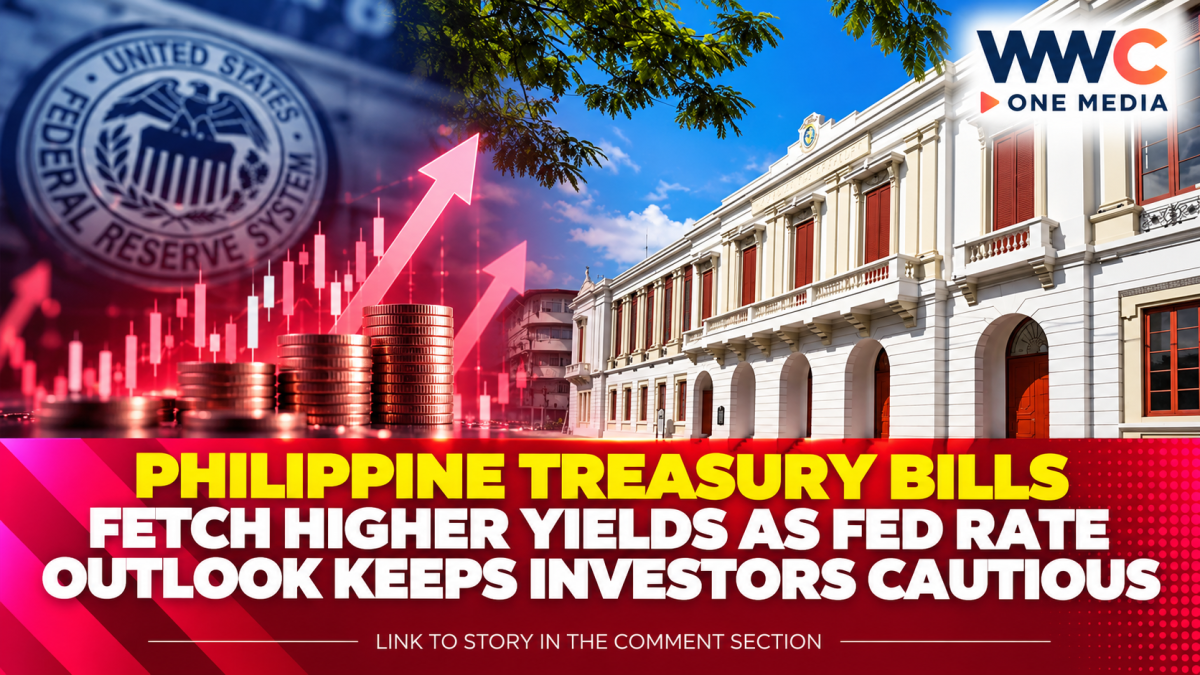
Philippine government short-term borrowing costs moved higher at Monday’s auction as investors adjusted to expectations that the US Federal Reserve may keep monetary policy tight for longer amid lingering inflation risks.
The Bureau of the Treasury raised a combined P52 billion from cash management bills and Treasury bills, fully awarding the securities offered despite stronger demand. Total tenders reached P91.251 billion, up sharply from the P71.478 billion in bids received at the previous auction, when the government offered P42 billion in Treasury bills.
The Treasury borrowed P10 billion through 35-day cash management bills, which attracted P12.177 billion in total bids. The one-month bill fetched an average rate of 5.124%, an increase of 8.8 basis points from the 5.036% recorded when similar papers were last awarded on Sept. 1. Bid yields ranged from 5% to 5.228%.
The higher rate reflects investors demanding greater returns as global interest-rate expectations remain uncertain. Markets have been closely watching the Federal Reserve’s policy direction, with persistent inflation pressures complicating expectations for future rate adjustments.
Higher US interest rates can affect Philippine financial markets by influencing global yields, capital flows and expectations for the Bangko Sentral ng Pilipinas. Domestic Treasury yields can rise when investors reassess the relative returns available from Philippine securities compared with assets in other major markets.
The latest auction also comes as Philippine bond investors continue to monitor inflation and geopolitical risks. Rising energy prices and uncertainty in the Middle East have added another layer of concern because prolonged increases in oil prices can feed into domestic inflation and affect expectations for interest rates.
Despite the higher yields, demand for the government’s short-term securities remained strong. The amount of bids submitted significantly exceeded the amount offered, allowing the Treasury to raise its planned borrowing without reducing the award.
The movement in short-term rates is important for the government because Treasury bill yields influence the cost of short-term public borrowing. For investors, higher yields can increase potential returns but also reflect greater uncertainty about inflation, monetary policy and market conditions.
The latest auction therefore shows how developments in US monetary policy can quickly affect the Philippine debt market. With inflation risks, oil prices and global interest-rate expectations still shifting, Treasury yields could remain sensitive to new economic and geopolitical signals in the coming weeks.