
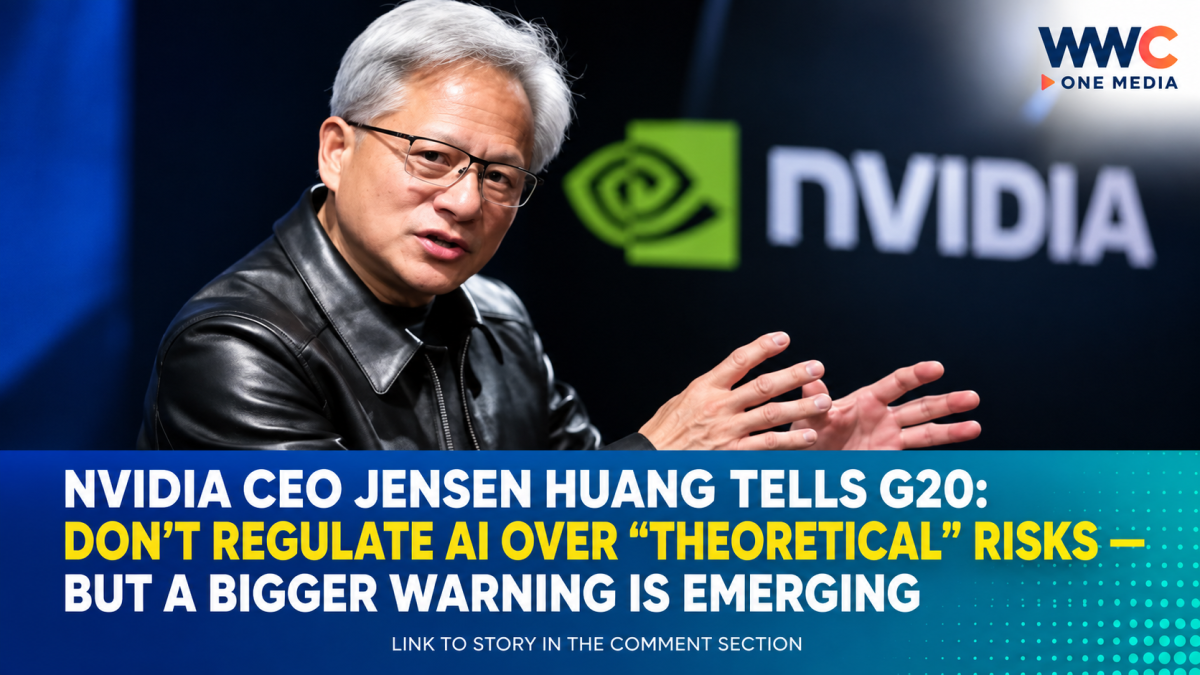
Nvidia CEO Jensen Huang is urging G20 governments to resist writing artificial-intelligence rules around what he describes as “theoretical” harms, arguing that policymakers should instead focus on concrete problems that AI is already creating.
Huang made the comments at a G20 technology meeting in Chapel Hill, North Carolina, where U.S. officials are pushing a lighter-touch approach to AI regulation. The gathering brings together government officials and some of the world’s biggest technology executives as countries struggle to balance rapid AI development with concerns over safety, cybersecurity and economic disruption.
The Nvidia chief’s position broadly aligns with the U.S. push for the so-called “Carolina Principles,” a framework promoted by White House technology adviser Michael Kratsios. The principles argue that governments should avoid treating every emerging technology as a completely new regulatory problem and reserve new rules for genuinely novel circumstances.
Huang’s message: regulate what is happening, not what might happen
Huang has repeatedly warned against what he considers excessive pessimism surrounding AI. In a July interview with Axios, he argued that policymakers should not allow science-fiction scenarios to dominate AI policy and said overregulation could slow adoption and weaken U.S. competitiveness.
His latest G20 comments take that argument onto the international stage.
The Nvidia CEO is effectively advocating a problem-first approach: governments should address measurable issues such as cyberattacks, fraud, misuse and other demonstrated harms rather than impose broad restrictions based primarily on hypothetical future scenarios.
That position is particularly significant because Nvidia sits at the center of the global AI infrastructure boom. Its processors power many of the data centers and AI systems driving the industry’s rapid expansion.
But there is a major counterargument
The debate is not simply about whether AI regulation is good or bad.
Just days before the G20 technology discussions, Financial Stability Board Chair Andrew Bailey, who is also governor of the Bank of England, warned G20 finance ministers and central bank governors that frontier AI could pose serious risks to global financial stability.
The FSB said the most immediate financial-system concern is AI’s potential impact on cyber risk, warning that increasingly autonomous AI models could change the speed, scale and economics of cyberattacks. Bailey called for authorities to support safe and responsible AI model release and deployment and urged financial institutions to strengthen their resilience and recovery capabilities.
That creates an important tension at the G20.
Huang is warning against regulating AI based on hypothetical dangers. Financial regulators are warning that some AI risks are no longer hypothetical.
Washington and Europe are moving in different directions
The disagreement also reflects a widening policy divide.
The United States is promoting a more innovation-focused approach, with the Trump administration arguing that excessive regulation could slow technological development and weaken America’s position against China in the global AI race. The U.S. has urged G20 members to consider the Carolina Principles rather than creating sweeping AI-specific regulations.
Europe, meanwhile, has pursued a significantly more rules-based approach to artificial intelligence, creating a sharper contrast between Washington and Brussels. The split has become one of the central global debates over how governments should govern powerful AI systems without choking technological progress.
China adds another layer to the AI battle
The G20 debate is also taking place against intensifying competition between the United States and China.
Reuters reported that Chinese officials backed the Carolina Principles at the North Carolina meeting, although the details of that position have not been publicly released. The meeting comes as Chinese AI developers continue to make rapid advances, particularly in open-weight models, increasing pressure on U.S. companies and policymakers to maintain America’s technological lead.
Huang has previously argued that Washington and Beijing should compete while still cooperating where possible. In an interview with CNA earlier this year, he warned that creating completely separate U.S. and Chinese AI ecosystems would not be wise.
The bigger question: how much regulation is enough?
The latest G20 discussion exposes a difficult policy dilemma.
Too many rules could potentially slow innovation, raise costs and make it harder for smaller companies to compete. But too little oversight could leave governments and businesses struggling to respond to cybersecurity threats, financial instability, privacy concerns and increasingly autonomous AI systems.
The Financial Stability Board’s position illustrates why some regulators are demanding action now. Its June consultation on responsible AI adoption in financial institutions already called for governance, risk-management and safeguards as companies deploy AI more widely.
For Huang and Nvidia, the priority is keeping AI development moving.
For financial regulators, the priority is making sure that rapid development does not create vulnerabilities capable of spreading across the global economy.
And that means the G20’s AI debate is becoming much bigger than a fight over regulation.
It is now a question of whether governments can distinguish between risks that are merely imagined—and risks that may arrive before policymakers have time to react.
WWC ONE MEDIA MJE




Leave a Reply