
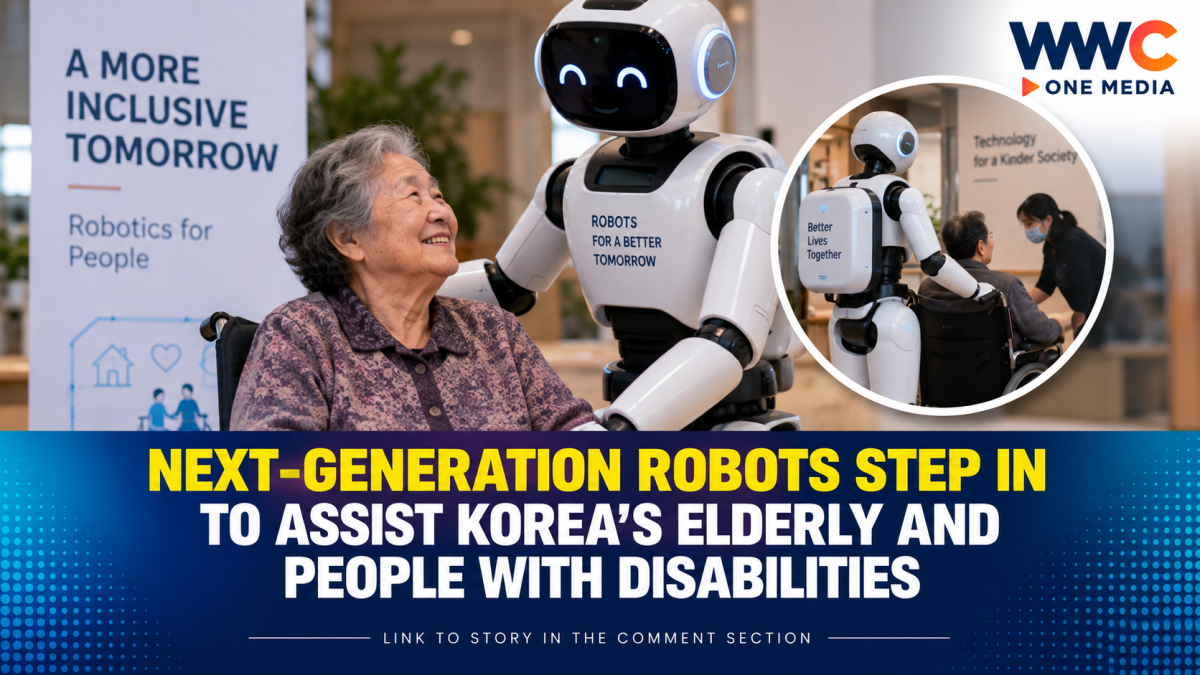
SEOUL — South Korea is taking another step toward a robot-assisted future as artificial intelligence and autonomous machines move into everyday services designed to help older adults, people with disabilities and others facing mobility challenges.
One of the clearest examples is emerging in Seongnam, where an AI-powered porter robot is being tested at Moran Traditional Market to help shoppers carry goods and navigate the market’s narrow, complicated passages.
Robot That Carries Up to 20 Kilograms
The project allows users to scan a QR code at the market entrance and have the robot follow them while carrying up to 20 kilograms of goods.
Seongnam officials specifically designed the demonstration to improve mobility for elderly residents, people with disabilities and other transportation-vulnerable users. The trial is scheduled for August through October 2026.
The technology is particularly suited to Moran Market, where narrow alleys and poor GPS reception make navigation difficult for conventional autonomous systems.
AI Navigation Adds Another Layer
The project isn’t limited to carrying shopping bags.
Seongnam is also testing an AI-based augmented-reality navigation system that can guide shoppers through the market to individual stores. Officials say the system uses Naver Cloud technology and can operate without relying on GPS, an important feature inside the market’s maze-like environment.
The goal is to demonstrate how physical AI can solve practical problems in public spaces rather than remain confined to laboratories or factories.
Korea’s Aging Population Is Driving the Technology
The push comes against the backdrop of South Korea’s rapidly aging population and growing pressure on the country’s care system.
Robotics is increasingly being examined as a way to supplement—not simply replace—human caregivers.
Research published in 2026 has also examined how the adoption of age-related technology can affect stress and turnover among long-term-care workers in South Korea, suggesting that technology could potentially serve as one tool for supporting an increasingly demanding care environment.
Meanwhile, earlier deployments of AI companion robots have shown another possible role: providing reminders, communication and companionship for older people living alone. Korean care-robot projects have included systems such as Hyodol, which has been deployed in communities supporting seniors.
Humanoid Robots Enter the Conversation
The technology is also moving beyond small companion devices.
KB Financial Group unveiled a humanoid robot for senior-care applications at AI EXPO Korea 2026, demonstrating how large Korean institutions are exploring robotics as part of the country’s expanding care-technology ecosystem.
These systems represent different approaches: some focus on companionship and monitoring, while newer mobile robots are being developed to physically assist people with everyday activities.
Robots Are Becoming Part of Korea’s Wider AI Strategy
South Korea’s robotics ambitions extend well beyond elder care.
The country is investing heavily in humanoid robots, artificial intelligence and physical AI, with Korean manufacturers, technology companies, universities and government-backed initiatives working to build a domestic robotics ecosystem.
Recent developments have also included robots for industrial environments and technologies designed to help people perform physical tasks with less assistance.
At the same time, the government is developing new security guidelines for increasingly autonomous AI systems, reflecting concerns about safety, accountability and cybersecurity as these technologies become more capable.
The Human Factor Still Matters
The arrival of assistive robots does not mean human caregivers are disappearing.
Instead, Korea’s current projects point toward a model in which robots handle carrying, navigation, monitoring and other repetitive tasks, allowing people to remain responsible for care and personal interaction.
That distinction will become increasingly important as robots move from demonstrations into homes, hospitals, markets and other public spaces.
For South Korea, the experiment is already underway: robots are no longer being developed solely for factories. They are increasingly being designed to help people move, shop, communicate and live more independently.
And as Korea’s aging population grows, the biggest test may be whether these machines can move from impressive demonstrations to reliable everyday companions.
WWC ONE MEDIA G.A




Leave a Reply