
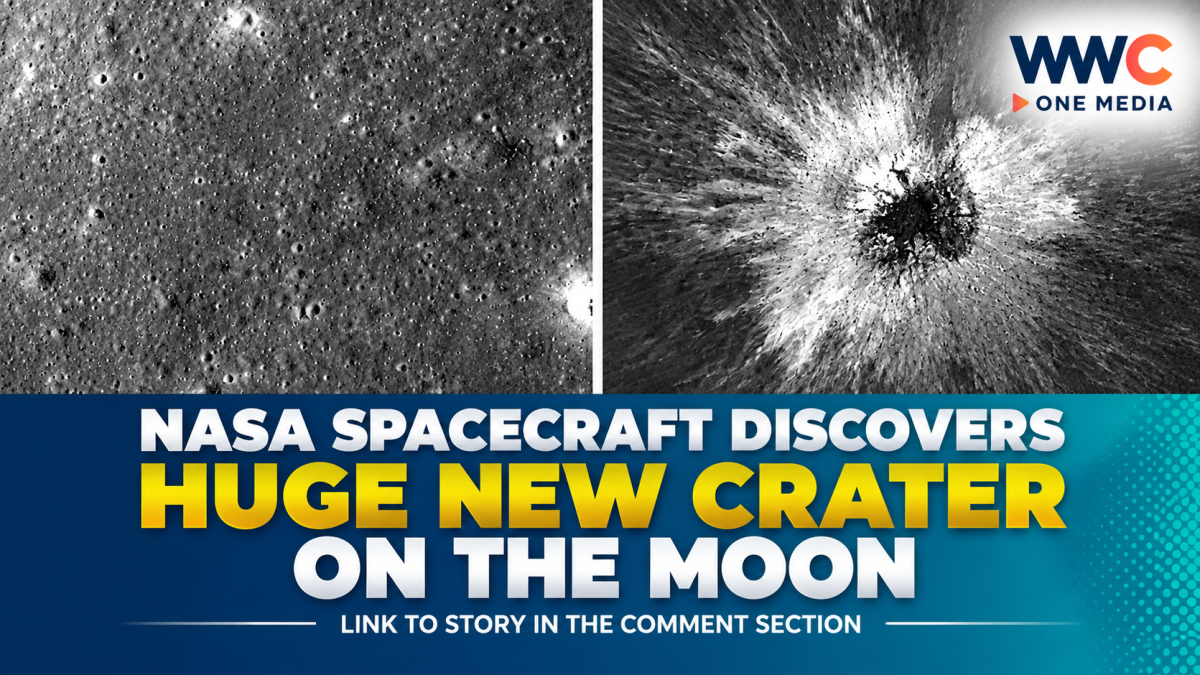
Scientists have discovered a huge new crater on the Moon that was created by a powerful impact in 2024, offering a rare opportunity to study how the lunar surface changes over time.
NASA’s Lunar Reconnaissance Orbiter detected the crater on the Moon’s near side in May 2024, shortly after an object believed to be a fragment of an asteroid or comet struck the surface. The impact was not detected in real time by telescopes on Earth or in space.
The crater, officially named McGetchin after lunar scientist Thomas McGetchin, measures about 222 metres across and reaches up to 43 metres deep. It is the largest newly formed impact crater discovered in the solar system in recent times and is roughly three times larger than the previous record-holder found by the same spacecraft.
Researchers estimate that an impact of this size occurs on the Moon only about once every century or longer, making the discovery an unusually valuable scientific observation.
The crater was initially overlooked in the enormous volume of images collected by the Lunar Reconnaissance Orbiter. Scientists identified changes in the spacecraft’s data in 2025 before obtaining more detailed images and confirming the crater earlier this year.
The impact also disturbed the lunar surface far beyond the crater itself. Researchers found evidence that dust and rocky material were thrown across an area extending more than 100 kilometres.
A separate study identified a cold region about seven kilometres wide around the crater. Scientists believe the impact loosened and disturbed the Moon’s upper layer of soil, known as regolith, changing how the surface retains heat.
Researchers describe the process as a form of lunar “gardening”, in which impacts churn material on the surface and bring previously buried soil and rocks closer to the top.
The findings are also changing scientists’ understanding of how quickly the Moon’s surface is reshaped. Data from the Lunar Reconnaissance Orbiter suggest that the upper two centimetres of lunar soil are overturned by material ejected from impacts roughly every 80,000 years.
The discovery could have practical implications for future lunar exploration. NASA and other space agencies are preparing for longer-term human activity on the Moon, and understanding how far impact debris can travel could help engineers assess risks to future landing sites, vehicles and lunar habitats.
Scientists are now examining the potential threat posed by material ejected from similar impacts. The information could help guide the design of structures intended to protect astronauts and equipment from debris.
The newly identified crater therefore provides more than a glimpse into a recent lunar collision. It gives researchers a rare opportunity to observe the effects of a major impact while also improving understanding of the changing environment future astronauts may encounter on the Moon.




Leave a Reply