
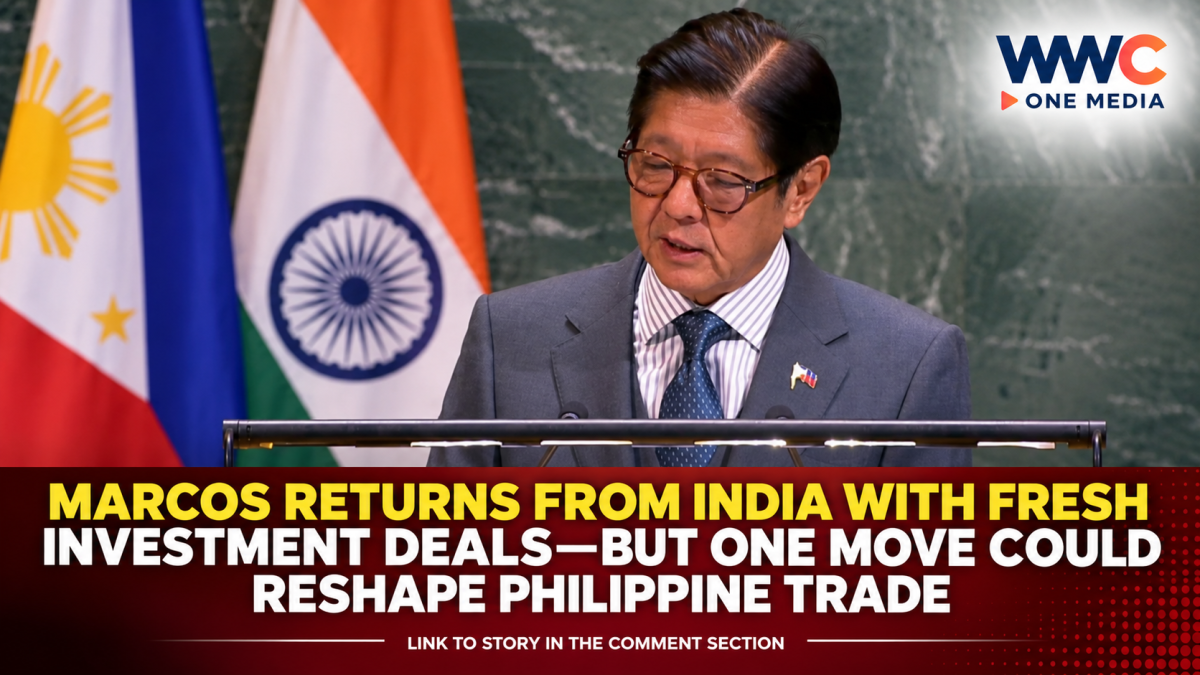
President Ferdinand Marcos Jr. has returned from India after using his latest visit to push the Philippines-India relationship beyond diplomacy and into investment, digital technology, aviation, healthcare and trade—with several initiatives now positioned to deliver more tangible economic gains for Filipinos.
Marcos traveled to New Delhi for the 18th BRICS Summit on September 12–13, 2026, attending in his capacity as chair of the Association of Southeast Asian Nations (ASEAN). But alongside the high-level summit, the President also held meetings with Indian business leaders and government officials to advance the economic agenda between Manila and New Delhi.
The latest trip effectively served as a follow-up to Marcos’ 2025 state visit, when the Philippines and India elevated their relationship to a Strategic Partnership and the Philippine government reported 18 business agreements involving actual investments of about US$446 million, alongside potential investment interest reaching US$5.8 billion.
Indian companies signal expansion in the Philippines
One of the clearest outcomes of the latest visit was renewed expansion interest from Indian companies already operating or establishing a presence in the Philippines.
Trade and Industry Secretary Ma. Cristina Roque said Indian companies expressed plans to expand in areas including agricultural technology, healthcare, telecommunications, business-process outsourcing, artificial intelligence and digital infrastructure.
Among the most notable commitments was from iSON Group, which committed about US$75 million in new and scaled-up Philippine investments expected to generate around 2,000 jobs.
The proposed investments include a US$50-million agro-solar project, healthcare initiatives including teleconsultation services, and a US$10-million expansion of BPO and global delivery centers.
For the Philippines, the significance goes beyond the headline investment figure.
The projects connect several priorities of the Marcos administration—food security, digitalization, healthcare access, renewable energy and employment—potentially bringing Indian technology and capital into sectors with direct domestic applications.
India-style digital payments could be next
Another potentially important development involves India’s Unified Payments Interface (UPI).
Marcos met with NPCI International Limited to discuss digital-payment cooperation, including a possible partnership with LandBank to explore a Philippine payment system based on India’s UPI model.
If implemented, the initiative could make cross-border transactions faster and potentially improve payment interoperability for OFWs, businesses and small and medium enterprises.
It could also support more efficient government payments and QR-based transactions—an area where India’s digital-payment ecosystem has become a major part of its economic infrastructure.
Sangley airport also enters the India equation
Marcos also met representatives of GMR Group and Cavitex Holdings to advance discussions surrounding the Sangley Point International Airport project.
The proposed airport is being positioned as a potential aviation and logistics hub that could help address capacity constraints at Ninoy Aquino International Airport while supporting tourism, trade and connectivity.
The Philippine government sees expanded air connectivity as an important component of stronger economic relations with India and the broader region.
Philippine tech sector could get another boost
The President’s meetings also included executives from Cognizant, VVDN Technologies, Hinduja Group and HCLTech.
According to Roque, the companies expressed interest in expanding their Philippine operations, particularly in digitalization, AI, telecommunications and other technology-driven industries.
That is significant because the Philippines has increasingly been positioning its workforce and growing digital economy as advantages in attracting global technology and business-services investments.
The bigger economic picture
The latest push comes as trade between the two countries continues to expand.
India’s Ministry of Commerce said bilateral trade reached about US$3.9 billion in fiscal year 2025–26, up from roughly US$3.3 billion in 2024–25. Philippine and Indian officials have also been discussing a Preferential Trade Agreement (PTA) that could further expand trade in goods and services.
The proposed agreement could become one of the most consequential pieces of the economic relationship because it aims to increase market access, diversify traded products and strengthen supply-chain links between the two economies.
The two countries are also working through the review of the ASEAN-India Trade in Goods Agreement, while separately exploring a bilateral PTA.
From strategic partnership to economic results
The Philippines and India formally established their Strategic Partnership in 2025, covering not only trade and investment but also defense, maritime security, science and technology, healthcare, agriculture, digital technologies, tourism and connectivity.
The agreement’s five-year Plan of Action for 2025–2029 provides the framework for turning those commitments into concrete cooperation.
For Marcos, therefore, the latest India trip was not simply another diplomatic appearance.
It was an effort to demonstrate that the strategic relationship announced last year can translate into capital, jobs, technology, infrastructure and greater market access for the Philippines.
And that may be the bigger story emerging from the trip.
The real test now is whether the investment pledges and proposed projects move from announcements to actual implementation—and whether the Philippines can convert its rapidly expanding relationship with India into sustained economic gains.
That is where the next chapter of the Philippines-India partnership could become much more important than the headlines coming out of New Delhi.




Leave a Reply