
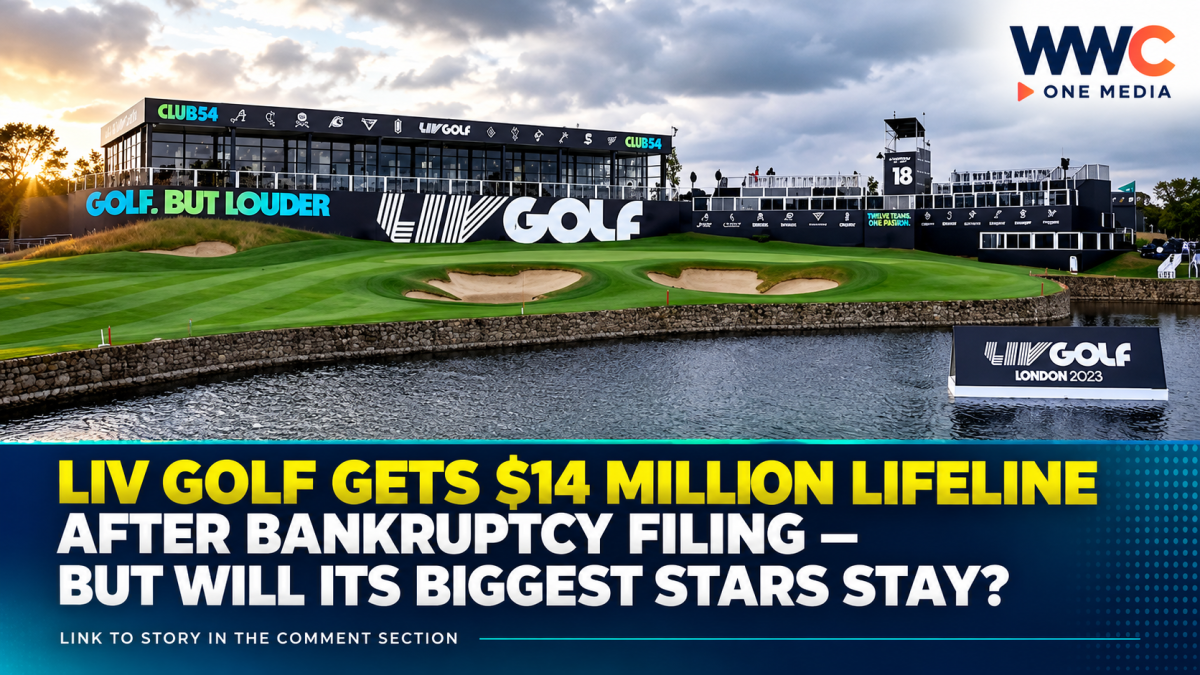
The Saudi-backed golf league, which filed for Chapter 11 bankruptcy protection earlier this week, said a U.S. Bankruptcy Court in New Jersey approved several first-day motions, including interim access to $14 million in debtor-in-possession financing.
The court’s decision allows LIV Golf to continue paying employee wages and benefits, maintain certain employee programs and make selected payments to vendors and business partners while it works through a major restructuring.
But while the ruling provides much-needed breathing room, it does not answer the biggest question hanging over LIV Golf:
Can the league keep its players, rebuild its finances and return as a credible force in professional golf?
LIV Golf’s $14 Million Lifeline
LIV Golf has access to a total of $49.6 million in debtor-in-possession, or DIP, financing, according to court filings and reports on the restructuring.
The interim court order permits the league to immediately draw $14 million, while access to the remaining financing will depend on further court approval. LIV is scheduled to return to court on October 7 to seek final approval for additional relief supporting its restructuring.
Debtor-in-possession financing is commonly used in Chapter 11 cases to provide a company with cash to continue operating while it reorganizes.
For LIV Golf, the money is crucial.
The league needs to maintain operations while negotiating with players, employees, creditors, vendors and potential investors — all while trying to create a new version of the business for 2027.
LIV Golf Wants a Major Reset
LIV Golf filed for Chapter 11 protection in the U.S. Bankruptcy Court for the District of New Jersey after entering into a restructuring support agreement connected to BC Partners Credit.
The league has described the proposed transaction as a recapitalization designed to preserve LIV as a going concern and eventually create what it calls a more player-first ownership model.
LIV Golf CEO Scott O’Neil described the court approvals as important momentum for the league’s proposed next chapter.
The company is aiming to complete its restructuring and emerge from Chapter 11 in early 2027, potentially launching a new phase of LIV Golf after one of the most dramatic financial collapses in modern professional sports.
But the restructuring could produce a dramatically different league.
Reports from multiple golf and sports outlets indicate that LIV’s future model may involve smaller-scale operations, a redesigned competition format and significantly greater player involvement in ownership.
The Biggest Problem: LIV Golf Owes Players Millions
The financial restructuring has also exposed one of LIV Golf’s most serious challenges.
Several of the league’s highest-profile players are listed among its major creditors and are reportedly owed millions of dollars.
Court documents reviewed by golf media have identified major names including Jon Rahm, Bryson DeChambeau, Dustin Johnson and Cameron Smith among players with significant financial claims against the organization.
Reports have placed LIV Golf’s total liabilities in the range of $500 million to $1 billion, underscoring the enormous scale of the restructuring challenge.
That creates a potentially uncomfortable situation for the league.
LIV needs players to believe in its future at the same time that some of its biggest stars are also creditors seeking money from the organization.
The league has said it intends to continue discussions with players about its future structure and participation after bankruptcy.
Can LIV Golf’s Biggest Stars Leave?
That question could define the future of men’s professional golf.
The uncertainty surrounding LIV’s restructuring has fueled speculation about whether some players could eventually pursue opportunities with the PGA Tour, DP World Tour or other professional circuits.
Rory McIlroy has publicly said traditional tours will face important decisions as LIV’s situation develops, particularly if players seek a path back into the broader golf ecosystem.
However, any potential return for LIV players remains complicated by existing rules, eligibility requirements and possible disciplinary issues.
For now, there is no confirmed mass player exodus.
But the restructuring process has created a new level of uncertainty around the future of some of the biggest names in the sport.
Saudi Funding Withdrawal Changed Everything
LIV Golf launched in 2022 with enormous financial backing from Saudi Arabia’s Public Investment Fund and quickly transformed professional golf by offering massive contracts to players who left the PGA Tour.
The strategy attracted some of the sport’s biggest stars and triggered years of division across men’s golf.
But the league’s financial model has now come under intense pressure.
Recent reports indicate that the Public Investment Fund’s future role in funding LIV changed significantly, forcing the league to seek a restructuring and new financial support. LIV’s bankruptcy filing represents a dramatic turning point for a tour that once appeared capable of spending almost without limits.
The proposed involvement of BC Partners Credit is now central to LIV’s plans for survival.
LIV Adelaide Future Also Faces Questions
The financial crisis is not affecting only players and executives.
LIV Golf’s international events are also under scrutiny.
In Australia, South Australian Premier Peter Malinauskas has expressed concern about whether LIV can deliver the level of event promised for Adelaide in 2027. He warned that the government’s relationship with the tournament could be reconsidered if LIV is unable to meet its contractual commitments or delivers a significantly reduced event.
That illustrates the wider challenge facing LIV.
The league is not simply trying to reorganize a company.
It must also maintain relationships with tournament hosts, governments, sponsors, commercial partners, broadcasters and fans across multiple countries.
What Happens Next?
The next few weeks could be critical.
LIV Golf must:
- Secure further court approval for financing.
- Continue paying employees and key business partners.
- Negotiate with players about future participation.
- Work with creditors during the Chapter 11 process.
- Finalize its proposed recapitalization.
- Build a sustainable business model for 2027.
The immediate $14 million gives LIV Golf time.
It does not guarantee survival.
The October court hearing will be another major milestone, but the ultimate success of the restructuring may depend on something even more important than financing:
Whether LIV Golf’s biggest stars still believe the league is worth saving.
For a tour that entered professional golf with unprecedented financial firepower, the story has suddenly changed.
LIV Golf is no longer asking how much it can spend.
It is now fighting to prove that it still has a future.




Leave a Reply