
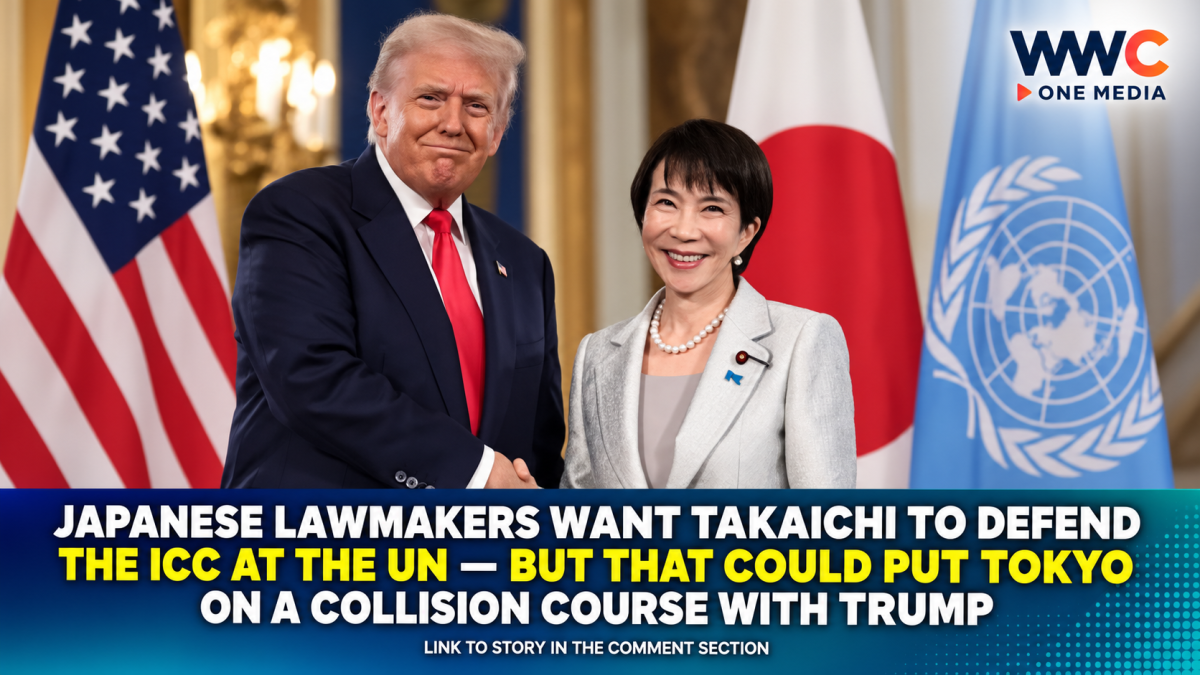
TOKYO — Prime Minister Sanae Takaichi is heading to the United Nations next week with a diplomatic problem Japan can no longer easily keep behind closed doors.
A cross-party group of Japanese lawmakers is urging her to use one of the world’s biggest political stages to publicly defend the International Criminal Court, whose Japanese president has been sanctioned by the United States.
The lawmakers want Takaichi to go further still.
They are asking her government to tell Washington directly:
Lift the sanctions.
The demand puts Tokyo in an unusually uncomfortable position — forced to choose how aggressively it will defend an international legal institution it has financed and championed for years when the government challenging that institution belongs to Japan’s indispensable military ally.
The lawmakers want the issue inside Takaichi’s U.N. speech
The Nonpartisan Parliamentary Association for Reconsidering Human Rights Diplomacy delivered its written recommendation to State Minister for Foreign Affairs Ayano Kunimitsu on Monday.
Its members urged Takaichi to voice clear support for the ICC during her address to the U.N. General Assembly’s general debate on Sept. 22.
They also asked the government to directly call on the United States to withdraw its sanctions against ICC President Tomoko Akane.
Former Defense Minister Gen Nakatani, a senior Liberal Democratic Party lawmaker and co-chair of the parliamentary group, said the General Assembly was a place where countries should publicly make their case to the international community.
His broader message was harder to miss:
Japan should not limit its support for the ICC to quiet diplomacy.
The lawmakers want Takaichi to put it on the record in New York.
Sept. 22 gives Takaichi an unusually visible opportunity
The timing could hardly be more sensitive.
The 81st session of the U.N. General Assembly’s general debate begins Sept. 22 and runs through Sept. 28 at U.N. headquarters in New York.
Takaichi is scheduled to speak on the opening day, in what will be her first address to the General Assembly’s general debate as prime minister.
U.S. President Donald Trump is also scheduled to speak that day, earlier in the programme.
Tokyo has separately explored the possibility of arranging a meeting between Takaichi and Trump while she is in the United States.
That makes the ICC dispute potentially more than one paragraph in a U.N. speech.
It could become a direct Japan-U.S. diplomatic issue while both leaders are in New York.
Why Washington sanctioned Tomoko Akane
The dispute began escalating on Aug. 18, when the U.S. Treasury Department added Akane to its Specially Designated Nationals list alongside Senegalese ICC senior trial lawyer Abdoulaye Seye.
Akane is not merely another ICC judge.
She is the court’s president, the first Japanese national ever to hold that position.
Secretary of State Marco Rubio said the two officials had participated in ICC efforts involving people whose governments had not consented to the court’s jurisdiction.
The Trump administration argues that the ICC has exceeded its authority by pursuing citizens and officials from countries such as the United States and Israel, neither of which has ratified the Rome Statute establishing the court.
Washington’s language has been unusually aggressive.
The administration has described the ICC as politicized and has said its broader campaign is intended to prevent the court from threatening U.S. sovereignty.
Rubio has also called on countries to stop funding and participating in the institution.
The sanctions have real consequences
Akane’s designation is not simply symbolic diplomatic criticism.
Being added to the U.S. sanctions list generally blocks property and interests in property under U.S. jurisdiction and severely restricts transactions involving U.S. persons and the U.S.-linked financial system.
Akane has since said the sanctions have interfered with financial transactions and that some companies have refused to deal with her.
She described being treated as though she were a criminal and said the measures had affected both her economic freedom and personal dignity.
The ICC says the pressure reaches far beyond the people whose names appear on sanctions lists.
The court said in August that nine of its 18 judges, both deputy prosecutors, its former prosecutor and one staff member had by then been subjected to U.S. sanctions.
It called the measures an attack on judicial independence and warned that they could impede the ability of victims of atrocities to seek justice.
Washington and the ICC fundamentally disagree over jurisdiction
At the heart of the confrontation is a genuine and consequential legal dispute.
The United States argues that an international tribunal should not be able to prosecute nationals of countries that never consented to its authority.
That concern is particularly important to Washington because the United States has never ratified the Rome Statute. Israel has not ratified it either.
The ICC’s position is different.
Under the court’s interpretation of the Rome Statute, it can exercise jurisdiction over alleged crimes committed on the territory of a member state even if the accused is a citizen of a country that is not itself an ICC member.
That principle became central to the ICC’s Palestine investigation.
Palestine acceded to the Rome Statute in 2015, and the court later ruled that its territorial jurisdiction for that situation extends to Gaza and the West Bank, including East Jerusalem.
The United States rejects the application of that authority to Israeli officials.
The ICC says the nationality of an alleged perpetrator does not eliminate jurisdiction over alleged crimes committed on territory within the court’s jurisdiction.
That disagreement is one reason neither side views the current confrontation as a minor diplomatic quarrel.
They disagree about the reach of international criminal law itself.
The immediate political flashpoint has been Israel
The Trump administration’s campaign intensified after the ICC pursued Israeli leaders over alleged crimes in Gaza.
In 2024, the ICC issued arrest warrants for Israeli Prime Minister Benjamin Netanyahu and then-Defense Minister Yoav Gallant after rejecting Israel’s jurisdictional challenges at that stage of the proceedings.
The United States strongly opposed those actions.
Trump has since said his anti-ICC campaign is intended in significant part to protect Netanyahu and others, while U.S. officials have also cited concern over potential cases involving American personnel.
Those allegations remain matters before international judicial processes, and an arrest warrant is not a criminal conviction.
That distinction is essential.
The ICC says its role is to adjudicate individual criminal responsibility under the Rome Statute; Washington argues that the court is overreaching into the sovereignty of non-member states.
Japan is not an ordinary bystander in this fight
That is what makes Tokyo’s position so awkward.
Japan has been an ICC member since October 2007 and has consistently described support for international law and the rule of law as core elements of its foreign policy.
It is also the court’s largest assessed financial contributor.
The latest figure published in Japan’s Diplomatic Bluebook says Japan accounted for approximately 15% of the ICC’s assessed contributions as of 2024.
Tokyo has also repeatedly supplied Japanese judges to the court.
Akane, a former Japanese prosecutor and former ambassador for international judicial cooperation, became an ICC judge in 2018 and was elected president of the court in March 2024.
So when Washington sanctions Akane, it is not targeting a remote international bureaucrat from Japan’s perspective.
It is sanctioning the Japanese official occupying the highest position in an institution Tokyo has spent years financially and diplomatically supporting.
Japan’s first response was only two words stronger than silence
That explains why Takaichi’s initial reaction created such controversy.
After the Aug. 18 sanctions, Japan’s Foreign Ministry said the action was “very unfortunate.”
Takaichi publicly used similar language and said Japan would remain in communication with the United States and other countries.
For some lawmakers, that was nowhere near enough.
Critics noted that Tokyo frequently invokes the “rule of law” when criticizing actions by China or Russia.
If Japan was unwilling to speak forcefully when its own closest ally put sanctions on the Japanese president of an international court, they argued, that could weaken the credibility of Japan’s wider foreign-policy message.
Even members of Takaichi’s own LDP began questioning the government’s restraint.
That is significant because this is not simply an opposition attack on the prime minister.
Some of the loudest criticism has come from experienced conservative security politicians who strongly support the U.S.-Japan alliance.
Takaichi says the criticism is unfair
The prime minister subsequently pushed back.
On Aug. 26, Takaichi said she did not accept accusations that her government had been “weak-kneed.”
She said Tokyo had pressed Washington at several levels until shortly before the sanctions were imposed, attempting to prevent Akane from being designated.
Takaichi also sharpened her public wording.
She described the sanctions as incompatible with Japan’s position and said the government took them seriously.
She added that Japan had a responsibility both to protect Akane as a Japanese national and to protect the ICC as its largest financial contributor.
That changes the political picture.
This is no longer a debate between a government that supports U.S. sanctions and lawmakers who oppose them.
Tokyo opposes the sanctions.
The argument is now about whether private lobbying and carefully worded criticism are sufficient — or whether Japan needs to publicly demand that Trump reverse course.
Akane wants Japan to do considerably more
Akane herself has made that request increasingly explicit.
In late August, she called the sanctions a crisis for the rule of law and asked Japan to use its relationship with Washington to prevent further escalation.
She also urged Tokyo to help persuade other ICC member states, particularly in Asia, not to abandon the court.
Akane rejects Washington’s assertion that the ICC improperly stripped non-member countries of sovereignty.
She has said she was simply performing her duties under the court’s founding treaty and that there was no proper basis for personally sanctioning her.
Her request puts Japan in a unique position.
Few countries have both Tokyo’s record of financial support for the ICC and its unusually close security relationship with Washington.
That gives Japan leverage.
It also makes the political cost of using it much higher.
And pressure on the ICC is no longer confined to sanctions
The court is confronting another problem that makes the Japanese debate more urgent.
A small but growing group of countries has announced plans to withdraw from the Rome Statute.
AP reported last week that Venezuela, Chad, Burkina Faso, Mali and Niger have all announced moves to leave within the past year.
Those withdrawals should not be described as instantaneous.
Under the Rome Statute, withdrawal generally becomes effective one year after formal notification, and it does not erase the court’s jurisdiction over conduct occurring while a country was bound by the treaty.
But politically, the trend is serious.
The U.S. State Department has openly welcomed further withdrawals.
For Akane and the lawmakers now lobbying Takaichi, that transforms the dispute from a question about one Japanese judge into a debate about whether the ICC itself can withstand sustained pressure from the world’s most powerful country.
Another Japanese parliamentary group is also pushing the government
The pressure on Takaichi is not coming from just one lawmakers’ association.
On Sept. 11, a separate group composed of lawmakers from the ruling LDP and Komeito submitted an urgent recommendation to Justice Minister Hiroshi Hiraguchi.
That delegation was led by former Foreign Minister Yoko Kamikawa, who herself publicly welcomed Akane’s election as ICC president when she was foreign minister in 2024.
Kamikawa’s group asked the government to continue providing diplomatic backing to the ICC and help discourage member countries from leaving it.
She also stressed the need to maintain visible dialogue with Washington.
This is important politically.
It shows that calls for a stronger response are spreading across overlapping groups of Japanese lawmakers rather than being confined to one ideological faction.
Yet supporting the ICC does not mean Japan endorses everything the court does
There is another nuance often lost in the confrontation.
Japan has long supported the ICC while also calling for improvements in how it operates.
Tokyo has urged the institution to maintain financial discipline, increase efficiency, broaden membership and ensure fair and impartial procedures.
Japan therefore does not need to accept every prosecutorial decision or judicial interpretation in order to defend the court’s independence.
Those are separate questions.
A government can criticize an international court’s decisions through legal and diplomatic channels while simultaneously opposing sanctions designed to pressure judges personally.
That distinction could give Takaichi room to frame her U.N. message carefully:
support the ICC as an institution,
defend judicial independence,
continue arguing for reform,
and avoid endorsing every individual decision made in The Hague.
That may be the diplomatic formula Tokyo is looking for
Takaichi has strong reasons not to turn the ICC dispute into an open confrontation with Trump.
The U.S.-Japan alliance remains the foundation of Japan’s security strategy.
Japan faces nuclear-armed North Korea.
It is strengthening deterrence around the East China Sea and Taiwan.
It relies heavily on U.S. military power as China modernizes its armed forces.
And Takaichi is pursuing closer coordination with Washington on economic and security questions.
A public clash with Trump over the ICC therefore carries costs Japan cannot simply ignore.
But excessive caution carries another cost.
Japan repeatedly asks other countries to respect international law.
It has criticized Russia over Ukraine.
It argues that territorial disputes should be resolved peacefully.
It stresses rules against unilateral attempts to change the status quo.
And it has made the phrase “rule of law” one of the foundations of its international diplomacy.
If Tokyo appears willing to soften those principles whenever Washington is responsible for challenging them, rivals can point to an obvious inconsistency.
That is precisely the vulnerability Takaichi’s critics are highlighting.
Nakatani’s intervention is particularly difficult for Takaichi to dismiss
Gen Nakatani is not an anti-American politician.
He is a veteran conservative lawmaker and former defense minister from Takaichi’s own Liberal Democratic Party.
That gives his criticism a different political weight.
Nakatani has argued that sanctioning Akane is not merely a personal matter but a challenge to a rules-based international system Japan depends upon for its own security.
He has called for Tokyo to lodge a formal protest and demand that Washington remove the sanctions.
In other words, he frames defending the ICC not as opposition to the U.S.-Japan alliance but as something Japan should do because a rules-based system ultimately benefits Japan.
That argument could resonate within an LDP government confronting more powerful neighbors.
The U.N. speech therefore becomes a test of wording
Takaichi does not need to devote her entire Sept. 22 address to the ICC for the message to matter.
One carefully constructed paragraph could send a significant diplomatic signal.
She could reiterate Japan’s support for the court.
She could defend judicial independence.
She could explicitly reject sanctions on judges.
And — if she follows the lawmakers’ request — she could call for their withdrawal.
Each step would be stronger than the one before it.
And Washington will almost certainly notice the difference.
The General Assembly is particularly significant because the statement would not be buried in a Japanese press conference or bilateral diplomatic exchange.
It would become part of Japan’s formal message to the international community.
Trump will be speaking from the same building
That gives the moment an additional layer of political theatre.
Trump is scheduled to address the General Assembly on the same day.
His administration has promised that its campaign against the ICC will be broad and has encouraged other countries to stop funding and participating in the court.
Japan is doing almost the opposite.
It remains the institution’s largest financial supporter according to its latest official data.
Its national is the court’s president.
And influential lawmakers are now asking their prime minister to use the U.N. stage to defend the institution Washington wants weakened.
That sets up an unusually clear clash of principles between two allies.
But it would be wrong to reduce the dispute to “Japan versus America”
The United States has legitimate longstanding objections to aspects of the ICC’s jurisdiction.
Washington never became a party to the Rome Statute and argues that American personnel should not be subject to a tribunal the United States did not accept.
Israel makes a similar sovereignty argument.
Supporters of the ICC respond that territorial jurisdiction is a familiar legal principle: when alleged crimes occur on the territory of a state that has accepted the court’s authority, the nationality of the suspect does not necessarily remove jurisdiction.
Reasonable legal and political debate about that principle will continue.
The more immediate Japanese controversy is different.
It concerns whether economic sanctions against judges and prosecutors are an acceptable way to resolve that disagreement.
The ICC says no.
Washington says the sanctions are necessary to protect sovereignty.
Japan now has to decide how loudly it will take sides on that narrower question.
The biggest danger for Takaichi may be appearing inconsistent
Takaichi’s government has emphasized deterrence, international rules and the need to oppose coercion by stronger states.
That makes this controversy unusually difficult to compartmentalize.
If Japan believes institutions and legal processes should be protected from political coercion, its critics argue that principle should apply whether the pressure comes from Moscow, Beijing or Washington.
Yet foreign policy has never been purely about applying principles identically in every relationship.
Governments weigh security alliances, economic dependencies and political consequences.
Tokyo clearly has more at stake in a rupture with Washington than it does in criticizing most other governments.
That is the reality behind the cautious language.
And it is exactly why the lawmakers’ demand matters.
They are effectively asking Takaichi whether Japan’s commitment to international law remains strong when upholding it becomes diplomatically expensive.
Sept. 22 could finally provide the answer
Takaichi has already moved well beyond her initial “very unfortunate” formulation.
She says the sanctions conflict with Japan’s position.
She says Tokyo tried to stop them.
She says Akane should be protected.
She says the ICC should be protected.
What she has not yet done publicly is what the lawmakers are now asking:
use one of the highest-profile speeches of her premiership to demand that Washington withdraw the sanctions.
That makes the coming U.N. appearance more than another foreign-policy address.
Japan has spent years telling the world that a rules-based international order matters most when powerful states are tempted to ignore it.
Now one of those powerful states is its closest ally.
And the person Washington has sanctioned is not only a foreign judge.
She is Tomoko Akane — Japan’s own president of the International Criminal Court.
Takaichi’s challenge on Sept. 22 will therefore be unusually simple to state and extremely difficult to execute:
Can Japan defend the international legal order it says it believes in without turning that defense into a confrontation with the United States?



Leave a Reply