
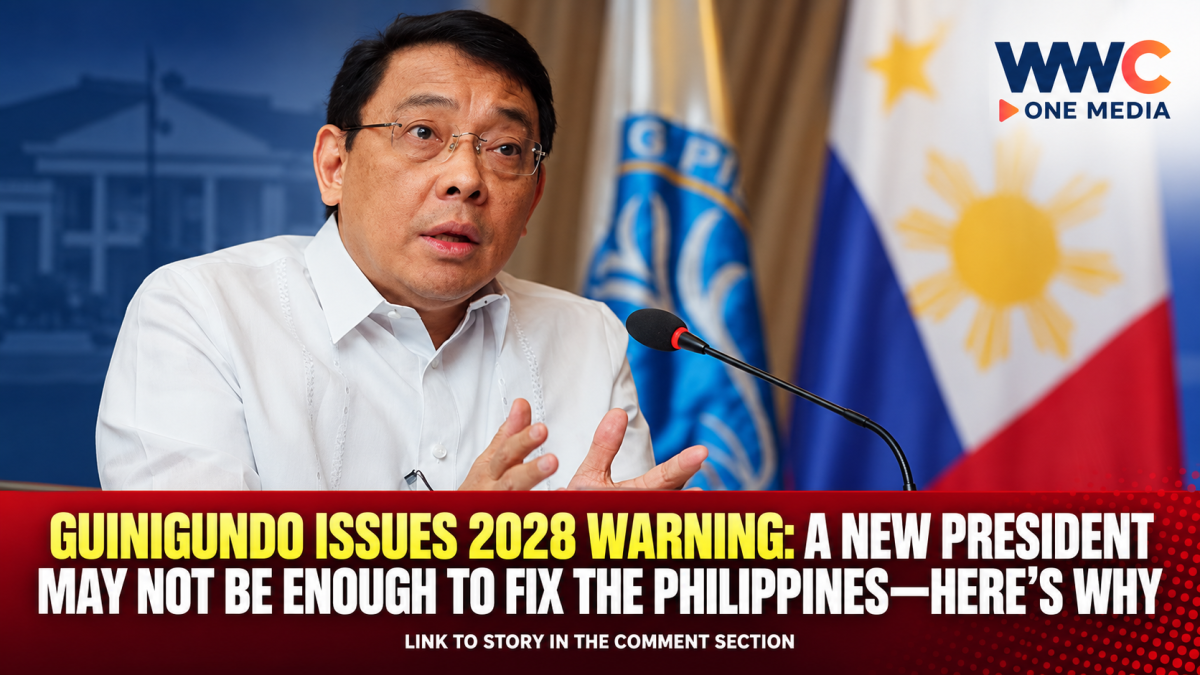
MANILA, Philippines — Electing a new president in 2028 may change the occupant of Malacañang, but it may not change the Philippines’ trajectory if Filipinos continue to tolerate corruption, political tribalism, disinformation and institutional dishonesty.
That is the warning from former Bangko Sentral ng Pilipinas (BSP) Deputy Governor Diwa Guinigundo, who argued that meaningful national change cannot depend solely on choosing a new leader at the ballot box.
In a September 4 BusinessWorld column cited by Bilyonaryo, Guinigundo asked whether the more important question ahead of the 2028 presidential election is not simply who Filipinos will vote for, but whether voters are prepared to reject the practices that keep a flawed system in place.
‘Living within a lie’
Guinigundo drew on the ideas of former Czech President Václav Havel, particularly the concept of “living within a lie.”
The idea describes a society in which people recognize that something is wrong but continue participating in or tolerating it because confronting the system can be inconvenient, costly or risky.
For Guinigundo, that concept offers a troubling lens through which to view the Philippines’ continuing governance problems.
The country’s recurring corruption controversies, he argued, cannot simply be blamed on individual politicians. They also raise questions about the willingness of institutions, businesses, civil servants, journalists and ordinary voters to challenge practices that have become normalized.
Flood-control controversy becomes a warning sign
One of the clearest examples is the continuing controversy surrounding government flood-control spending.
Guinigundo pointed to cases in which projects were funded and certified as completed even while communities continued to experience flooding and questions were raised over allegedly missing, unfinished or substandard infrastructure.
The controversy has also become an economic issue.
In August, Guinigundo said the flood-control scandal and political uncertainty had become a “major domestic amplifier” of the Philippine economic slowdown, alongside poor governance and weak implementation of public works projects.
The Philippine economy expanded only 2.3% year-on-year in the second quarter of 2026, according to reports citing official data, with weakness particularly visible in investment and construction. Guinigundo warned that the problem goes beyond one disappointing quarter because weak investment can undermine the economy’s ability to grow in the future.
Why corruption matters to investors
Guinigundo has repeatedly linked governance problems to investor confidence.
Earlier this year, he warned that corruption and weak accountability could discourage businesses from committing capital to the Philippines, particularly when investors believe public funds are being misallocated or government rules are inconsistently enforced.
GlobalSource Partners, where Guinigundo serves as an analyst, likewise reported that Philippine foreign direct investment weakened in late 2025 amid concerns about governance, corruption and policy uncertainty. The group said these issues contributed to a more cautious, “wait-and-see” stance among foreign investors.
The concern is straightforward: investors need confidence that contracts will be respected, regulations will be predictable and public institutions will enforce rules fairly.
Without that confidence, even aggressive economic programs may struggle to attract the investment needed to create jobs, improve productivity and raise incomes.
It’s not only about the next president
Guinigundo’s latest argument goes beyond the usual question of who might win the 2028 presidential race.
He also pointed to the ongoing impeachment proceedings involving Vice President Sara Duterte as a test of whether Philippine institutions can make decisions based on evidence, constitutional rules and due process rather than political loyalty.
That distinction is important.
A change in political leadership can alter policies and personnel, but institutions determine whether reforms survive beyond a single administration.
Guinigundo has previously argued that the Philippines needs stronger institutions, credible accountability and consistent enforcement rather than simply another round of government promises.
The economy cannot rely on headline numbers alone
Guinigundo has also cautioned against focusing exclusively on headline economic indicators while overlooking weaker investment, productivity and household income growth.
In a recent analysis, he argued that the Philippines needs to move beyond short-term “catch-up” spending and address deeper structural weaknesses involving governance, infrastructure, education, energy security, industrial policy and regulation.
His argument is that faster government spending may provide a temporary boost, but it cannot substitute indefinitely for strong private investment and rising productivity.
The same concern has appeared in his earlier commentaries, where he warned that governance failures can divert resources away from infrastructure, innovation, education and other investments necessary for long-term competitiveness.
The choice facing voters in 2028
That leaves Filipinos with a bigger question before the next presidential election.
It is not simply whether the country can elect a different president.
It is whether voters, institutions and the broader business and civic community are willing to stop rewarding corruption, patronage, political tribalism and impunity.
Guinigundo’s message is ultimately a warning against expecting one election to solve problems that have become deeply embedded in institutions and political culture.
A new president can change policies.
But if the same incentives remain, the same practices are tolerated and accountability continues to depend on political affiliation, the system itself may remain largely unchanged.
The 2028 election could therefore be about more than choosing the next president. It could become a test of whether Filipinos are finally willing to change the system that keeps producing the problems they complain about.
WWC ONE MEDIA J.M.S



Leave a Reply