
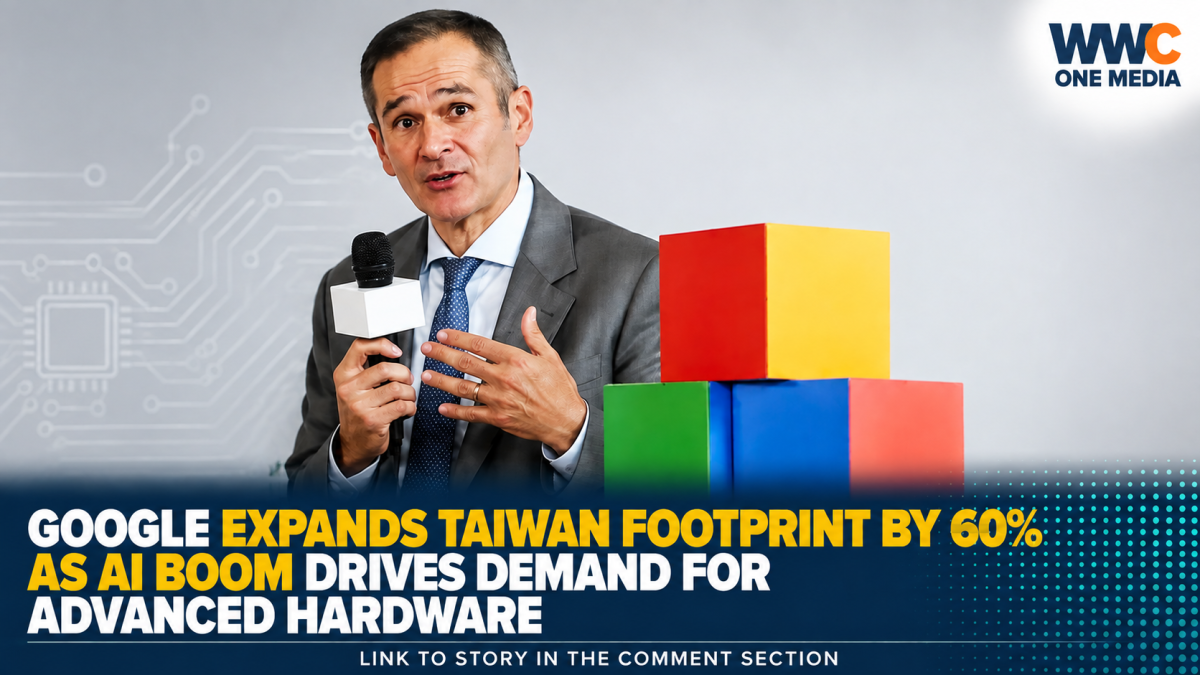
Google is expanding its office space in Taiwan by 60%, deepening its presence in one of the world’s most important semiconductor and hardware manufacturing hubs as demand for artificial-intelligence computing continues to surge.
The expansion was revealed by Amin Vahdat, Google’s senior vice president and chief technologist for AI and infrastructure, during SEMICON Taiwan 2026 in Taipei. Vahdat said Google expects its Taiwan operations to continue growing, although the company did not disclose an investment amount, hiring target or specific completion timeline.
The move highlights how Taiwan’s role in the global AI industry is extending well beyond semiconductor manufacturing.
Taiwan Is Becoming Critical to Google’s AI Hardware Strategy
Vahdat described Taiwan as a crucial engineering hub connecting a broad technology ecosystem that includes advanced chip packaging, liquid cooling, high-power electrical systems and other components needed to build large-scale AI infrastructure.
Much of Google’s hardware design and manufacturing is carried out in Taiwan in partnership with local companies.
Google engineers work closely with Taiwanese partners to develop and validate hardware, including chips produced by Taiwan Semiconductor Manufacturing Co., better known as TSMC.
The company is also discussing future generations of AI hardware with Taiwanese partners, including rack-level architecture, manufacturing design and system reliability.
That means Google’s relationship with Taiwan is becoming increasingly strategic as the AI industry shifts toward massive computing infrastructure.
AI Demand Is Creating a New Hardware Race
Vahdat said demand for computing power could be increasing by perhaps 10 times year over year, driven by increasingly capable AI models and services.
But producing more AI computing capacity requires much more than advanced processors.
Companies also need memory, networking equipment, cooling systems, electricity and complete server racks — creating potential bottlenecks throughout the supply chain.
Vahdat warned that the most serious constraint over the next 18 months could shift between power availability, chips, memory, cooling, rack delivery and networking.
In other words, even if enough AI chips are available, another part of the infrastructure could become the next major limitation.
Google’s Taiwan Presence Is Already Significant
Google has operated in Taiwan for two decades and maintains its largest hardware engineering hub outside the United States there.
Its Taiwan operations include hardware development and testing, while the company has also invested in infrastructure such as a data center in Changhua County and undersea cable projects connecting Taiwan with global networks.
The latest expansion therefore represents more than simply additional office space.
It reinforces Taiwan’s growing role in Google’s hardware ecosystem at a time when AI companies are racing to build increasingly powerful computing platforms.
Taiwan’s Semiconductor Industry Is Riding the AI Wave
The expansion comes as Taiwan’s semiconductor industry experiences another major growth phase.
Taiwan’s semiconductor production value reached US$209.1 billion in 2025, increasing 22.7% from the previous year, according to Premier Cho Jung-tai.
The government says it is preparing additional land, energy, talent and financial support as semiconductor and AI investment expands.
SEMICON Taiwan 2026 itself reflects the scale of the industry, with more than 1,300 exhibitors and 4,300 booths from more than 60 countries and regions.
More Investment Is Flowing Across Borders
Google’s expansion is happening alongside a broader push by Taiwanese technology companies to expand their international footprint.
Taiwan’s Economy Minister Kung Ming-hsin said Taiwanese companies are planning another US$20 billion of investment in the United States, largely driven by demand for AI technologies.
That comes on top of major investments already announced by TSMC, including its planned US expansion, which Taiwan says will help strengthen global semiconductor supply-chain resilience.
At the same time, Taiwan is seeking to preserve its position as a critical technology hub while diversifying manufacturing and investment across the United States, Europe and other markets.
The Power Problem Could Become the Next Big Challenge
There is, however, a major issue behind the AI expansion: energy.
Vahdat identified power availability as one of the constraints that could become increasingly important as AI computing demand grows. Google says it remains committed to expanding round-the-clock carbon-free energy and plans to continue investing in renewable energy, batteries and geothermal power.
For Taiwan, this creates a difficult balancing act.
The island wants to attract more semiconductor and AI investment, but rapidly expanding chip fabs, data centers and AI infrastructure require enormous amounts of reliable electricity.
Taiwan’s government has said it intends to prepare the necessary energy and industrial infrastructure to keep pace with the technology sector’s expansion.
Why This Matters Globally
The significance of Google’s expansion goes beyond Taiwan.
The global AI race is increasingly becoming a race to control the entire infrastructure stack — from advanced chips and memory to servers, cooling, electricity and networking.
Taiwan sits near the center of that ecosystem.
TSMC remains the world’s leading contract chipmaker, while Taiwanese companies provide expertise across much of the hardware supply chain. Reuters recently reported that Taiwan is also planning additional U.S. investment as Washington seeks to strengthen semiconductor manufacturing outside Asia.
Google’s decision to expand its Taiwan footprint therefore sends a clear signal: the AI boom is making Taiwan even more important to the global technology industry.
But as computing demand explodes, another question is becoming increasingly difficult to ignore:
Can Taiwan secure enough chips, power, cooling and infrastructure to keep up with the world’s rapidly accelerating AI race?
WWC ONE MEDIA J.M.D




Leave a Reply