
Public school teachers who once had to travel to a bank branch during working hours may increasingly find the bank coming directly to them.
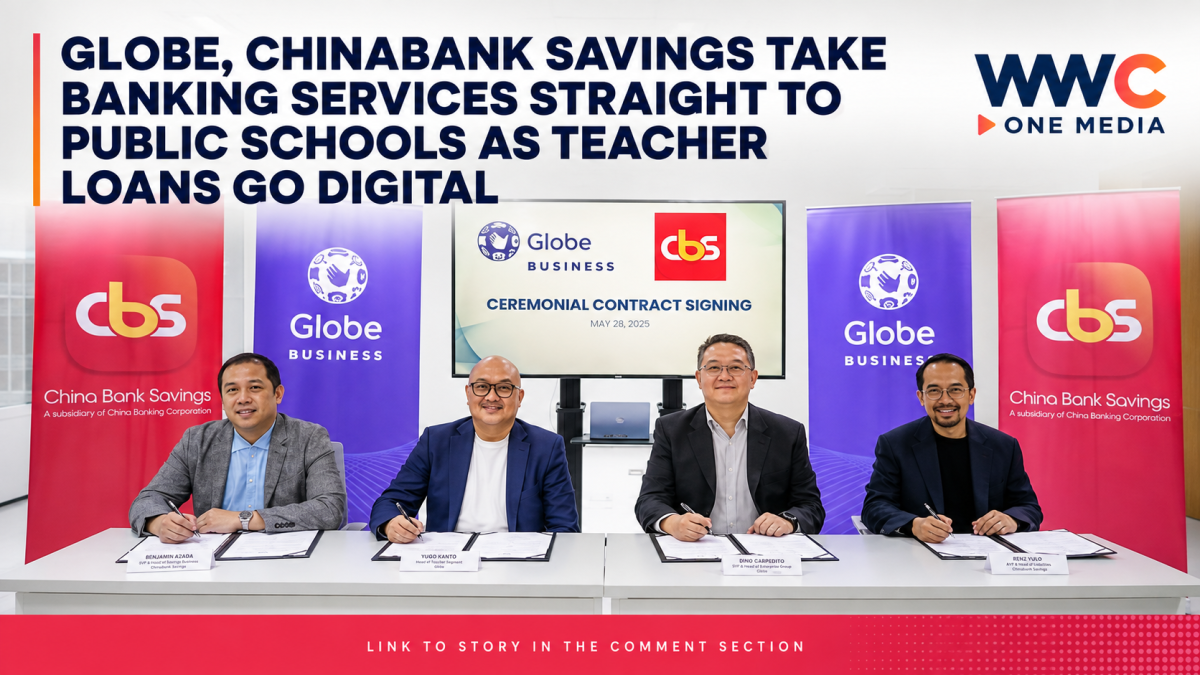
Globe Business and Chinabank Savings (CBS) have rolled out a mobile field-banking initiative designed to let CBS officers process selected financial services at school sites, potentially making loan applications, account concerns and other transactions easier for educators—particularly those working far from commercial centers.
Under the partnership, CBS field teams are being equipped with 215 Samsung tablets powered by Globe Business’ GPlan Biz connectivity, giving officers mobile data as well as calling and messaging capabilities while working outside traditional bank branches.
But the bigger story may not be the tablets themselves.
The partnership is emerging at the same time that the system used by thousands of Department of Education employees to repay salary loans is undergoing a wider digital and regulatory transformation.
Bank Services Move Closer to the Classroom
Using the mobile setup, CBS officers can meet teachers and other school personnel on-site, manage customer portfolios, respond to inquiries and handle applications for certain non-collateral loans processed through the Department of Education’s Automatic Payroll Deduction System, or APDS.
That distinction matters.
The program does not mean teachers are being given 215 tablets, nor does it mean every banking transaction can suddenly be completed inside a school. The devices are intended for CBS field personnel, allowing them to deliver selected banking and credit services more efficiently outside branches.
For educators assigned to geographically isolated areas, however, even that change could be significant. A trip to the nearest commercial center can mean transportation costs and time away from school. Mobile field processing is intended to reduce some of that friction.
Globe Business Vice President Glenn Estrella said technology should make it easier for companies to serve customers beyond conventional offices, while CBS President James Christian T. Dee said reliable connectivity would help field officers respond more efficiently to teaching and non-teaching personnel nationwide.
This Is Bigger Than One Globe Partnership
Separate reporting shows that Chinabank Savings’ strategy goes beyond the current Globe deployment.
Bankero reported on Aug. 29 that CBS has also partnered with Smart Communications and Samsung as part of its effort to digitize the bank’s Automatic Payroll Deduction lending operations. The partnerships support the use of the APD Smart App, which allows personnel to conduct digital loan onboarding in the field.
CBS described the initiative as part of a five-year digitalization roadmap aimed at developing a more scalable, integrated and progressively paperless APD ecosystem.
In other words, putting connected devices in the hands of field officers appears to be one part of a much broader shift away from paperwork-heavy teacher lending.
CBS Already Has a Large Teacher Customer Base
The potential reach is substantial.
Back in 2023, Chinabank Savings said it was already servicing more than 170,000 public school teacher clients through its relationship with DepEd. At that time, more than 11,000 teachers had already been digitally onboarded through the CBS Go App.
That means the current field-banking push is not starting from zero. CBS has spent years building a sizable education-sector customer base and gradually moving teacher-facing services online.
The bank has also expanded beyond lending.
In 2025, the Philippine Information Agency reported that CBS and DepEd conducted financial wellness activities for teachers, including a program attended by around 3,000 educators in the Visayas focusing on debt management, savings, financial goal-setting and other personal-finance issues.
Those programs have become even more relevant because the rules governing APDS borrowing have recently changed.
DepEd’s New Seven-Year Loan Rule Changes the Equation
On August 7, 2026, DepEd issued DepEd Order No. 020, s. 2026, revising loan repayment terms under the APDS program. The order extended the maximum allowable repayment period for covered APDS loans from five years to as long as seven years. DepEd’s official issuances database confirms the new order.
But a seven-year term is not automatically available to every teacher.
The lender still has to assess the borrower’s capacity to repay and decide whether the longer term is appropriate. DepEd itself does not approve the private loan; its role under APDS is essentially to facilitate authorized payroll deductions.
The revised policy also requires APDS-accredited lenders to provide borrowers with financial literacy or loan education before evaluation or release of a loan, covering matters such as interest and charges, repayment obligations, responsible borrowing and the consequences of default.
That safeguard is particularly important as digital onboarding makes applying for credit faster and more convenient.
Convenience Is Only Half the Story
For public school teachers, bringing banking services directly to schools could eliminate unnecessary trips, shorten processing times and make financial services more accessible to employees assigned outside major urban centers.
For Chinabank Savings, it could also make its large teacher-lending operation faster, more scalable and less dependent on paper.
For Globe Business, meanwhile, the project demonstrates how enterprise connectivity can be used to extend financial services beyond bank branches and into geographically dispersed communities.
But easier access to credit creates another question.
A loan that can be applied for more quickly is not automatically a loan that should be taken.
The new seven-year APDS framework can reduce monthly amortization by stretching payments over a longer period, but a longer repayment period can also mean remaining in debt for years and potentially paying more interest overall. DepEd’s decision to require financial education alongside the revised loan rules reflects that trade-off.
So while the immediate headline is about 215 tablets bringing bank officers closer to classrooms, the longer-term story is much bigger: the financial relationship between Philippine teachers and lenders is steadily becoming digital.
The real test will be whether that technology merely makes borrowing faster—or helps make financial services more accessible, transparent and sustainable for the teachers using them.
WWC ONE MEDIA J.M.D




Leave a Reply